The body's biggest cell
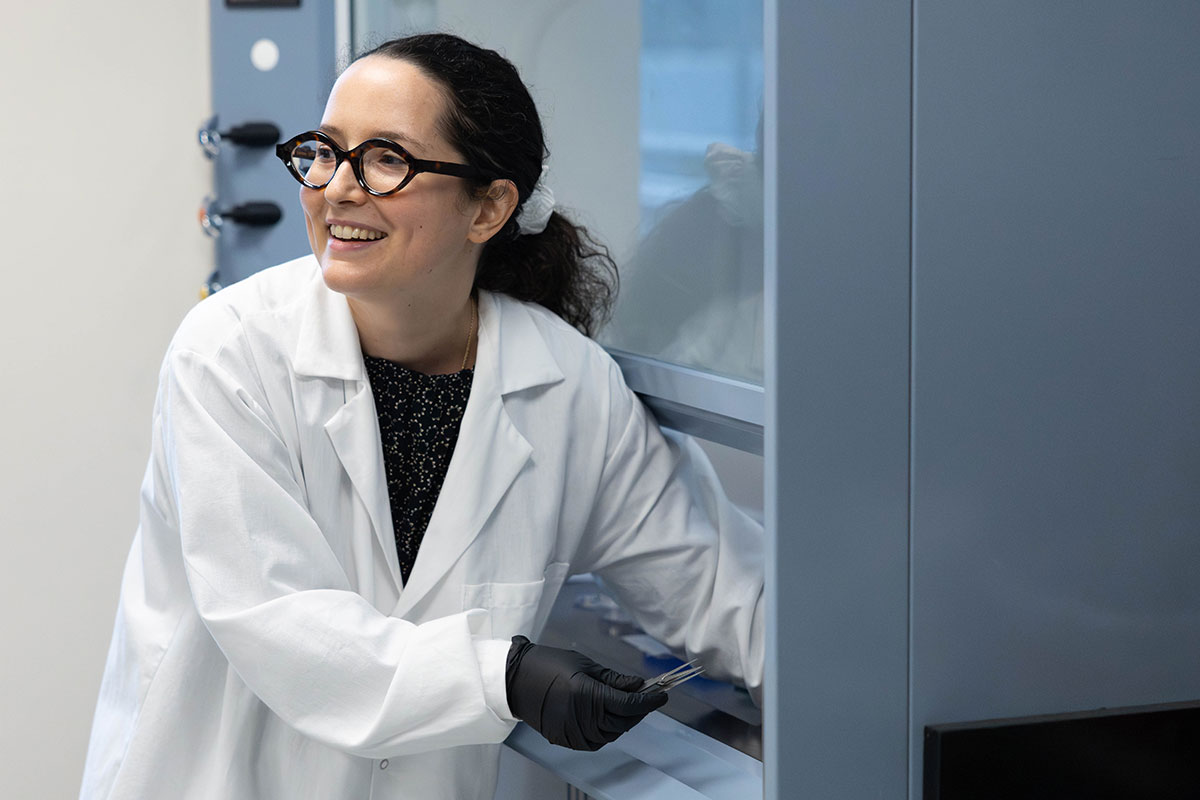
Photo Credit: Dan Holmes
By David Levin
February 3, 2026
WATCH: SciShow highlights Brandeis researcher’s study of “giant cell” in human placenta
Every pregnancy depends on an organ that most people will never see.
As organs go, the placenta — the tissue that surrounds a developing fetus — is a jack of all trades. It can filter toxins like a liver, regulate hormones like a thyroid gland, process waste like a kidney, and shield against infections like an immune system. It’s a temporary multipurpose life-support system, performing the work of several distinct organs at once.
One of the keys to its success, however, comes down to a single, massive cell.
That cell, called the syncytiotrophoblast, stretches across the entire surface of the placenta’s vascular tree, a branching network of blood vessels that carries nutrients and oxygen between mother and child. By the end of a pregnancy, its surface area can reach nearly 13 square meters, or roughly the size of a parking space.
"It really just breaks open our understanding of what a cell is," says Hannah Yevick, assistant professor of physics, who studies how massive cells like these behave.
Unlike virtually every other cell in the human body, the syncytiotrophoblast doesn't have a single nucleus. It has roughly 10 billion of them. It grows not by dividing, but by fusing: Smaller cells merge, their membranes dissolving to form a continuous structure that eventually spans an area measured in meters rather than microns.
Massive though it may be, the syncytiotrophoblast is made of the same basic proteins as its tiny peers. Those molecules are great for holding together something microscopic, like a muscle or skin cell, but using them to create a membrane the size of a backyard trampoline is another feat entirely. It’s like building a luxury high-rise with Legos.
"What’s really interesting here is that you’re basically keeping the same building materials of the cell, but you have to keep on repurposing them as your construction project changes its size," Yevick says.
In other words, if the building blocks can’t change, the cell has to shift its architecture to compensate.
Exactly how this happens isn’t clear. A shift in scale dramatically changes a cell's mechanics, Yevick says: Bigger cells can’t hold onto their neighbors the same way smaller ones can. It impacts how they coordinate with other cells and respond to biochemical signals. They act fundamentally differently than their more diminutive peers. So how do they maintain their own existence?"
In the lab, Yevick and her lab members are trying to tease apart this question. They’re studying how giant cells maintain their integrity as they grow; how they organize their internal machinery across vast distances; and how they decide when to fuse with other cells. What they’re seeing is surprising. Giant cells like the syncytiotrophoblast are dynamic — they can survive with holes in their structure, and can even fuse the edges of holes back together. "That might tell us something about how the placenta itself is able to maybe self-heal," Yevick says.
Her work could have a real-world impact. Problems with the syncytiotrophoblast have been linked to preeclampsia, stillbirth and other complications that endanger both fetus and mother. If Yevick can shed light on how the large cells work on a basic level, it could eventually lead to new treatments for those conditions.
For now, those answers remain in the realm of basic science — but basic science has a way of becoming clinical insight. "The placenta is sort of like a diary of all of human development," Yevick says. "Having a better understanding of how to read that diary could really help us understand fetal and human health in the long term."