President Levine releases new book on changes that work in American higher education
March 3, 2026
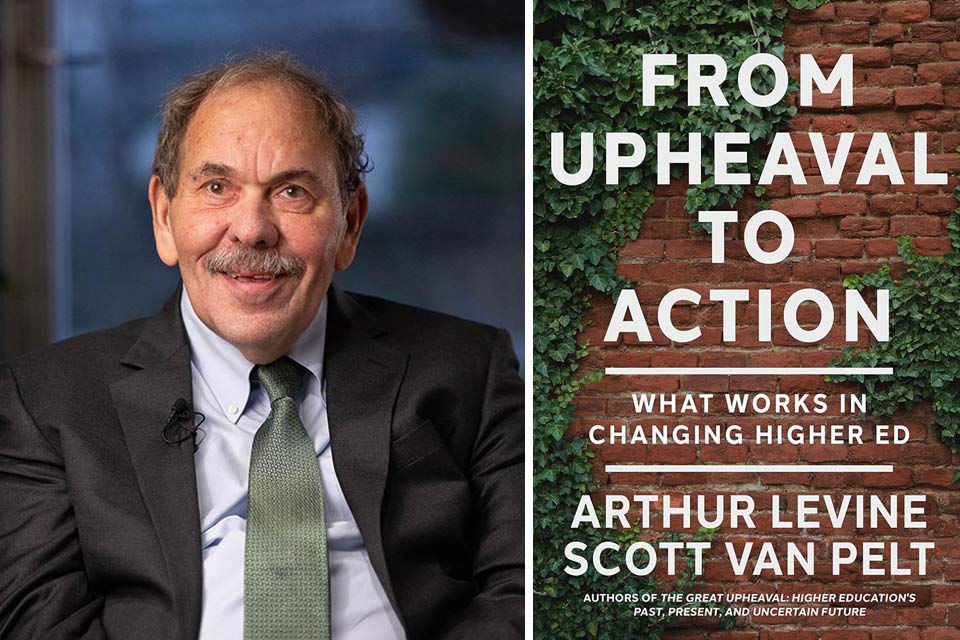
President Arthur Levine had already completed his new book, "From Upheaval to Action: What Works in Changing Higher Ed," along with collaborator and co-author Scott Van Pelt, when he joined Brandeis in 2024. Based on years of research and on-the-ground engagement with institutions across the country, the book, released on March 3, focuses on what is working in higher education, and what is not.
At Brandeis, those ideas are not theoretical.
Since returning to his alma mater, Levine has led a faculty-driven effort to reimagine the university itself – work that closely reflects the book’s central argument: that incremental reforms are no longer sufficient, and that higher education must rethink its structures, assumptions and measures of success.
“The question facing colleges and universities is not whether to change, but how—and whether they are willing to move beyond surface-level adjustments to confront what truly needs to be rethought,” said Levine.
That work at Brandeis has included a reimagining of the structure of the university’s academic schools to bring together theoretical inquiry and applied learning, and to more intentionally connect the liberal arts with professional programs; a revision of the core curriculum focused on the knowledge, skills and values students need in a global, digital knowledge economy; and a broader rethinking of how learning is defined, assessed and recognized across the university. This includes new approaches to documenting student learning wherever it occurs, including competency-based microcredentials and a second transcript that captures applied and experiential learning alongside traditional coursework.
In "From Upheaval to Action," Levine and Van Pelt, director of research and faculty affairs at the University of Pennsylvania Graduate School of Education, argue that many institutions remain stuck, either resisting change or cycling through disconnected experiments, even as public confidence in higher education declines and students increasingly demand clarity about value and outcomes. Building on the insights of their 2021 bestselling book, "The Great Upheaval," the book identifies common traits of institutions that have made real progress, including a clear focus on students, visible evidence of learning and impact, organizational coherence and leadership guided by mission rather than nostalgia.
Brandeis’ transformation has been shaped by those same principles.
“What makes Brandeis distinctive is not that we’re simply adding applied learning,” Levine said. “It’s that we’re making the value of a liberal arts education legible—by being explicit about what students learn and what they can do with it.”
Founded in 1948 to expand access to academic excellence and challenge exclusion in American higher education, Brandeis has long been willing to question inherited models rather than preserve them. That founding impulse, to ask who higher education serves, how learning is organized, and what outcomes truly matter, now shapes the university’s response to a period of profound upheaval.
Guided by the same values that defined its creation, Brandeis is rethinking learning itself within a rigorous liberal arts and research environment, moving beyond incremental change toward a more purposeful design. Today, that legacy is informing a new chapter—one that positions the university not only to navigate disruption, but to help define what works next.
“There is no single future of higher education,” said Levine, who is nationally sought for his expertise on the challenges facing the sector. “And, no college is so exceptional that it will be magically passed over by the changes facing the nation.”