Q&A: Kara Ayers, co-investigator, Accessible Pregnancy Action Plan
March 17, 2026
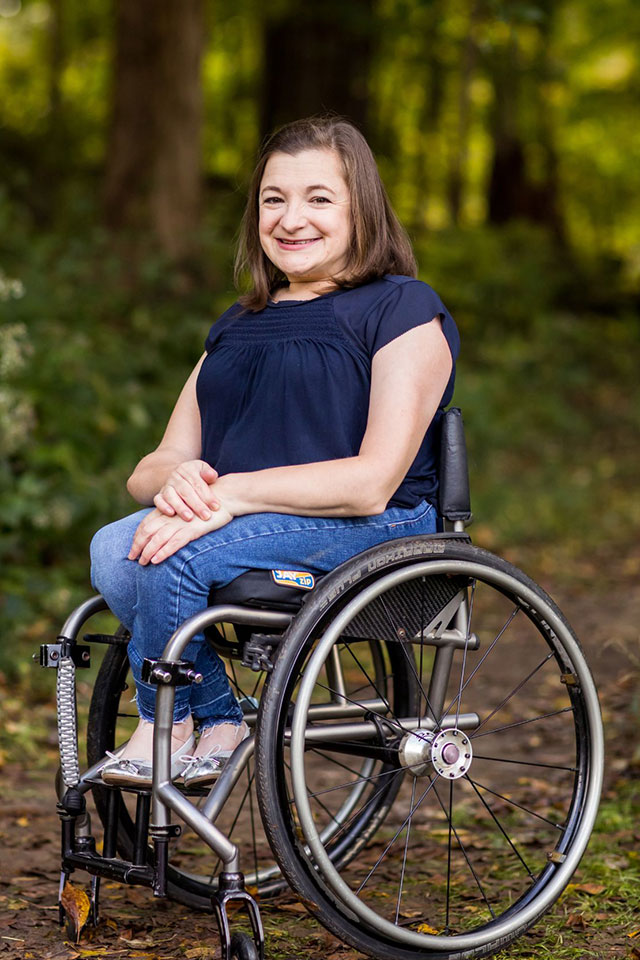
Photo courtesy of Kara Ayers.
Kara Ayers is co-founder of the Disabled Parenting Project, and Associate Director of the University of Cincinnati Center for Excellence in Developmental Disabilities. Trained as a psychologist, Ayers is an Associate Professor of Pediatrics in the College of Medicine at the University of Cincinnati and Cincinnati Children’s Hospital Medical Center. She works on numerous disability policy issues, including health equity, home and community-based services, and bioethics. Her research interests include protecting the rights of parents with disabilities, improving adoption access for parents with disabilities, and increasing peer support for women with disabilities during pregnancy. Kara is a disabled mother of three. She was co-investigator with the National Center for Disability and Pregnancy Research at the Lurie Institute for Disability Policy at Brandeis to develop the Accessible Pregnancy Action Plan, or APAP.
You have talked about having participants think repeatedly about "what matters most" in relation to the Accessible Pregnancy Action Plan and health empowerment theory. Can you expand on that a bit more? Why is it important for them to be able to articulate that?
Health empowerment theory centers the question, "What matters most?" because this theory aims to empower people—especially those from groups who often feel they have little control or power in many situations—to name what they care about most and articulate what they want to see happen. This framework is a natural fit for the Accessible Pregnancy Action Plan because many pregnant people with disabilities experience their prenatal care, birth, and postpartum period as something that happens to them rather than with them. They may have been labeled "high risk," encounter providers who don't understand their disability well, or face assumptions about what they can or should do as pregnant people and parents. By starting with this question and returning to it throughout the planning process, we're doing two things: First, we're actively disrupting the power imbalance that often exists in healthcare settings. Second, we're creating space for participants to develop and refine their own understanding of their priorities—which may shift as pregnancy progresses and circumstances change. The repetition isn't about us checking a box; it's about participants building the muscle of self-advocacy and ensuring that their voices remain central to every decision, not just the first conversation.
Was there anything that surprised you, or that you found counterintuitive, in the course of the research you did when designing the APAP?
I wish I could say I was surprised by the lack of accessible exam tables, the absence of ASL interpreters, or providers who've never thought about how to conduct a prenatal appointment with someone who uses a wheelchair—but more than 35 years after the ADA's passage, these barriers remain depressingly common. What does continue to surprise and frustrate me is how many healthcare systems treat accessibility as an afterthought or accommodation rather than a basic standard of care. On the positive side, I'm consistently amazed by the ingenuity and creativity disabled people bring to pregnancy and parenting. People who've been told their entire lives what they can't do are remarkably skilled at figuring out what they can do—and often doing it in ways that work better than the conventional approach. That innovation isn't just impressive; it's exactly why tools like the APAP need to center what matters most to the person using it, not what a checklist or protocol says should matter.
How did you "test" the plan? Were there subjects/trials, or some equivalent arrangement?
We piloted the tool with 12 pregnant people with disabilities, with me serving as the peer facilitator. The pilot had a dual purpose: We wanted to see how participants actually used the plan – what sections resonated, what felt confusing or irrelevant, where they got stuck – but we also needed to test our implementation model itself. Could this work effectively over Zoom in a 1:1 format? What kind of support did people need to complete their plans in ways that felt meaningful rather than like paperwork?
We gathered both quantitative data (completion rates, time spent on different sections) and qualitative feedback through follow-up conversations. Participants told us what worked, what didn't, and – critically – what we were missing. That feedback shaped everything from the language we used to the order of the sections to how we framed the "what matters most" question. The pilot confirmed that peer facilitation was essential, not optional. People needed someone who understood disability from lived experience to help them think through scenarios their providers might never raise—and to validate that their concerns and priorities were legitimate, not difficult or unrealistic.
Are people actively using the plan? What feedback are you getting?
Yes, people are using it, and the feedback has been encouraging. We're hearing from participants that the plan gives them language and structure to advocate for themselves in ways they hadn't felt equipped to do before. Some have told us their providers were initially skeptical but became more collaborative once they saw the plan as a tool for better communication rather than a list of demands. Others have said the process of completing the plan helped them identify gaps in their support system before they became crises—things like "I don't actually know how I'll manage feedings if I can't lift the baby" or "My OB has never asked about my wheelchair access needs for delivery." Right now, we're in an exciting growth phase. Awareness is spreading through word of mouth and our webinar series, but we're also being strategic about how we scale. Peer facilitation is critical to the plan's effectiveness, so we can't just post a PDF online and call it accessible. We're developing training materials for facilitators and building partnerships with the independent living network and other disability-led organizations. These are the natural homes for this work: they already have the trust, the expertise, and the infrastructure to support disabled people through major life transitions. Our goal is to embed the APAP into existing systems where people are already getting support, not create a parallel system they have to seek out.
Why is this research important to you?
This research is personal for me in multiple ways. As a parent and as someone deeply embedded in disability communities, I see every day how parenting with a disability is treated as an exception, a risk, or even a mistake, rather than as one of many beautiful and ordinary ways people build families. I know what it's like to navigate healthcare systems that weren't designed with disabled bodies and lives in mind, and I know the toll that takes.
But it's also personal as a researcher and advocate who knows this gap is completely unnecessary. We have the knowledge, the frameworks, and the tools to support disabled people through pregnancy and parenting. The barrier isn't a lack of information—it's a healthcare system built on a medical model that pathologizes disability and assumes nondisabled experience as the default. That model doesn't just fail to serve disabled parents; it actively harms them by centering what providers fear might go wrong rather than what parents hope will go right.
This research matters because disabled parents and families deserve better than retrofitted accommodations or afterthought accessibility. They deserve care that starts with the assumption that they are capable, that their parenting matters, and that their lived expertise is valuable. The APAP is one small tool in a much larger project of reimagining reproductive healthcare through a disability justice lens, and that's work I'm committed to for the long haul.
What is the most important thing you would want people to know about APAP and the work that went into it?
The most important thing I want people to know is this: The APAP wasn't created for disabled parents; it was created by and with disabled parents. Every aspect of this tool, from the questions we ask to the way we implement it, comes from disabled people's lived expertise about what we need, what we're told we can't have, and what actually works when systems are designed with us at the center instead of as an afterthought.