Brandeis Magazine
A Love Letter to Ukraine
Debut novelist Sam Wachman ’22 crafts a harrowing, tender portrait of a nation at war.
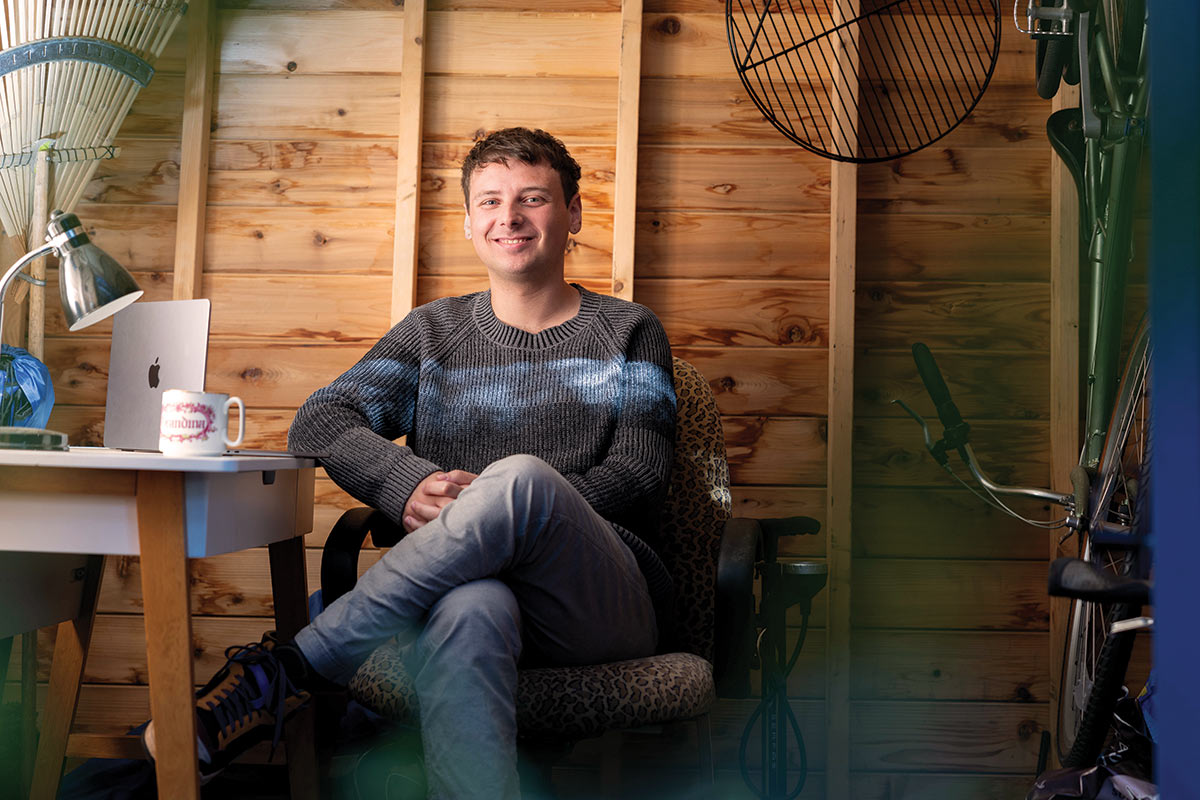
Photo Credit: Dan Holmes
By Julia M. Klein
For years, Ukraine exerted a powerful allure for Sam Wachman ’22. Drawn to exploring his Ukrainian Jewish roots, he taught English there, in a provincial one-room schoolhouse. He learned Ukrainian. And he began writing a gay coming-of-age novel set in Ukraine.
When Russia launched its 2022 invasion during his final Brandeis semester, Wachman, then studying abroad in Denmark, knew where he wanted to be. But his mother, he says, took him by the shoulders and begged, “Don’t go to Ukraine.”
So Wachman used his language skills and Brandeis EMT training to assist Ukrainian refugees in Germany, Poland, Romania, Latvia and Boston. Some of them had survived war crimes. Inspired by their stories, he reimagined the gentle bildungsroman he’d been writing, turning it into something darker and more epic: a tale of two brothers forced to fend for themselves in war-ravaged Ukraine.
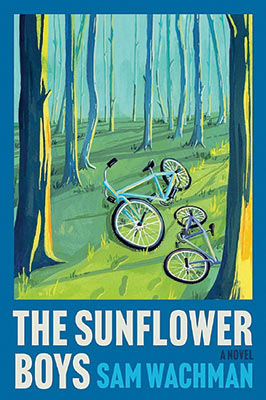
“The Sunflower Boys” was published by HarperCollins in August 2025 to literary acclaim. The Pulitzer Prize-winning author Junot Díaz touted the 25-year-old Wachman as “a writer of boundless sympathies and boundless talent.” A Washington Post book critic praised the debut novel as “at once timeless and precisely of the moment.”
“This is a story I’ve been wanting to tell,” says Wachman, who thought U.S. media depictions of Ukraine lacked nuance and context. “Ukraine popped into the American consciousness when it was invaded. It’s almost as if it didn’t exist to a lot of Americans before that.”
Literary stardom was not what the Cambridge, Massachusetts, native had envisioned for himself. A Health: Science, Society and Policy major at Brandeis, he planned to become a pediatrician. “Growing up in the shadows of Harvard and MIT, I internalized the implicit cultural message that STEM is serious and respectable, and writing is frivolous,” he explains. “I always feel a little embarrassed at parties in Cambridge or Somerville where everyone else is getting their PhD in something like ‘molecular quantum biogeochemical data engineering,’ and I have to admit that I just write my little stories.”
“I always feel a little embarrassed at parties in Cambridge or Somerville where everyone else is getting their PhD in something like ‘molecular quantum biogeochemical data engineering,’ and I have to admit that I just write my little stories.”
Even as a teenager at Cambridge Rindge and Latin (a large public high school that has “the ambience of Logan Airport,” Wachman says), he was already publishing short fiction. In 2018, he was one of 16 high school seniors nationwide who received the Scholastic Art & Writing Awards’ Gold Medal Portfolio, which included a $10,000 scholarship. He described the theme of his winning entry, a set of short stories, as “queer teenage boys discovering their identities, grappling with their definition of masculinity and finding their places in life.”
A few years later, a literary agent signed him after reading “The Right Way To Drown,” a story set in Russia that the New England Review published in 2021.
Wachman came to Brandeis, in part, to study with novelist Stephen McCauley, co-director of the creative writing program. They had met years before at a bookstore café in Cambridge’s Porter Square. “My experience at Brandeis was a lot of good things fit into a very short amount of time,” says Wachman. “I had a few professors who really did reorient the trajectory of my life.”
Among them was Irina Dubinina, director of the Russian language program, “an astoundingly gifted instructor” whose class was “life-changing,” he says. “It’s the reason this book exists, to be honest. And her class was the reason I first went to Ukraine.”
Both of Wachman’s grandmothers were Ukrainian Jews. He was aware, he says, of the “long and fraught relationship between ethnic Ukrainians and ethnic Jews,” and the continuing glorification of Ukrainian nationalist leader Stepan Bandera, a Nazi ally who collaborated in the murder of Ukrainian Jews.
Wachman says he “was expecting something that felt a lot more alien” on his first visit to Ukraine, in summer 2019. Instead, he found familiar food, mannerisms, decorations and other day-to-day details that evoked his late maternal grandmother and caused him to “feel very much at home.”
He had made that trip with a friend who was attending an education conference in Vinnytsia Oblast, near where his grandmother had once lived. The conference was hosted in a one-room primary school that happened to need an English teacher. “I threw my hat in the ring, and mine was the only hat,” he says.
The six kids Wachman taught — briefly in person and then, until 2023, online — became his close friends, and they remain in almost daily touch. From them, he says, he picked up a “slangy” version of Ukrainian and the original idea for his novel, “a love letter from diaspora to ancestral homeland.”
One night in February 2022, Wachman, in Denmark, was texting with one of his Ukrainian students, who was anxious about a chess competition the next day. Then, in the early-morning hours, his phone rang. “I’m in a basement,” the student said. “There are sirens going off. We’re at war.”
Wachman recalls feeling “intense fear and grief” for his students and friends. He stopped writing, skipped classes and devoted himself to helping the Ukrainian refugees pouring across the border. With his medical and linguistic skills (he speaks Ukrainian, Russian, Norwegian, Danish, French, “atrocious” Spanish and “household Yiddish”), he says he “felt obligated to continually do more and sleep less.”
A year later, in 2023, at a Romanian camp designed to offer respite and English immersion to refugee children, he reunited with his six students. That three-week sojourn, he says, brought him “the kind of joy you really don’t expect to find in February in Romania’s 28th-largest city,” an otherwise dismal place. It was a pivotal encounter. “We were sitting around, drinking tea and exchanging stories. I said to one of my kids, ‘You should write a book about this.’ And he said, ‘I’m busy — you do it.’”
That, Wachman says, was a green light to pause his work as “a renegade social worker” and start writing again.
The protagonist/narrator of “The Sunflower Boys” is a 12-year-old boy in Chernihiv, a city in northern Ukraine. Artem is skilled at drawing; mostly bored at school; missing his father, who works in the United States; and wrestling with a romantic and sexual attraction to his best friend.
The novel’s picaresque plot — after war breaks out, Artem and his little brother traverse a chaotic landscape in search of safety and an eventual reunion with their father — relies on “versions of real people’s experiences I got permission to fictionalize,” Wachman says. To reconstruct the landscape of wartime Ukraine, Wachman interviewed Ukrainian friends and refugees. “I figured I had the opportunity to do something really great here, if I could pull it off,” he says. He didn’t want his book to be “schlocky” or “exploitative.”
“If there’s anything [the events in Ukraine] taught me,” Wachman says, “it’s that it could happen here. None of my kids, none of my friends were thinking, ‘Russia could invade us. War crimes could happen in my hometown. They could happen at my supermarket.’”
Wachman is currently working on a second novel. He is also pursuing a master’s in social work at Boston College and mulling a move to Norway to study English-language acquisition or English literature.
As for “The Sunflower Boys,” Wachman says, “I hoped the reaction would be positive, and, of course, mostly I hoped there would be a reaction, that it would be noticed. And I hoped it would fall into the hands of Ukrainian readers, because it was a gesture of love, and that really only means something once it’s been received. And, thankfully, all these things have happened.”
Now, he says, “I’m trying my best to just enjoy it.”
Julia M. Klein, a contributing book critic at the Forward, has written for The Atlantic, The New York Times and The Wall Street Journal.