Brandeis Magazine
Perspective
A Growing Crisis in Childhood Cancer Research
As federal funding for treatment is slashed, vulnerable patients face an uncertain future.
By Elizabeth Allen ’14
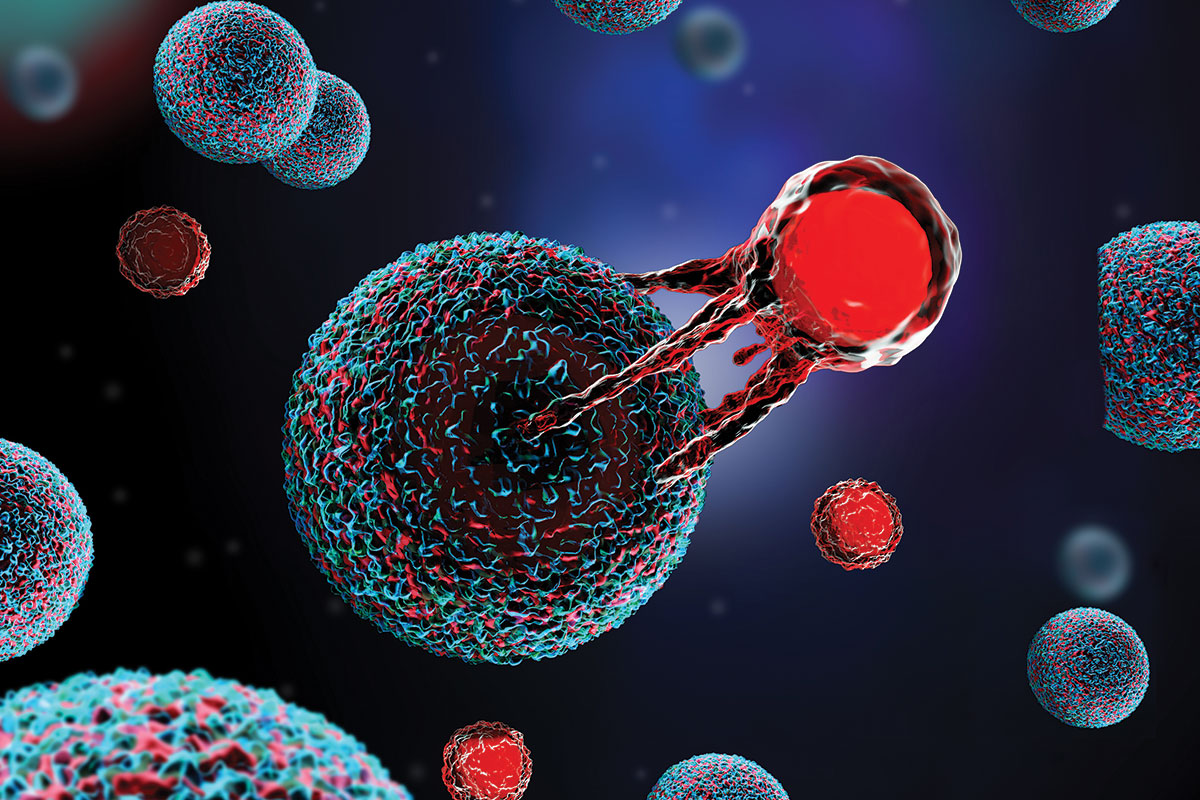 An illustration of a T cell attacking a cancer cell. Photo Credit: Meletios Verras / Getty Images
My mother’s green notebook tells the story of my childhood. Pages are filled with reminders in her handwriting: “back for vincristine on Mon.,” “first Cytoxan cycle,” “Zofran every 8 hours.” Tucked between the pages is an MBTA train schedule from 2004 — the year I was diagnosed, at age 11, with medulloblastoma, a malignant brain tumor.
The day after my diagnosis, I underwent brain surgery, followed by radiation and chemotherapy. The notebook became my parents’ lifeline, where they tracked every treatment and every question for my doctors.
Twenty-one years later, I’d like to leave that chapter behind, but I can’t. The treatment that saved my life also set me up for a lifetime of health problems.
When I was a high school junior, an MRI revealed a cluster of noncancerous blood vessels in my brain, a rare side effect of radiation. I had surgery again. More recently, doctors found three new brain tumors. I take blood thinners to reduce my stroke risk and have undergone gamma knife radiosurgery, which may itself trigger future side effects.
I’m not an exception. According to the National Cancer Institute, up to 90% of childhood-cancer survivors develop chronic health conditions from treatment. Nearly 16,000 children and teens are diagnosed with cancer each year in the U.S. Within three decades, more than 400,000 survivors may suffer chronic conditions — heart disease, or neurological damage, or secondary cancers — caused not by their illness but by the therapies used to treat it.
This is the hidden crisis of childhood cancer. Our treatments are dangerously outdated, and research to develop safer alternatives with extraordinary potential — such as CAR T-cell therapy, monoclonal antibodies and cancer vaccines — is chronically underfunded. Though children’s cancers are genetically distinct from adult cancers and require different therapies, pediatric oncology receives less than 4% of federal cancer-research funding.
Even before the Trump administration froze or slashed federal grant money to universities, pediatric-oncology treatment and research fields had already taken a major hit. The 2025 federal budget included cuts to several vital legislative acts, cuts that reduced research and care for young cancer patients — not including the reduction in Medicaid spending that risks putting lifesaving care completely out of reach for some children and families.
When I was being treated, every drug I received — vincristine, lomustine, cisplatin (which robbed me of some hearing; I now wear hearing aids) and Cytoxan — had already been in use for more than three decades. These drugs were the gold standard then.
They remain the foundation of treatment today. Children are receiving toxic, outdated treatments, while safer, more-targeted therapies stall in labs. This is not just a medical crisis — it is a moral one.
Children deserve better than being treated with repurposed adult drugs that leave them battling lifelong health problems. Families deserve better than watching their kids survive cancer only to face secondary illnesses for decades. And the United States deserves better than seeing its future citizens burdened with preventable chronic conditions that strain an already overtaxed health-care system.
Investing in pediatric cancer research is an investment in the future. It means fewer hospitalizations, fewer disabilities and fewer lifelong health costs. More important, it means children will not only survive cancer but thrive afterward.
Sometimes, I feel like a walking reminder of the consequences of neglecting childhood cancer research. I’m alive because of the treatments I received, but I’ll spend the rest of my life dealing with their fallout.
We have the knowledge, the science and the tools to develop safer treatments. What we lack is the political will and the financial commitment. It’s time to change that — because kids with cancer can’t afford to wait another 30 years.
Elizabeth Allen holds an MPH and an MS from the Friedman School of Nutrition Science and Policy at Tufts University. She is a data analyst at Massachusetts General Hospital’s Center for Health Outcomes and Interdisciplinary Research.