Brandeis Magazine
Listening to Leviathans
Marine-mammal researcher Adam Pack ’85 knows the secrets of the elusive humpback whale.

By David Levin
Photos courtesy Adam Pack
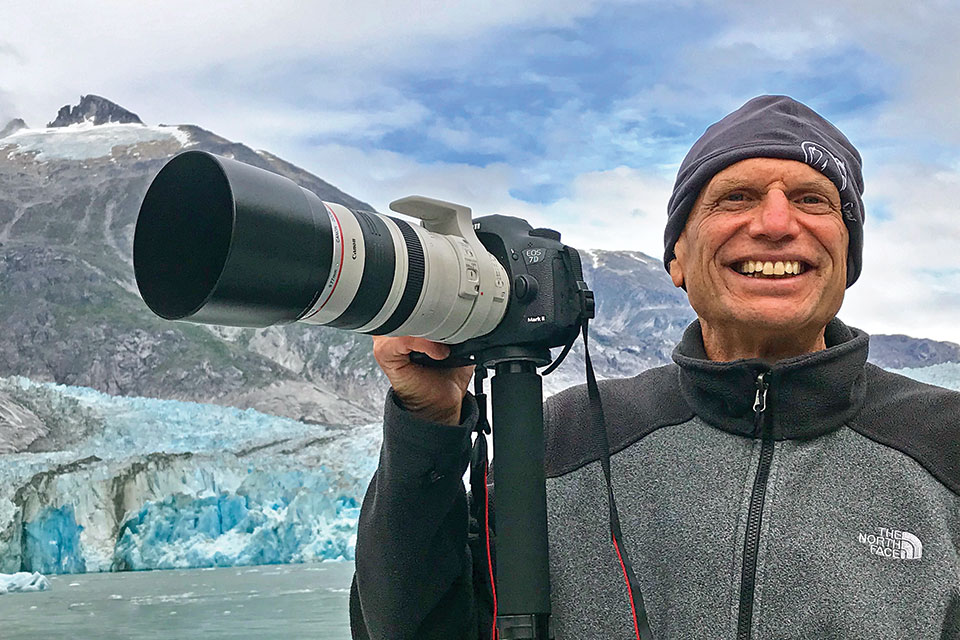
Adam Pack ’85
At the bow of a small research vessel, Adam Pack ’85 steadies himself against the waves. The humpback whale he’s tracking is just out of reach but gradually moving closer. As the giant mammal surfaces next to him, Pack swings a long black fiberglass pole down toward it and, with a decisive smack, affixes a small suction-cup device to its skin. The tiny sensor will accompany the animal for up to 24 hours, recording its position, speed, depth and — perhaps most critically — the enigmatic sounds it makes along its journey.
A professor at the University of Hawai‘i at Hilo, with a joint appointment in the biology and the psychology departments, Pack says the suction-cup tag offers an essential window into the life of an animal largely hidden from view. “Studying whales is so different from studying terrestrial species,” he explains. “Humpbacks spend 90% of their time underwater. We need innovative techniques to follow them.”
Each bit of data he and his colleagues collect helps illuminate these leviathans’ life cycle and behaviors — including how they communicate, through a kind of language built from haunting clicks, hums and whirs. Among adult male humpbacks, this dialogue includes “songs,” long, complex patterns that evolve over the course of a breeding season. (Whales of all ages and both sexes make non-song social sounds.)
Pack didn’t plan to study whales. As a biology major at Brandeis, he originally intended to become a veterinarian. But during a summer internship at the University of Hawai‘i’s Kewalo Basin Marine Mammal Laboratory, he met two dolphins, Phoenix and Akeakamai, who had been trained to recognize unique symbols, respond to multistep sentences where word order mattered and even communicate back to scientists.
“Seeing that for the first time, it felt like a wall between human cognition and animal cognition was crumbling right in front of me,” Pack recalls. “It became clear that humans aren’t the only ones capable of complex communication.”
Captivated, Pack decided to pursue a PhD in the same lab. His doctoral work revealed — for the first time — that bottlenose dolphins can recognize complex shapes through the use of echolocation and vision. His adviser, the marine-mammal psychologist Louis Herman, asked him to expand into whale research. Over the next decade, Pack alternated between studying dolphins and whales, eventually focusing entirely on humpback behavior and communication.
Today, Pack divides his time between humpback whales’ breeding grounds in Hawaii and their feeding grounds in Alaska, a 3,000-mile route. He often spots the same animals at both locations and has documented the long-term behavior of scores of whales, including the oldest-known living humpback, which has been under observation for more than five decades.
Humpbacks hunt in ingenious ways. In one particularly stunning strategy, up to 23 whales work together to trap schools of herring. The whales locate the herring, then dive below them. One whale circles upward, blowing a wall of bubbles that traps the fish. Another whale emits a series of loud trumpet-like calls, which startle the herring toward the surface — a cue for the rest of the whale group to charge upward in pursuit. As the whales burst through the water, they swallow their prey whole.
To understand humpback whale ecology, Pack and his team use an array of tools: tags, underwater video recordings and airborne drone cameras. They also collect tiny samples of whale blubber with a hollow crossbow dart. By analyzing hormone concentrations in the biopsies, the researchers can assess each whale’s physical and reproductive health. The result is one of the world’s most comprehensive whale databases — more than 30,000 photos, recordings and field observations, representing at least 5,000 individual humpbacks.
Armed with nearly 50 years of data on the same northern Pacific whale population, Pack is slowly crafting a picture of humpback whales across the entire region, examining how they fit into the broader marine ecosystem — and how their roles may change as the climate gradually warms.
“To tell their story, we need to look at all aspects of their lives,” he says. “Since they’re feeding on animals that make up the base of the food web, they’re a canary in the coal mine. Their overall health is a good proxy for the health of our oceans as a whole.”