Brandeis Magazine
Utopia: We’re All for It!
Nathan Robinson ’11, GSAS MA’11, is one of democratic socialism’s fiercest and funniest champions.
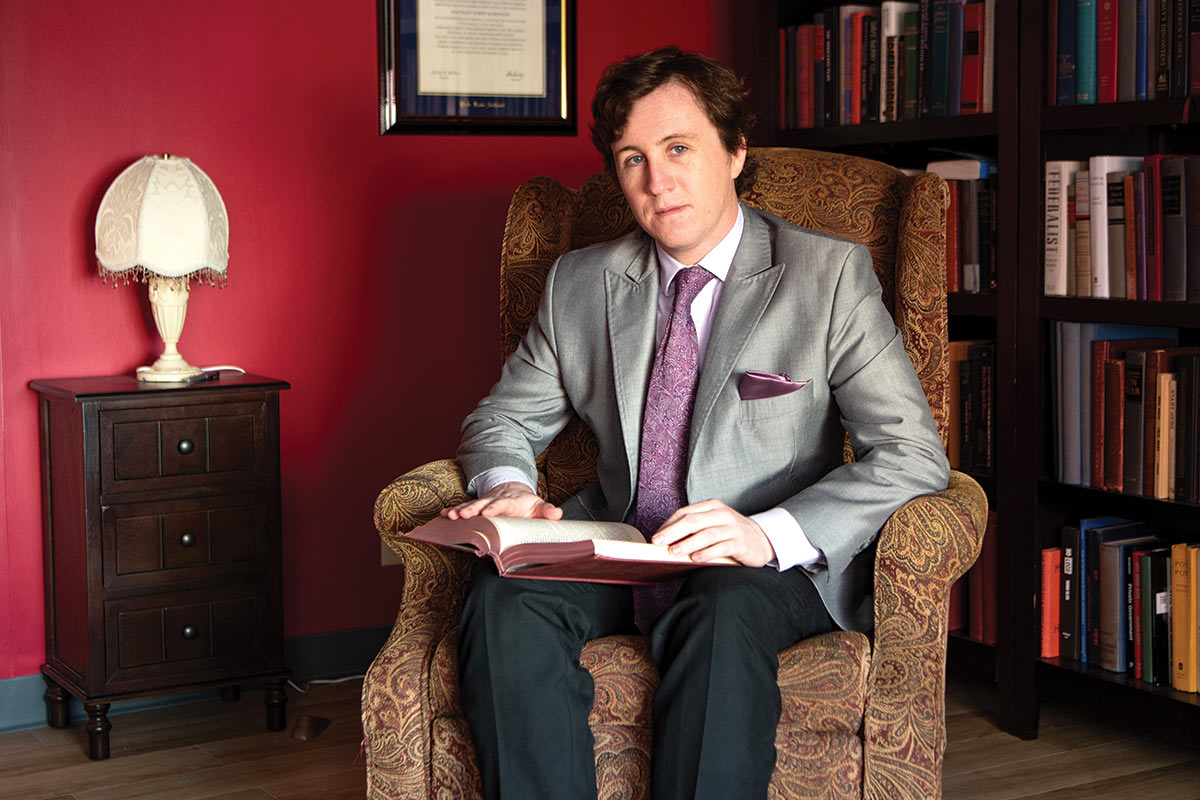
Photo Credit: Avery White
By Lawrence Goodman, P’24
Nathan Robinson ’11, GSAS MA’11, is on a mission to remake politics in America. As editor-in-chief of Current Affairs — a richly illustrated political magazine he co-founded in 2015 with his Brandeis roommate — he has built a platform that is part think tank, part comedy revue and part political rallying cry. A socialist agenda, he says, is the only way to counteract Trumpism and the far right.
An England-born intellectual who favors paisley ties and purple velvet jackets, Robinson is an outsized, colorful character. After coming to the U.S. as a 5-year-old, he sensed, even as a child, that he should hold on to his British accent for as long as possible. “Americans add 10 IQ points to you if you have a British accent,” he jokes.
His political awakening began at Brandeis. In January 2009, he borrowed a BranVan and drove with friends to Washington, D.C., to witness Barack Obama’s inauguration. On the National Mall, huddled with fellow students in the cold, he watched America’s first Black president take the oath of office on a jumbotron. “It was just this incredible moment,” Robinson recalls. “We were all so full of hope and optimism.”
That hope didn’t last. Within months, Robinson had grown disillusioned by Obama’s centrist Cabinet choices and incremental economic response to the Great Recession. The sweeping transformation he had hoped for never came.
The next semester, he enrolled in a Brandeis course on Marxism and anarchism taught by Mark Hulliung, now the Richard Koret Professor Emeritus of the History of Ideas. The class exposed Robinson to radical politics and a leftist visionary intellectual tradition.
By 2016, Robinson was a committed socialist. Today, he is part of a cadre of young millennials fomenting an American rebirth of democratic socialism, a political tradition that was marginalized in the mid-20th century but is being energized by Sen. Bernie Sanders, I-Vt., and the rise of the Democratic Socialists of America.
Along with writers like Matthew Bruenig (husband of Elizabeth Bruenig ’13, a staff writer at The Atlantic) and Sam Adler-Bell, Robinson draws inspiration from the resurgent DSA movement, which has claimed its most significant political victory yet: the election of Zohran Mamdani as mayor of New York City.
The author of 10 books, including several for kids, Robinson champions Medicare for All, moving to 100% renewable energy by 2035, free child care, free tuition at public universities and mass forgiveness of student loan debt. His critics accuse him of belonging to what is derogatorily called the alt-left.
Yet, even at what seems to be an undeniably low point for the political left, he’s undaunted. He proudly proclaims himself a utopian. “What we are demanding,” he says, “is a different understanding of what a just world is.”
Cerebral chic
Robinson’s radical streak has always been accompanied by a flair for satire.
At Pine View School for the Gifted, in Osprey, Florida, Robinson gravitated toward political mischief. As head of the Pine View Progressive Club, he fought the school board’s internet filters, which blocked websites that discussed Wicca, Buddhism and Islam. With friends, a shaggy-haired Robinson produced a low-budget public access television show called “Electric Discourse,” featuring Monty Python-esque skits mixed with political commentary. Robinson spoofed such targets as the media and Christian family values.
In high school, he began developing his trademark wardrobe — open-collar shirts and blazers bought at thrift shops — described by one writer as what “Austin Powers might [wear] if he were teaching Ivy League liberal arts.” Over the years, Robinson has created a carefully cultivated persona through his attire: lilac shirts, tassel loafers and thin-framed glasses. He calls it a “cheap way of buying credibility” as a public intellectual.
Launched in 2015, Current Affairs announced its ambitions with trademark bombast: to “bring a sharp critical eye to the absurdities of modern American life.”
At Brandeis, Robinson, who arrived with perfect SAT scores, found what he describes as a “heady intellectual environment.” “My parents didn’t go to college, so they hadn’t prepared me for the experience,” he says. “I remember looking at the course catalog for the first time and thinking, ‘What a delicious feast of intellectual meals.’”
After earning a bachelor’s and a master’s in politics, Robinson got a JD at Yale Law School. His first case as a lawyer — taken pro bono with former Brandeis roommate Oren Nimni ’11 — was defending an antiwar protester arrested for burning an American flag. Robinson came away feeling dissatisfied. He says he found “the whole experience just so boring I couldn’t take it,” a common refrain of his.
He switched tracks, earning a PhD in sociology and social policy at Harvard, with a dissertation on the revival of the DSA (which, by 2025, tallied around 80,000 members).
In 2015, Robinson and Nimni decided to launch Current Affairs, raising more than $16,000 on Kickstarter. The magazine announced its ambitions with trademark bombast: to “bring a sharp critical eye to the absurdities of modern American life.” A few months later, the magazine’s website declared the goal was “to render all other magazines both despised and obsolete,” and, in the process, “help usher in a glorious era of democratic socialism.”
Nimni soon left the magazine to pursue his legal career. Since 2017, Robinson has run the publication out of an office in New Orleans, where he moved after falling in love with the city’s arts, culture and architecture.
A libertarian, a liberal, a Marxist and a manatee
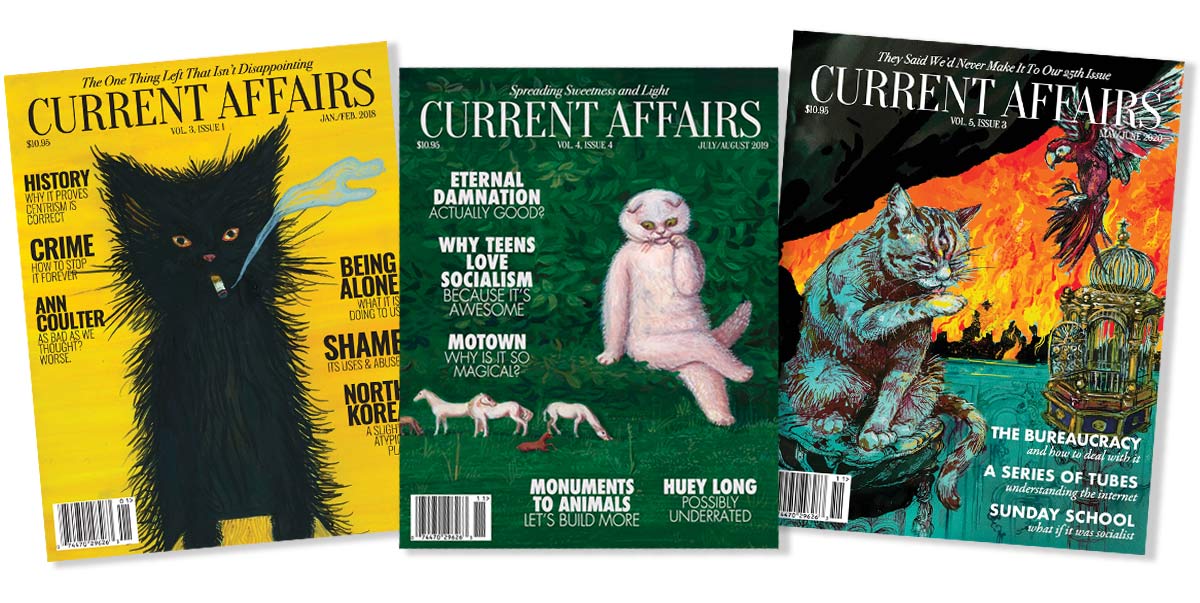
Current Affairs’ lush covers are minor works of art — colorful illustrations, created by freelance graphic artists, that capture the zeitgeist, and satirize culture and politics.
Its articles are somewhere between Jacobin magazine and the now-defunct Spy in style and tone. Topics run the gamut from deep dives into health care, immigration and criminal justice; to interviews with intellectuals; to satirical fake ads. Headlines and subheads ricochet between dogged declarations and hilariously posed questions — “Opera: It’s for everyone!” “Work: It completely sucks!” “Limits: Should there be any?” “Death: Should we think about it more?”
Robinson’s columns, which appear on the magazine’s website once or twice a week, combine deep intellectual analysis with polemic, satire and occasional whimsy. “Billionaires use philanthropy to bribe us not to hate them,” he wrote in a piece on Jeff Bezos. “We must respond by redoubling our hate.”
Current Affairs’ modest subscriber base — 3,500 print subscribers in all — belies the size of its impact. Robinson has been featured in The Ringer, The Nation and Vox, and has appeared on “The Ezra Klein Show” podcast. Political activist Cornel West, filmmaker Michael Moore and Hollywood director Adam McKay have all praised his work.
“I find myself regularly recommending Robinson’s articles to others, and re-reading them myself. Unusually valuable contributions,” Noam Chomsky says in a blurb on the magazine’s website. (Chomsky and Robinson co-wrote the 2024 book “The Myth of American Idealism: How U.S. Foreign Policy Endangers the World.”)
After Robinson’s book “Why You Should Be a Socialist” was published in 2019, he penned his own reviews in Current Affairs, writing them from the perspective of a libertarian, a liberal, a Marxist and a manatee. The libertarian writes, “Socialism is as twisted and dangerous a vision today as it was in 1917, and let us hope that the millennials infatuated with this terrifying and ignorant creed soon wake up and notice the blessings they have been given by capitalism.”
“As a sea-dwelling herbivore, I find this book about American politics to be of little practical use,” notes the manatee.
Then Robinson rebuts all those scathing takes he wrote: “The socialist creed is that ‘a better world is possible.’ I want you to believe in that creed. I think it will make you happier, that it will give you something beautiful and valuable to fight for.”
Visions of sublime possibility
Robinson’s career hasn’t been all wit and whimsy. In 2021, while working as a political columnist for The Guardian, he tweeted, “Did you know that the U.S. Congress is not actually permitted to authorize any new spending unless a portion of it is directed toward buying weapons for Israel? It’s the law.” Critics denounced the post as promoting antisemitic conspiracy theories about Jews controlling American politics.
Robinson says he was making a joke. Congress had just passed a COVID-19 relief bill that included military support for Israel. He deleted the post, but The Guardian fired him. He regrets backing down: “If they’re just going to fire you anyway, you might as well show some backbone.”
Around the same time, a labor dispute broke out among the ranks at Current Affairs. Workers at the magazine alleged they were fired because they tried to form a worker cooperative. “Socialist Publication Current Affairs Fires Staff for Doing Socialism” read a headline in the online publication Vice.
In a public letter, Robinson denied the dispute had anything to do with the workers’ co-op. Instead, he said, he had attempted to reorganize the magazine staff and ran into long-standing problems stemming from the lack of a clearly defined organizational hierarchy. “I have very serious regrets about how I handled it all,” he wrote, “and I have a great deal to learn about effectively managing an organization in accordance with the values I hold.”
In the end, the magazine’s board placed the publication on hiatus for a month and negotiated a lump-sum severance package for most of its employees.
In 2019, Robinson published a spoof memoir titled “My Affairs: A Memoir of the Magazine Industry (2016–76),” in which he purports to look back at his life from the year 2076. He describes the six-decade path America has taken to become “an extraordinary socialist utopia.” Private schools have been abolished. Amazon has been nationalized and combined with the U.S. Postal Service to create a new business and delivery service. Income inequality has been eliminated. Work has been largely automated, allowing people to create things, learn and explore. Humans have built the technology for interstellar travel and are preparing for a “Great Voyage” to search for alien civilizations in other galaxies.
The world’s transformation into such a glorious place hinges on a crucial turning point: In 2020, Bernie Sanders is elected president. Sanders eliminates fossil fuel use, passes Medicare for All and packs the Supreme Court with progressives, putting the world on course for a utopian future. In reality, of course, Joe Biden was elected. Four years later, Donald Trump succeeded him.
Robinson isn’t any less hopeful, though, or any less committed to the socialist project.
“If no one’s trying to stop authoritarianism, avoid war and environmental catastrophe, and build an alternative future, then, yes, it will happen,” he says. “There is an obligation to keep working, even at moments where you think you have no chance.”
Lawrence Goodman, a former marketing-communications staffer at Brandeis, is a playwright living in New York City.