Webinar Recordings
January 15, 2026
Pamela S. Nadell, the Patrick Clendenen Chair in Women’s and Gender History at American University, discusses her new book, "Antisemitism, an American Tradition." The book recounts the powerful story of antisemitism in America and how it has shaped the lives of Jews for almost four centuries.
Called “the book that the world needs now” (The Atlantic’s Franklin Foer), this “vital and unsettling new book” (Religion News Service) shows that freedom in America always came with conditions.
Listen also to the March 29, 2026 Boundless Insights podcast with Pamela Nadell and Rachel Fish.
December 4, 2025
Trump is waging war against higher education. While most Americans don’t support the attack, they share his distrust. This lack of faith in our universities is attributed to campus antisemitism and political lopsidedness among faculty, especially when it comes to teaching contentious issues, including the Israeli-Palestinian conflict. Despite these frequent and long-standing allegations of bias, however, remarkably little hard evidence has ever been adduced to prove them. We recently discovered just that evidence when we analyzed a database of 27 million college syllabi. In this short talk, we reviewed our findings and addressed how college administrators might encourage more responsible and broadminded curriculums, build a university culture of robust liberal debate, and begin winning back public trust. Presented by Professors Yuval Avnur (Scripps College, Claremont) and Stephanie Muravchik (Claremont McKenna College).
November 10, 2025
Antisemitism—and the traumatic invalidation that often accompanies it— has impacted students and staff across educational institutions, creating heightened stress, fear, and division. This session offered a trauma-informed dialogue framework specifically for administrators and support staff, designed to surface and validate the experiences of those affected by antisemitic bias, repair relational ruptures, and cultivate a shared commitment to psychological safety. Presented by Dr. Miri Bar-Halpern, Director of Trauma Training and Services at Parents for Peace and a Lecturer in Psychology at Harvard Medical School.
November 10, 2025
In the wake of rising antisemitism and widespread communal trauma, Jewish families are experiencing profound grief, fear, and invalidation. This session offered a supportive and empowering space for community members to come together, learn, and heal.
Through the lens of resilience-centered approach, participants explored how antisemitism and traumatic invalidation affect individuals and families, and how we can respond effectively. The session included interactive tools for supporting individuals and communities, guidance for parents navigating school-based challenges, and strategies for bridging divides across communities through safe activism and dialogue. Presented by Dr. Miri Bar-Halpern, Director of Trauma Training and Services at Parents for Peace and a Lecturer in Psychology at Harvard Medical School.
April 10, 2025
Democracy is under threat—not just from authoritarian movements, but from the forces of racism, antisemitism, and division that fuel them. Race Forward’s Executive Vice President Eric K. Ward explored how the politics of othering weaken democratic societies and empower extremism.
March 25, 2025
In this talk, Izabella Tabarovsky, a scholar of Soviet antizionism and contemporary antisemitism, surveyed "anti-Zionist" antisemitism as a form of information warfare targeting democracies; discussed what specifically makes it antisemitic; and talked about why it is critical that democracies learn to resist it.
February 11, 2025
Research findings related to college students in the U.S., Jewish and non-Jewish, were presented. Higher ed administrators gained insights into how this research can impact higher education policy, and identified opportunities for meaningful education and skills building for students, faculty, and administrators. Presented by Professors Len Saxe (Brandeis University), Eitan Hersh (Tufts University), and Rachel Fish (Brandeis University).
November 20, 2024
Chancellor Emeritus and constitutional law scholar, Mark Yudof, in conversation with Rachel Fish, PhD, about the challenges university leaders encounter on many campuses today.
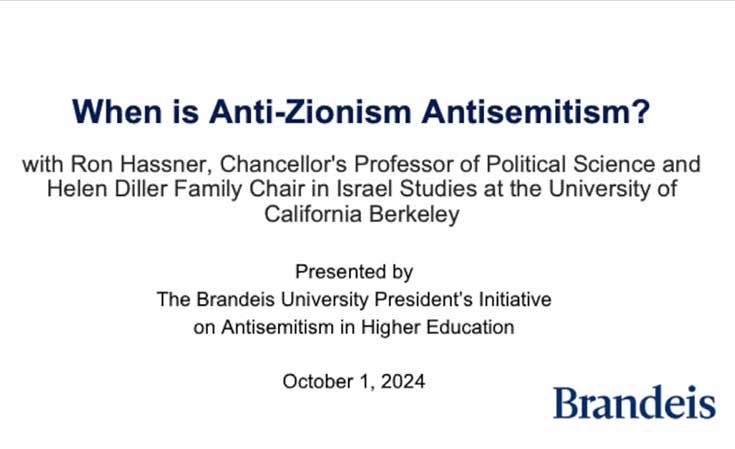
October 1, 2024
What is antisemitism, and how is it different from other kinds of racism? What forms does it assume and what are its primary tropes? When is anti-Zionism antisemitic and when is criticism of Israel antisemitic?
Ron Hassner, Chancellor's Professor of Political Science and Helen Diller Family Chair in Israel Studies at the University of California Berkeley, addresses these questions and more in this presentation, along with an understanding of how this impacts campus discourse among faculty and students.
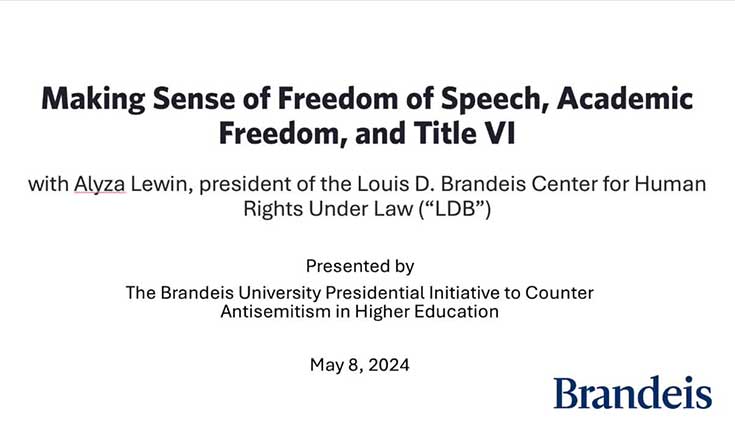
May 8, 2024
Presented by Alyza Lewin, president of the Louis D. Brandeis Center for Human Rights Under Law (“LDB”), a non-profit organization established to advance the civil and human rights of the Jewish people and promote justice for all. The Brandeis Center conducts research, education, and legal advocacy to combat the resurgence of anti-Semitism on college and university campuses. It empowers students by training them to understand their legal rights, and educates administrators on best practices to combat racism and anti-Semitism on campus.
April 17, 2024
Shai Feldman, the Raymond Frankel Chair in Israeli Politics and Society at the Crown Center for Middle East Studies and Professor of Politics at Brandeis University, shared the unique approach to teaching the Arab-Israeli conflict adopted at Brandeis University some 19 years ago. It argued that this unique approach accounts for the civilized conversation and the lack of any emotional explosions in the classroom at Brandeis since 2005. It also suggested that, with some adjustments, this approach could be applied to teaching other sensitive subjects such as those related to issues of gender and ethnicity.
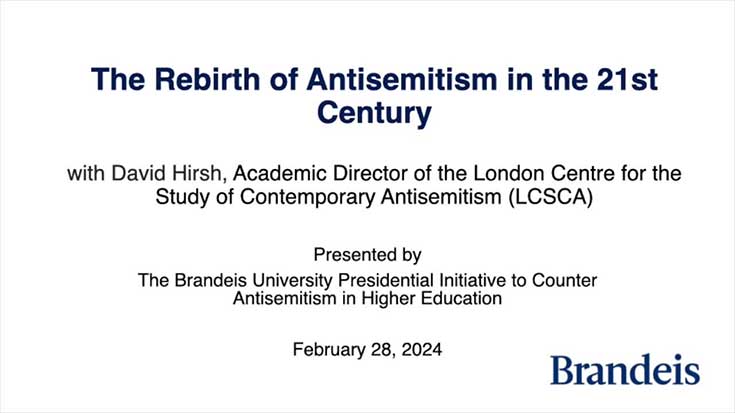
February 28, 2024
David Hirsh, Academic Director of the London Centre for the Study of Contemporary Antisemitism (LCSCA) and a Senior Lecturer at Goldsmiths, University of London examined the nature and sources of institutional antisemitism in higher education, its relationship to a more general rejection of racism, and opportunities to challenge it.