
Meet the Author features Professor William Flesch today
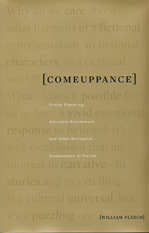 “Comeuppance: Costly Signaling, Altruistic Punishment, and Other Biological Components of Fiction” by Brandeis Professor of English Literature William Flesch
Wednesday, Oct. 22, 2008
4-5:30 p.m.
Rapaporte Treasure Hall
Free and open to the public.
Bring a friend; buy a book; have it signed.
“…an exploration of the appeal of gossip…with an account of how much we can think about characters and care about them as much as about persons we know to be real.”
–Harvard University Press
From “Fabula:”
“With Comeuppance, William Flesch delivers the freshest, most generous thinking about the novel since Walter Benjamin wrote on the storyteller and Wayne C. Booth on the rhetoric of fiction. In clear and engaging prose, Flesch integrates evolutionary psychology into literary studies, creating a new theory of fiction in which form and content flawlessly intermesh.
Fiction, Flesch contends, gives us our most powerful way of making sense of the social world. Comeuppance begins with an exploration of the appeal of gossip and ends with an account of how we can think about characters and care about them as much as about persons we know to be real. We praise a storyteller who contrives a happy or at least an appropriate ending, and fault the writer who refuses us one. Flesch uses Darwinian theory to show how fiction satisfies our desire to see the good vindicated and the wicked get their comeuppance. He conveys the danger and excitement of reading fiction with nimble intelligence and provides wide reference to stories both familiar and little known.”






