Category: Science and Technology
President: India mission far exceeded expectationsFeb. 17, 2012Exchanges of scholars, significant donations and possibilities for broadening Study Abroad opportunities are among results of the trip, which also included meetings with alumni, friends of the university and potential future Brandeisians.
Gates Foundation awards grant to tackle malariaFeb. 13, 2012Can an innovative wallpaper-like liner help reduce the number of cases of malaria, and if so, will it be cost effective? Professor Donald S. Shepard wants to know, and he has gotten the Bill and Melinda Gates Foundation to help. A grant, totaling nearly $500,000 over the next three years, will allow Shepard and collaborators to pursue their research.
Lawrence's India trip advances partnership Feb. 8, 2012Faculty and administrators of Brandeis University and India’s National Center for Biological Sciences have agreed to work toward creating a formal institutional partnership that could involve graduate students, undergraduates and post-docs.
Closer to understanding, averting drug resistanceJan. 30, 2012Bacterial resistance against antibiotics is growing exponentially. One reason is because drug resistant proteins are transporting “good” antibiotics out of the cells leaving them to mutate. Professor Dorothee Kern and collaborators looked at how one of these drug transporters works.
Grants help research go from laboratory to marketJan. 28, 2012Seed money from last year’s Virtual Incubator landed one group additional funding for its smartphone study aid. Another group's ALS therapy is now under license for commercial development. Do you have a big idea? Preliminary proposals are due by Friday, Feb. 10, 2012.
Simon, world-class relief worker, teacher, at milestone Jan. 27, 2012By any standard, the professor of international development is at the forefront of his field. He has created new academic and service programs, pioneered technology to bring the benefits of modern science to Third World countries and done relief work across broad swaths of Latin America, Africa and Asia.
Spring courses on climate, rebels, laughing matters Jan. 16, 2012Sabine von Mering wants to have a conversation about climate change; one that goes beyond whether it's happening. So the German language and literature professor is teaching a course this spring, “European Perspectives on Climate Change,” that offers a European perspective on the topic, told through literature and film.
A new twist on surface tensionJan. 9, 2012Researchers have engineered a new way of controlling surface tension, by creating reversible transitions of a flat two-dimensional membrane to a single dimension. It is part of an overall research mission to manipulate microscale structures of materials.
Faculty Focus: Michael Rosbash, biologistJan. 3, 2012Director of the Brandeis National Center for Behavioral Genomics, Rosbash was recently awarded the Louisa Gross Horowitz Prize from Columbia University for groundbreaking studies on the molecular basis of circadian rhythms.
Researchers explain granular material propertiesDec. 14, 2011What is it is that makes granular materials change from a flowing loose state to a “jammed,” or solid, state? In a study out this week in the Journal Nature, researchers at Brandeis explain how granular materials are transformed when force is applied at a particular angle, a process known as shearing.
- Physicists say they are near epic Higgs boson discoveryDec. 13, 2011
The Holy Grail of high-energy physics — the predicted but elusive Higgs boson — is almost within reach, and the Brandeis high-energy physics group, along with other particle physicists around the world collaborating on making the finding, is almost giddy with excitement.
Researchers discover drug-resistance mechanismDec. 9, 2011Antibiotics are used for everything from squelching strep throat to suppressing the immune system after an organ transplant. Understanding how some microbes resist high concentrations of antibiotics is important to designing new drugs and deciding how and when to prescribe existing drugs.
Addressing pain and disease on the flyDec. 6, 2011Studies of a protein that fruit flies use to sense heat and chemicals may someday provide solutions to human pain and the control of disease-spreading mosquitoes. Research from the Garrity lab was recently published in the journal Nature.
Nobelist MacKinnon '78 speaks at science retreatNov. 3, 2011The chemistry researcher's much anticipated talk was delivered on the subject of eukaryotic K+ channels, the molecules responsible for the movement of potassium ions into cells. More than 100 Brandeis scientists participated in the annual event.
Growing cohort of women in science calling Brandeis homeOct. 31, 2011Since its founding, the university has made a concerted effort to recruit and maintain female faculty in the sciences. 'It's a welcoming place,' says Division of Science Chair Eve Marder '68. 'Women feel comfortable when they come to interview.'
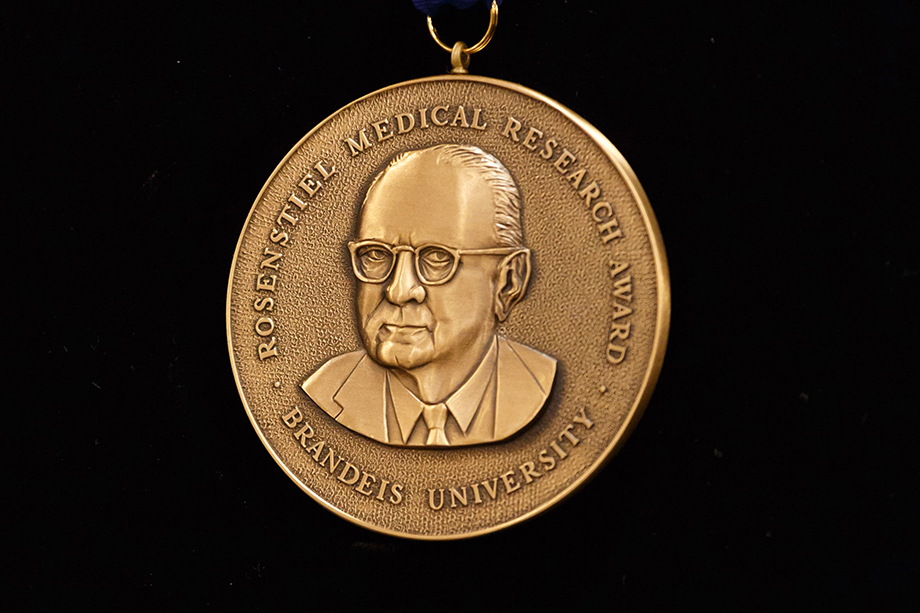
- Nahum Sonenberg to receive 41st Rosenstiel AwardOct. 26, 2011
Structure of Parkinson’s disease protein identifiedOct. 21, 2011The Petsko-Ringe, Pochapsky and Agar laboratories have produced and determined the structure of alpha-synuclein, a key protein associated with Parkinson’s disease. Information may someday be used to produce a new kind of treatment.
- Hoffmann, recipient of 2010 Rosenstiel Award, wins 2011 NobelOct. 4, 2011
This year's Nobel Laureates for physiology of medicine have revolutionized our understanding of the immune system by discovering key principles for its activation. One of the winners, Jules Hoffmann, was bestowed the 2010 Lewis S. Rosenstiel Award for Distinguished Work in Basic Medical Science.
Asian Food Network taps Prof. Hayes for documentarySept. 23, 2011China and India have joined overweight Americans in the obesity epidemic that’s sweeping across the world. This concern has prompted the folks at the Asian Food Channel to create a documentary investigating healthy diets.
Failure of brain's clock could play role in causing neuropsychiatric disordersSept. 19, 2011People who battle neuropsychiatric disorders can also have poorly regulated biological rhythms, which leads to altered sleep/wake cycles and hormonal rhythms. New research shows evidence that these circadian system symptoms, which have long been considered a result from the pathology, may also be involved in the cause of psychiatric disorders.
How much sleep's enough? Navy wants to knowSept. 7, 2011Brandeis' Ashton Graybiel Spatial Orientation Laboratory has long inquired into topics such as sensory motor adaptation and motion sickness, making the lab a hot spot as the Navy develops small combat ships with limited crew that must always be on top of their game.
Prof. Turrigiano wins HFSP Nakasone AwardSept. 6, 2011The Nakasone Award honors scientists who have undertaken frontier-moving research in biology, encompassing conceptual, experimental or technological breakthroughs. Turrigiano’s work in synaptic scaling is allowing scientists to further understand how the brain self-regulates and maintains balance.
Researchers explain how railways in cells are builtSept. 1, 2011Every cell in the human body contains a complex system to transport critical material such as proteins and membrane vesicles from one point to another. Bruce Goode, professor of biology, and his team have come one step closer to understanding the elusive mechanics of this process.
Butterfly can't leaf it alone, so biologist lends a handAug. 15, 2011Field biologist Eric Olson has long been a crusader against invasive species. They can crowd out native species, and generally disrupt the natural order. But this summer Olson's been busy protecting a weed from Europe for the sake of a prized butterfly.
Marcus Long awarded new HHMI fellowshipAug. 4, 2011Research on a new strategy that aims to selectively tag and target proteins for destruction has won Marcus Long a Howard Hughes Medical Institute fellowship for international graduate students. A member of the Hedstrom Lab, Long says that the ability to target disease-causing proteins, in principle, could save lives.
Artificial cilia spur new thinking in nanotechnologyJuly 26, 2011Cilia, tiny hair-like structures that perform feats such as clearing microscopic debris from the lungs and determining the correct location of organs during development, move in mysterious ways. Brandeis researchers have created artificial cilia-like structures that offers a new approach for cilia study.
Graybiel Lab poised for next round of space explorationJuly 21, 2011Companies are currently taking reservations for suborbital flights on their spaceships, and payload specialists - astronauts needed to carry out research and commercial work- must be be trained. The Graybiel Lab is one of a handful of facilities in the country that can do this.
When it comes to eating, rats follow their nosesJuly 7, 2011Would your favorite dinner taste the same if you couldn’t smell it? Does a sense of smell require a sense of taste? Associate professor Don Katz set out to find some answers in his laboratory. The results reveal the complex connections between taste and smell.
Collaborative develops drug to help hemophiliacsJune 23, 2011Collaborative work by Brandeis researchers and doctors at Children's and Brigham and Women's hospitals may lead to development of long-acting clotting medications that free patients from frequent infusions and from worries that an internal bleed has gone unnoticed.
Scientists discover protein complex linked to memoryJune 22, 2011Forget where you put your keys or recalling names at a cocktail party? New research from the Lisman Laboratory points to a molecule that is central to the process by which memories are stored in the brain.
President and faculty traveling to Israel seeking to enhance historic tiesJune 12, 2011Lawrence and a small group of senior faculty and administrators will visit leading universities and research centers in an effort to stimulate collaborations and to raise the profile of Brandeis with Israelis interested in studying in the US.
Sprout Grant Program looks for the next big ideasJune 3, 2011Have the next innovation that could change the world? Fourteen Brandeis scientists think that they do, and recently pitched their work to a panel of industry experts to win part of a $50,000 grant created to grow their ideas which ranged from targeting mutated proteins in cancer to a mobile application for studying.
Schumer says US must refocus on productionMay 7, 2011Veteran New York democratic senator says the country needs to improve education, reform immigration policy, make regulation more business-friendly, reform the tax code and encourage scientific research. First Saul G. Cohen Memorial Lecture attracts 300.
Sen. Charles Schumer to give first Cohen lectureApril 29, 2011The late science professor Saul G. Cohen was an instant film pioneer with a wide range of interests and a concern with the intersection of politics and science. Schumer will address the question: 'Can the United States Remain Ascendant?'
Researchers make strides in understanding ALSApril 26, 2011The Petsko/Ringe laboratory reports success in blocking the lethal effects of amyotrophic lateral sclerosis (ALS). The biochemical experiments in yeast cells proved effective in reversing the toxicity of a mutated protein in the familial type of the disease.
NSF graduate research fellowships soar in 2011April 15, 2011Students and graduates of the sciences at Brandeis scored big this year, winning nine National Science Foundation Graduate Research Fellowships, the largest number awarded in a decade. The youngest is physics major Netta Engelhardt ’11. Fellows share prestige, a three-year annual stipend of $30,000 and a $10,500 cost of education allowance.
- Week-long schedule of events to highlight greener livingApril 8, 2011
Students launch chapter of Global China Connection April 8, 2011A chapter of the The Global China Connection is emerging on campus this year. The group has organized a lecture on the history of chopsticks, an information session on studying in China and on Sunday, April 10, it will host the panel discussion, 'From Red to Green: The Intersection of Business and Environment in China.'
Governor Patrick outlines global advantages Massachusetts must leverage April 6, 2011- Ethics Center sponsors 'Consequences of Blogging'April 1, 2011
- Gov. Patrick to keynote Global Trade SummitMarch 24, 2011
Event to highlight opportunities for companies seeking expansion in Asia, Germany, the U.K. and South America. Summit will also examine ways that the state’s life sciences, clean energy and information technology sectors can foster job creation in Massachusetts. In-depth discussions on managing global operations, working with foreign investors and export financing will also take place.
Patterns found in lab spark insight into nature, societyMarch 24, 2011Irv Epstein's research is proving that patterns found in mathematical formulas and chemical reactions may be used to understand economics, how an epidemic might spread, population patterns in a city or region and the way animal communities survive in the natural world.
Experiential learning connects classroom with community and beyondMarch 21, 2011More than 80 students hope to inspire others at the third annual symposium on March 24.
- Women entrepreneurs making great stridesMarch 16, 2011
Women own about 41 percent of all privately held companies in the United States, participants in the International Business School's 'Fearless Founders' conference are told, but women's access to venture capital lags far behind. Only about 11 percent of U.S. firms with venture capital backing in 2009 had current or former female CEOs or founders.
- Social media study shows how we choose friendsMarch 11, 2011
Professor Peter DeScioli's research on the online friendship decisions of 11 million people sheds light on how we choose our best friends. His research supports what is called the 'alliance hypothesis of friendship,' and the study's findings were recently published in the journal Perspectives on Psychological Science.
- Harald Helfgott ’98 awarded Adams Prize by University of Cambridge, UKMarch 11, 2011
Lasers, custom microscope illuminate gene splicing March 10, 2011A microscope developed in the Gelles laboratory uses colored lasers to illuminate biomolecules, allowing researchers to study how cellular micro-machines are assembled in real time.
- Biology research experiences for undergrads offered for summer March 8, 2011
- What we can learn about aging, from wormsMarch 4, 2011
Princeton University Professor Coleen Murphy to share research on genes that regulate longevity in her Mar. 9 lecture: “Slowing the Ticking Clock: What we can learn about aging and memory from C. elegans. Genes that regulate the length of an animal’s reproductive span may yield clues to age-related changes in human fertility and memory.
Energy panelists look for better policy, profit mix March 3, 2011The trick to boosting clean energy, they say at business school forum, is for future business and public policy leaders to promote a confluence of public and private clean energy ventures that further the notion that 'there is green (money) in green.'
- Irene Abrams appointed associate provost for innovationFeb. 28, 2011
- Chemistry's Christine Thomas named a 2011 Sloan Research FellowFeb. 28, 2011
- Visit Story Archive »