Follow Us @
Events
October 9, 2013
The Other Peace Process
An Evening with Rabbi Ron Kronish '68 and Kadi Iyad Zahalk
November 4, 2013
Brown Bag Seminar
Tolerating Iran's Religious Other: The Jewish Community in The Nineteenth and Twentieth Centuries
November 22, 2013
Book Release Celebration
Arabs and Israelis: Conflict and Peacemaking in the Middle East
Recent Publications
Middle East Brief
Drivers of Democracy: Lessons from Tunisia
Eva Bellin
Middle East Brief
The Economic Legacy of Mahmoud Ahmadinejad
Nader Habibi
Middle East Brief
Can Iran Surprise by Holding a "Healthy" Election in June?
Seyedamir Hossein Mahdavi
Middle East Brief
Is the Jordanian Monarchy in Danger?
Asher Susser
Crown Center
Opening Event Video
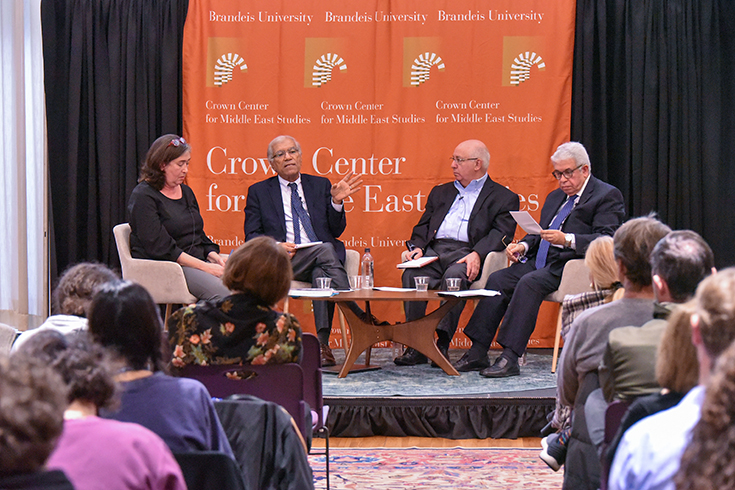
The Syrian Catastrophe: Regional Implications
September 25, 2013
Watch the lively and engaging discussion with Frederic Hof of the Atlantic Council, Mona Yacoubian of the Stimson Center, Joseph Bahout of Sciences Po Paris, and Professors Eva Bellin and Shai Feldman of the Crown Center. ... Watch here
2014-2015 Junior Research Fellowship
Application Open
The Crown Center for Middle East Studies is offering one-year fellowships to outstanding scholars of Middle East politics, economics, history, religion, or social developments for the 2014-2015 academic year. ... Read More
Middle East Brief 75
Drivers of Democracy: Lessons from Tunisia
Eva Bellin
Thirty-one months since the fall of Zine Abdine Ben Ali, how far has Tunisia progressed in the transition to democracy? The noise of the daily battles and aberrant acts of violence may obscure the country’s true political trajectory and generate discouragement about Tunisia’s future. However, some distance may provide a better perspective, revealing a surprisingly positive and encouraging trend line. ... Read More
The Christian Science Monitor - August 22, 2013
Views of Palestinians give reason for hope in Mideast peace talks
Khalil Shikaki and Steven M. Cohen
Skeptics see Palestinians as committed to violent resistance and unwilling to recognize the state of Israel. In fact, more than 20 years of polling data strongly refute these perceptions, and give leaders in Ramallah substantial room to maneuver in the ongoing peace talks. ... Read More
New York Review of Books - August 15, 2013
What Future for Israel?
A review of the Crown Center sponsored Israel, Jordan, and Palestine: The Two-State Imperative by Asher Susser
"Susser documents how the gaps between the two sides, or at least some leading spokesmen from the two sides, have narrowed on issues deriving from the 1967 war—borders, settlements, and security arrangements—while 'little if any real progress was made in resolving the 1948 question of refugee return.'"... Read More
Christian Science Monitor - July 23, 2013
Middle East peace talks: Finding believers amid the skeptics
“Abbas doesn’t think he can get a deal with Netanyahu,” says Khalil Shikaki, a senior fellow at Brandeis University’s Crown Center for Middle East Studies. Still, Abbas sees in the talks the means of boosting his own “legitimacy” among West Bank Palestinians, he adds. ... Read More
World Politics Review - June 18, 2013
Economic Crisis First Order of Business for Iran’s Rowhani
It is expected that Rowhani’s strong victory will help improve Iran’s political environment and restore some of the limited civil and political rights Iranians enjoyed during the 1997-2005 presidency of Mohammad Khatami. Rowhani’s first order of business, however, is likely to be Iran’s current economic crisis. ... Read More
June 15, 2013
The Election of Hassan Rouhani: Essential Crown Center Readings
The election of Hassan Rouhani as Iran's next President in the first round of voting caught many by complete surprise. Two Middle East Briefs help to shed light on this development in Iranian politics. ... Read More
Die Welt - June 14, 2013
Vom islamischen Robin Hood zum Krisenfaktor
Nader Habibi's analyses of Ahmadinejad's economic policies are reported in Die Welt. Read the full text [in German]
BBC News - June 12, 2013
Economic troubles loom over Iran presidential election
"Sanctions have become more intense and have exerted more downward pressure on Iran's trade and industrial activities," says Crown Center's Nader Habibi. "But the inconsistency and irrationality of economic policies have also had an adverse effect on business climate for private investors." ... Read the full text
Middle East Brief 73
Can Iran Surprise by Holding a "Healthy" Election in June?
Seyedamir Hossein Mahdavi, was a member of the Central Council of Mujahedin Inqilab, a reformist party in Iran, and on the editorial board of several reformist newspapers. He is currently an MA student in the Coexistence and Conflict program at the Heller School for Social Policy and Management at Brandeis University.
Citing the 2009 election and its violent aftermath, many Iranians came to believe that a regime that is capable of changing the result of an election according to its own will, would do the same in future elections as well, making them ceremonial at best. In this Brief, Seyedamir Hossein Mahdavi argues that it may not be so simple. ... Read the full text
Panel Discussion Video
The Coming Presidential Elections in Iran: Do they Matter?
Watch the in-depth panel discussion on the state of Iranian politics and impact of the upcoming presidential election. ... Watch the video
Middle East Brief 72
Is the Jordanian Monarchy in Danger?
Asher Susser, Stanley and Ilene Gold Senior Fellow at the Moshe Dayan Center for Middle Eastern and African Studies at Tel Aviv University
The Jordanian monarchy is going through one of its most difficult periods ever. The Arab Spring has emboldened the opposition by eroding the deterrent effect of the notorious “fear of government” (haybat al-sulta) in the Arab world in general and in Jordan in particular. ... Read the full text
Middle East Brief 71
The Islamic Awakening: Iran’s Grand Narrative of the Arab Uprisings
Payam Mohseni, Junior Research Fellow at the Crown Center, holds a Ph.D. from Georgetown University’s Department of Government and is a member of the Iran Study Group at the United States Institute of Peace
In Iran, the 2011 Arab Spring was hailed as an “Islamic Awakening” based on its own Islamic revolution in 1979. In this Brief, Dr. Payam Mohseni focuses on the Iranian conceptualization of this “Islamic Awakening” and the domestic ideological context in which it took shape. ... Read the full text
The National Interest - March 20, 2013
Netanyahu's Allies and Adversaries
Shai Feldman, Judith and Sidney Swartz Director of the Crown Center
The new Israeli government reflects the recent election’s confusing results. When added to other ambiguities of Israel’s electoral history, the results make it difficult to predict precisely what avenues the new government will take. The composition of the new Israeli government is the result of at least four new political realities. ... Read the full text
Middle East Brief 70
The Good, the Bad, and the Ugly of Egypt’s Political Transition
Abdel Monem Said Aly, Chairman, CEO and Director of The Regional Center for Strategic Studies (RCSS) in Cairo, and Senior Research Fellow at the Crown Center
Karim Elkady, PhD candidate in the Politics Department at Brandeis University and the Crown Center
To what extent has the transitional period--from the trial of Hosni Mubarak in August 2011 to the civil disobedience seen in the city of Port Said in Winter 2012--moved Egypt closer toward a democratic system of governance? In this Brief, Dr. Abdel Monem Said Aly and Karim Elkady provide a net assessment ... Read the full text
26th Annual Camden Conference - February 23, 2013
Israel and Iran: An Evolving Debate
Shai Feldman, Judith and Sidney Swartz Director of the Crown Center
Middle East Brief 69
The Transformation of Public Space in Turkey
Dror Ze'evi, Professor of Turkish and Ottoman History in the Department of Middle East Studies, Ben-Gurion University.
One of the mainstays of Turkey's governments throughout its modern history has been a dogged secularism. However, in recent years the ruling Justice and Development Party (AKP), while still paying lip service to secular tenets, has churned out a stream of laws and injunctions that, taken together, amount to a radical transformation of Turkey’s public sphere. ... Read the full text
The National Interest - February 27, 2013
The Tough Task of Middle East Peace
Shai Feldman, Judith and Sidney Swartz Director of the Crown Center
Assuming that the Obama administration decides that a breakthrough in Palestinian-Israeli relations is important not only for its own sake, but also for addressing other U.S. national interests in the Middle East, what would it take to achieve such a breakthrough? The long history of the efforts to resolve the Arab-Israel conflict—and particularly its Palestinian-Israeli dimension—yields at least eight different requirements for success ... Read the full text
Inter Press Service - February 20, 2013
Israel Not Pushing Obama to Arm Syrian Rebels
Crown Center Director Prof. Shai Feldman quoted on the "three phases of Israeli thinking on Syria: initially, a desire to keep 'the devil we know;' later, the view that getting rid of Assad would strike a major blow against Iran and its ability to supply Hezbollah in Lebanon and; now, 'real worries about what happens next.' Israel can handle 'extremists like Hamas in Gaza and [Hezbollah leader Hassan] Nasrallah in Lebanon,' ... but fears chaos. It worries about who will control Syria’s arsenal of weapons and who, if anyone, will check the influence of Al-Qaeda affiliates."