Ruth First Memorial Lecture
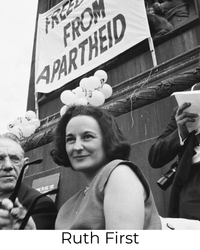 The Ruth First Memorial endowment was established through the generosity of Rose Schiff, Eileen Schiff Wingard, and Zina Schiff Eisenberg in memory of their beloved daughter and sister, Louise Joy Schiff.
They designed these funds for annual lectures on black liberation in southern Africa. The African and African American Studies Department, and specifically the late Professor Gloria Waite, and Professor Wellington Nyangoni, decided to name it in honor of Ruth First. And thus began the lecture series in 1985.
Ruth First was a white South African who was dedicated to the freedom of all South Africans in the apartheid regime under which they lived. The child of Communist South Africans, she devoted her life to the Communist Party as the Johannesburg reporter for the radical weekly Guardian. She exposed the Bethal farm labor scandal in which people sentenced for petty offences under the Pass Laws were covertly sent to work in terrible conditions in farm-prisons. In response, she helped to organize the resulting potato boycott campaign.
Ruth First was among many charged in the Treason Trial in 1956, when the African National Congress, or ANC, and other organizations were charged with trying to overthrow the government. In 1963, she was arrested, imprisoned and released on condition that she would leave South Africa permanently. She eventually settled in Mozambique, with her husband, prominent anti-apartheid activist Joe Slovo. She became the director of research for the Center for African Studies at Eduardo Mondlane University. It was here in her office, on August 17, 1982, that she opened a large manila envelope sent from a United Nations agency — all mail to Mozambique went through South Africa — and was instantly killed by the explosive device that had been placed in it. Her funeral in Mozambique was attended by thousands and was addressed by President Samora Machel (the late President who would eventually be assassinated as well).
Ruth First Lectures
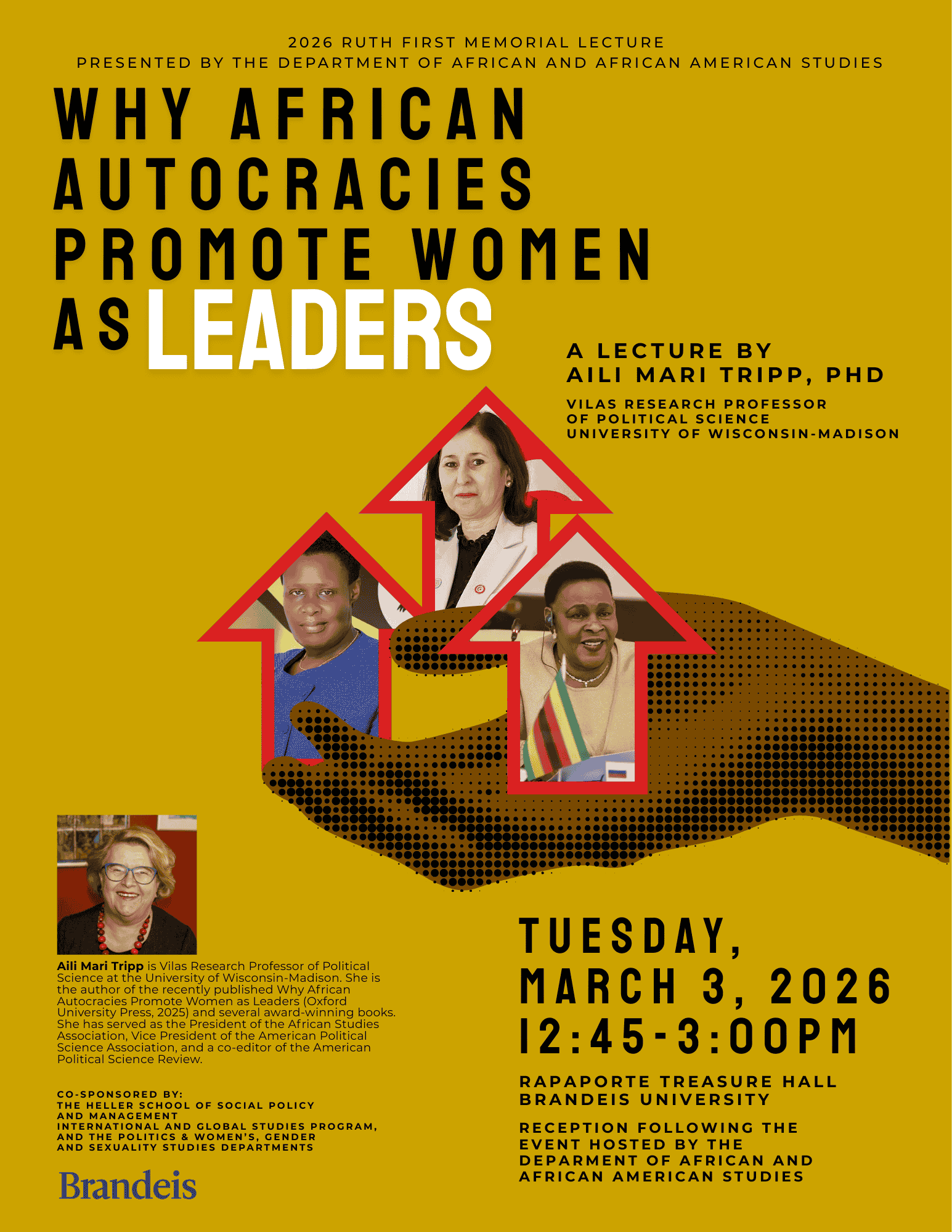
March 3, 2026
Tuesday, March 3, 202612:45-3:00PM
Rapaporte Treasure Hall
Lecture and Reception hosted by African and African-American Studies
The book, Why African Autocracies Promote Women as Leaders (Oxford University Press, 2025) by Aili Mari Tripp contrasts authoritarian countries with democracies in Africa to explain how and why autocracies promote women as leaders. The face of African politics has changed significantly since the mid-1990s as more women have entered politics in both democracies and autocracies. Women's movements and organizations have successfully lobbied for and won more leadership roles for women in the executive, legislature, and sub-national bodies. At the same time, in authoritarian countries this has created a conundrum: these successes in attaining leadership roles for women potentially end up strengthening the very regime that violates human and women's rights. These regimes instrumentalize women leaders and women's rights to enhance the longevity of an autocratic ruling party by increasing vote share, enhancing internal and external legitimacy, and softening their image after civil war, jihadist activity, or military rule. This occurred in the context of the shift from one-party to multiparty states, the end of major conflicts, and changing international gender norms in the 1990s. The study draws on cross-national research in Africa and over 188 in-depth interviews in Uganda, Rwanda, Zimbabwe, Mauritania, Morocco, and in two democracies, Namibia and Botswana.
About the Speaker
Aili Mari Tripp is Vilas Research Professor of Political Science at the University of Wisconsin-Madison. Her research has focused on gender/women and politics, women’s movements in Africa, transnational feminism, authoritarian politics in Africa, and the informal economy in Africa. She is author of the recently published Why African Autocracies Promote Women as Leaders (Oxford University Press, 2025) and several award-winning books, including Seeking Legitimacy: Why Arab Autocracies Adopt Women’s Rights (2019), Women and Power in Postconflict Africa (2015), African Women’s Movements: Transforming Political Landscapes (2009) with Isabel Casimiro, Joy Kwesiga, and Alice Mungwa, and Women and Politics in Uganda (2000). She has served as the President of the African Studies Association, Vice President of the American Political Science Association, and a co-editor of the American Political Science Review.
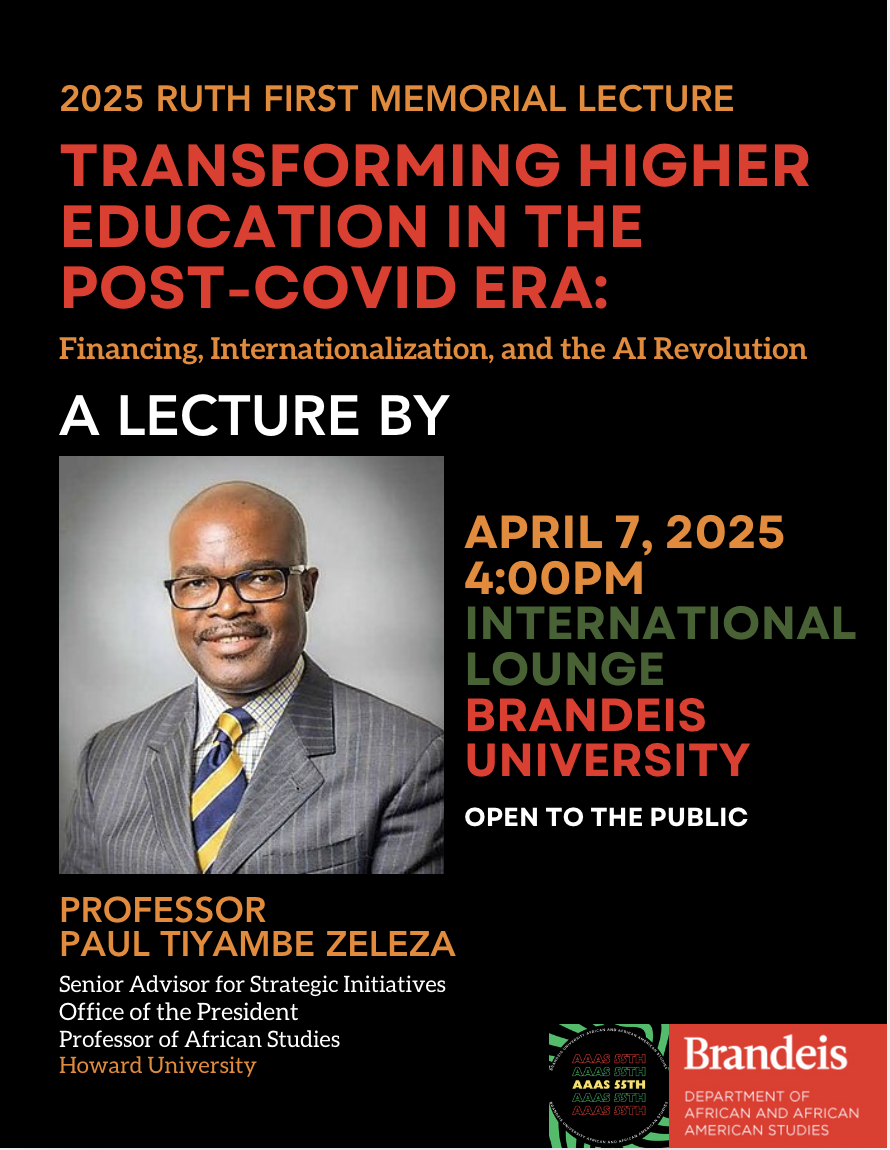
April 7, 2025
Professor with Professor Paul Tiyambe Zeleza, Professor of African Studies at Howard University.