The Benjamin and Rosemary (Alperin) Laskin correspondence (1944-45)
December 12, 2025
Description by Alejandro Franqui-Ferrer, University Archives and Special Collections intern.
The Benjamin and Rosemary (Alperin) Laskin correspondence, now held at Brandeis University’s Robert D. Farber Archives and Special Collections, is a rich source of information in understanding not just the day-to-day of the average American person during the Second World War, but the perspective of some educated American Jews during this time. The letters which make up the correspondence were produced by Corporal Benjamin Laskin and Rosemary (Alperin) Laskin between January 3, 1944, and September 24, 1945, the waning period and end of WWII. The collection is made up of more than 120 letters, as well as some newspaper clippings which the pair sent to each other.
Benjamin and Rosemary
Benjamin Laskin was born on February 12, 1909, in Brooklyn, New York to Russian Jewish immigrant parents.1 After graduating from High School, Laskin went on to study at New York University for his undergraduate degree, and proceeded to pursue more education at Brooklyn Law School.2 Laskin went on to work as a clerk at a Post Office3 until August 27, 1942, when he enlisted in the American military while it was the United States’ first year in the war. Something interesting about this fact is that Laskin was 33 years old when he enlisted, which was higher than average for this time. Laskin was never deployed to combat or stationed overseas, but he did serve in a number of places around the country, including Chicago, Illinois; Sheppard Field, Texas; Kearns, Utah; and the Aleutian Islands, all locations he wrote letters from. Before Laskin went off to serve, however, he met Rosemary Alperin, who he established a strong connection with.
Rosemary Alperin was born on January 24, 1915, in Ann Arbor, Michigan, also to Russian Jewish parents.4 After graduating from Pontiac Central High School in 1931, Alperin went on to live in a number of different places around the U.S. including Chicago, Illinois; Flint, Michigan; Rochester, New York; and in the 1940s, Cambridge, Massachusetts. It seems likely that Cambridge was where Benjamin and Rosemary met for the first time, and many early letters in the collection are written from there, while the later ones were written from Dorchester, Massachusetts. With the pair connecting before Laskin left home to serve, the two wrote to each other extensively during the war. While the collection begins with the pair seemingly engaged in dating or a type of courtship, there is a gap in letters between January and July of 1945, after which Benjamin refers to Rosemary as Mrs. Laskin, not Miss Alperin, signaling that the pair had been together during the gap and had married.
The Letters
One thing that makes the Laskin correspondence stand out from other collections of letters is the witty and playful tone which is consistently held by both writers, especially when relaying affectionate messages. As an example, on November 18, 1944, Benjamin writes to Rosemary,
“Dear, when I talk to you it is only with love and admiration, and never with tongue in cheek. Whenever I think of you I have the urge to kiss you, and how can I kiss you if I have my tongue in cheek. It is difficult, at best.”5
As stated before, both writers engage in this type of humor. Benjamin and Rosemary also have a host of inside jokes they reference many times, including a hypothetical child that the pair reference, called Zero,6 and a mink coat (written distinctly in the letters) which is repeatedly mentioned as a piece of clothing Rosemary very much wants.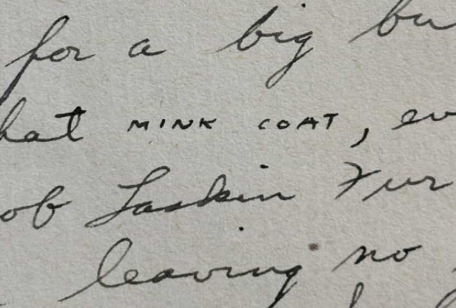
Another interesting feature of the correspondence is the discussion of politics often found in the letters, which seems to fit for an educated couple during this time. Benjamin and Rosemary mention politicians they approve and disapprove of, policies they support, and their general thoughts on a number of issues, including the payment of Works Progress Administration (WPA) workers,7 and the 1944 election.8 In one particular passage, Benjamin comments on the praise of the famous journalist, Westbrook Pegler, who opposed the New Deal:
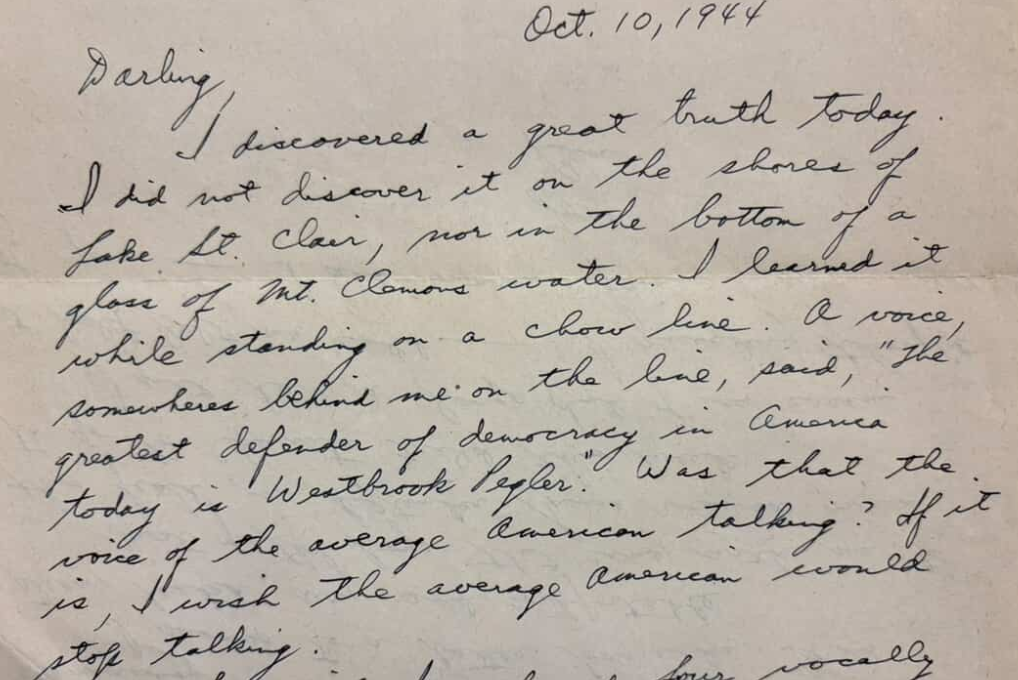
“I learned it while standing on a chow line. A voice, somewhere behind me on the line, said, ‘The greatest defender of democracy in America today is Westbrook Pegler.’ Was that the voice of the average American talking? If it is, I wish the average American would stop talking.”9
As is to be expected, the correspondence in the collection also contains commentary on the developments of the war. Speculations as to when the war is to end, the noting of progress towards the defeat of the Axis, and the mentioning of major specific events, like the atomic bombings, can all be found here. Often there is more than an acknowledgement of these events, and instead the writers engage with them in a more critical way. For example, on August 6, 1945, after hearing of the Atomic bombing of Hiroshima, Benjamin writes that the development of the bomb may be the reason why the Soviets had not yet invaded Japanese holdings on the Asian mainland.10
Finally, the correspondence contains many accounts of and inquiries into the day to day life of both writers. Benjamin describes how he lives in the various places he visits and is stationed at, while Rosemary keeps Benjamin updated on what is going on at home with both their families, whether it be health concerns, the college prospects of Rosemary’s younger sister Diane,11 or the acquisition of a new house.12
All together, the Laskin correspondence provides plenty of information to understand the particular perspectives of the two writers on the events of the war and political life during this period of American history.
Footnotes
- Year: 1910; Census Place: Brooklyn Ward 24, Kings, New York; Roll: T624_975; Page: 22b; Enumeration District: 0646; FHL microfilm: 1374988, Ancestry.com and Laskin Corr. 12 September 1944 - 18 October 1944, Box 1
- "U.S., School Yearbooks, 1880-2012"; School Name: Brooklyn Law School; Year: 1933, Ancestry.com
- National Archives at St. Louis; St. Louis, Missouri; WWII Draft Registration Cards For New York City, 10/16/1940 - 03/31/1947; Record Group: Records of the Selective Service System, 147, Ancestry.com
- Year: 1920; Census Place: Flint Ward 1, Genesee, Michigan; Roll: T625_764; Page: 28A; Enumeration District: 19
- Laskin Corr. 10 November 1944 - 20 November 1944, Box 1
- Various places, including Laskin Corr. 1 August 1945 - 5 August 1945, Box 2
- Laskin Corr. 30 October 1944 - 9 November 1944, Box 1
- Laskin Corr. 30 October 1944 - 9 November 1944, Box 1
- Laskin Corr. 12 September 1944 - 18 October 1944, Box 1
- Laskin Corr. 1 August 1945 - 5 August 1945, Box 2
- Laskin Corr. 9 July 1945 - 12 July 1945, Box 1
- Laskin Corr. 10 Nov 1944 - 20 Nov 1945, Box 1