Events

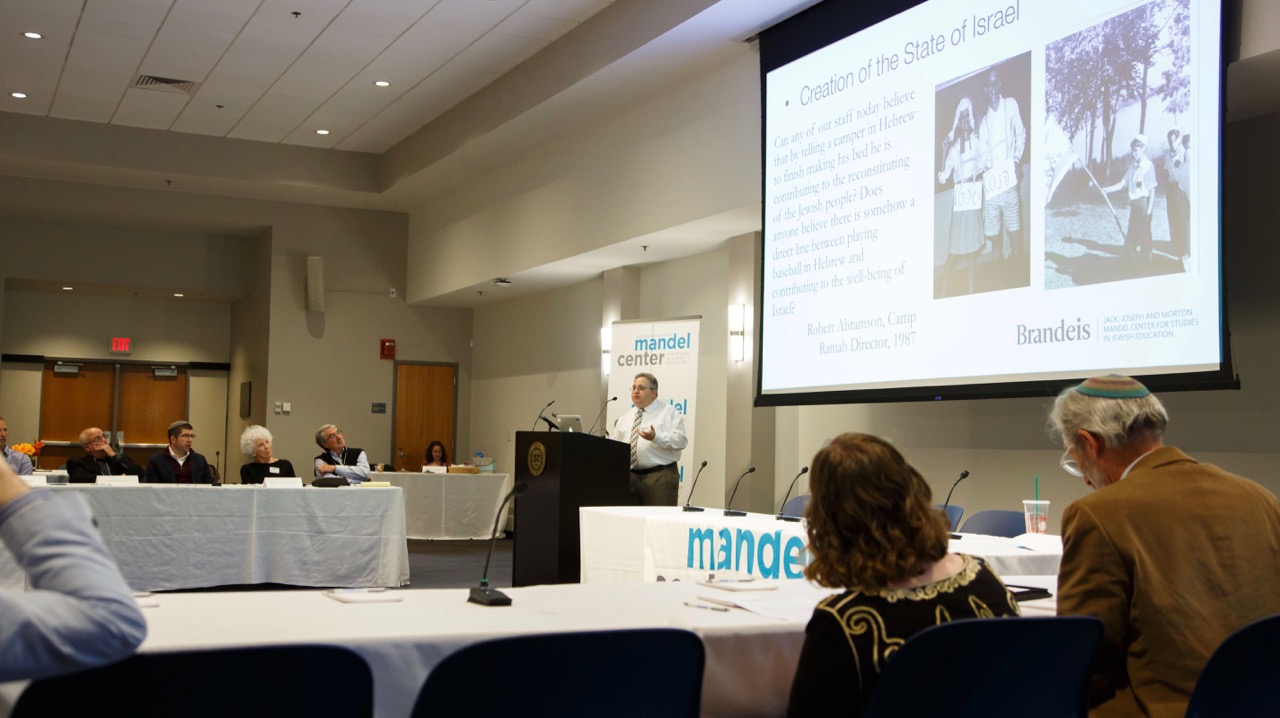
Each semester the Mandel Center offers a full schedule of events at which educators, scholars and members of the community can learn about new work in Jewish education research and exchange ideas.
Dialogue and Discourse: The Ongoing Relevance of Martin Buber's Thoughts on Education
Lunch Seminar with Ursula Reitemeyer, University of Munster
Wednesday, October 212:15-2:00 pm
Abraham Shapiro Academic Complex (ASAC)
Brandeis University
Lunch will be served. Dietary laws observed.
RSVP to mandelevents@brandeis.edu by Monday, September 29.
Democracy and participation in a Civil Society require a political and educational theory of inclusion. Our present school systems, however, using examinations and other "standards" for promotion and assessment are, at heart, functionally exclusive. According to Buber, teachers need to accord each student with whom they interact, at whatever level, a respect for his or her ideas, however uninformed they may be. This includes less-mature learners and people new to a field or domain of expertise. Martin Buber’s dialogic understanding of education, based on the principle of pedagogic inclusion, has not lost its relevance in the pedagogic discourse about democratic and moral education, not even when we consider that Buber understands inclusion as one-sided and asymmetrical when practiced by the teacher.
Ursula Reitemeyer is professor in the department of Educational Theory and Research at the University of Munster in Germany. Her fields of study include Philosophy of Enlightenment; Philosophy of the 19th und 20th Century; Theory of Modern Education; Ethics; and German-Jewish Philosophy during the Weimar Republic. She edits the series Ethics in Education and International Feuerbach Research.
'Show Me Your Badge': The Educational Potential of an Emerging Alternative Assessment
Lunch Seminar with Sam Abramovich 98', U at Buffalo
Wednesday, November 1312:15-2:00 pm
Abraham Shapiro Academic Complex (ASAC)
Rm. 204
Brandeis University
Lunch will be served. Dietary laws observed.
Educational stakeholders, armed with technological innovations, are now challenging established methods of educational assessment. For example, Mozilla and the MacArthur Foundation have begun to explore badges and badging systems as a way to connect and enhance learner interests. And while the implementation of educational badges is underway by many organizations, the Jewish Day School movement is currently leading the way in terms of badge design and use. A Jewish Day School has one of the most advanced badge implementations for formal K-12 education in the United States while other schools are implementing badge systems for use in teacher professional development.
However, the research community is just now beginning to uncover how badges can best serve students. As one of the first researchers exploring the educational potential of badges, Sam Abramovich will share the results of two studies examining badge system design and impact. His findings indicate that different types of badges affected different types of learners’ motivation depending on the abilities of the learners. He has also found that educational badges rely on interdependence between reward, student interest, and recognition. In addition, he will discuss the future growth of educational badges both inside and outside of Jewish education as well as share preliminary results from an analysis of badges used for Jewish Day School teacher professional development.
What's a Jewish Camp Director to do? Setting Priorities for Educational Leadership at Camp
Lunch Seminar with Joseph Reimer
12:15-2:00 pm
Abraham Shapiro Academic Complex (ASAC)
Rm. 204
Brandeis University
Lunch will be served. Dietary laws observed.
Two contrasting visions for leadership at Jewish camps have been articulated. One focuses on the camp director as the educator-in-chief and the other as the producer of a great show. Clearly these visions set different leadership priorities. How can future research on Jewish camps help guide the choices that camp leaders need to make to ensure they are running camps that are both financially healthy and educationally effective?
Joseph Reimer is an Associate Professor in Jewish Education who splits his teaching and advising time between the Education and Hornstein Programs. He also serves as faculty advisor to the Office for High School Programs at Brandeis. Trained at Harvard as a developmental psychologist, he currently focuses his research on experiential Jewish learning, Jewish camping, and the professional development of educators. His book, Succeeding at Jewish Education, won the National Jewish Book Award in 1997. His recent publications have focused on leadership in Jewish summer camps.
Recent Events
A Model of Teacher Development Grounded in Teaching Practice: Report on a Study Visit to the University of Michigan
Lunch Seminar with Nili Pearlmutter
Wednesday, September 18
The University of Michigan has two unique summer programs, one for novice teachers in their elementary MAT program and one for experienced math educators. What ties them together is their use of teaching practice as the central site for learning and their use of technology to support reflection and research on teaching. Nili Pearlmutter described these two innovative programs, reflected on their impact on her practice as a teacher educator, and led a discussion on possible implications for teacher education at Brandeis and beyond.
Nili Pearlmutter is a Senior Education Specialist in the Delet/MAT program. She teaches the Fundamentals of Teaching course and serves as director of field experiences. She has served as a field instructor for pre-service teachers, taught the Reflective Teaching seminar in the MAT-JDS program, co-facilitated a beginning teacher's study group, and worked with the Teacher Learning Project to help schools implement systems and practices that support and develop beginning teachers and make schools good places for all teachers to teach and learn.