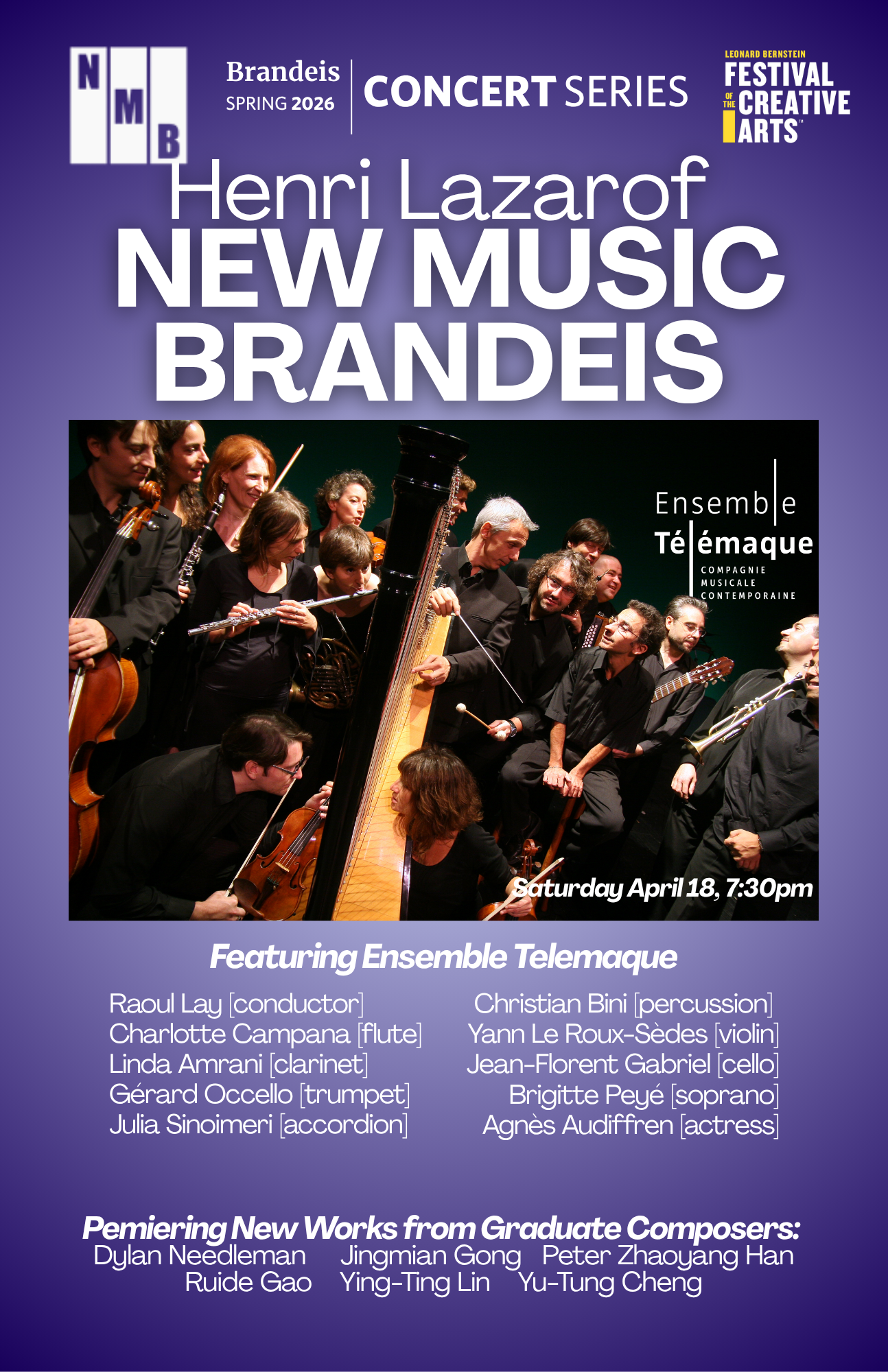
Henri Lazarof New Music Brandeis
Program: Titles and Composers
Dylan Needleman: Les Ponts
Yu-Tung Cheng: Fallen Angel Atraxa
Peter Zhaoyang Han: Children’s Play III (儿戏,叁) Open Score Canon & Aleatoric Musical Game
I. Canon a 6 super thema ludere puerorum, Puzzles 拼图II. Musical Game, Freeze Tag 三个字
Jingmian Gong: Proust Impression
Ruide Gao: Wonderful Journey
Ying-Ting Lin: Uh-oh!
Fallen Angel Atraxa | Yu-Tung Cheng
In the card game Magic: the Gathering, the Phyrexians are a race that fuse machinery and flesh, forming biomechanical organisms. Their mythology spans multiple worlds and storylines.
This piece centers on Atraxa, an angel from Mirrodin who was injured and captured during the Phyrexian invasion of her world. The praetor Elesh Norn transformed her into a Phyrexian angel through vivisection and reconstruction, claiming her as a daughter.
Phyrexians possess their own language. The text of this work is written in a mixture of Phyrexian and English.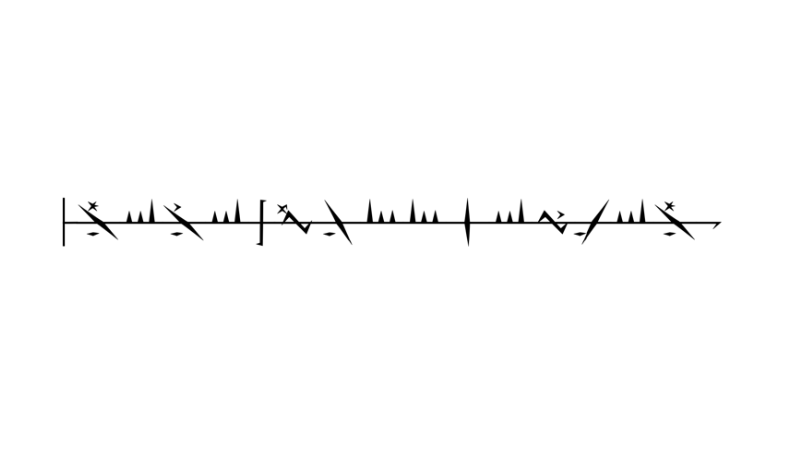
© Wizards of the Coast
Translation: “All Will Be One” — Elesh Norn
Born in Taiwan, Yu-Tung Cheng is currently a PhD candidate in Composition and Theory at Brandeis University, studying with Eric Chasalow, Yu-Hui Chang, and David Rakowski. She holds degrees in Composition from Boston University (MM) and Taipei University of Arts (BA), where she studied with Joshua Fineberg, Ming-Hsiu Yen, and Tsung-Hsien Yang.
Yu-Tung's music has been performed in Taiwan, China (Musicacoustica-Beijing), France (CNSMDL), and the United States (Tak Ensemble, Lydian String Quartet, Splinter Reeds, Ekmeles, Hub New Music, Hypercube, Loadbang, and Yarn/Wire). She enjoys creating music and sound that challenges the audience's auditory senses, bringing discomfort to their experience as social commentary. She’s also a veteran sniper in Call of Duty and Battlefield V; and believes cinnamon is a culinary crime.
Proust Impression | Jingmian Gong
Proust Impression is a song set to selected text from Swann’s Way (Book I of In Search of Lost Time) by Marcel Proust, scored for soprano, flute, clarinet, trumpet, percussion, accordion, violin, and cello.
Jingmian Gong is a composer whose music has been performed by ensembles including Ensemble Dal Niente, the Lydian String Quartet, LAMNTH, Hub New Music, and Collage New Music. Her recent commissions include works for Collage New Music, the Lingnan Normal University Choir, as well as Boston-based new music performers and ensembles.
Jingmian serves on the faculty of Berklee College of Music and Walnut Hill School for the Arts. She previously studied composition at the Boston Conservatory at Berklee (BM) and Brandeis University (MFA), where she is currently completing her PhD in Music Composition and Theory.
Il y a bien des années de cela.
It was a very long time ago.
La possibilité de telles heures ne renaîtra jamais pour moi.
The possibility of such hours will never be reborn for me.
Mais depuis peu de temps, je recommence à très bien percevoir si je prête l’oreille.
But for a little while now, I have begun to hear again very clearly, if I take care to listen.
En réalité ils n’ont jamais cessé;
They have never really stopped;
et c’est seulement parce que la vie se tait maintenant davantage autour de moi que je les entends de nouveau,
and it is only because life is now becoming quieter around me that I can hear them again,
comme ces cloches de couvents que couvrent si bien les bruits de la ville pendant le jour qu’on les croirait arrêtées
like those convent bells covered so well by the clamor of the town during the day that one would think they had ceased altogether
mais qui se remettent à sonner dans le silence du soir.
but which begin sounding again in the silence of the evening.
Marcel Proust
Swann’s Way
Translated by Lydia Davis
Uh-oh! | Lin Ying-Ting
For actor, soprano and ensemble 2026
Program note:
This piece grew out of time spent playing with my 20-month-old daughter as she explores popping pipes and a squeaky toy. Because she is still learning to speak, much of what she says emerges as short, repetitive utterances— “uh-oh,” “no-no,” “oh yeah”—small vocal gestures that already carry meaning before they become fully formed sentences. In these moments, language appears not yet as a stable system, but as sound, impulse, repetition, and play.
As the adult in the room, I often catch myself trying to guide her toward the “right” way to use an object, as though its function were self-evident. But what determines what is “right”? If someone encountered a mug for the first time, would they naturally know to hold its handle? And if there were no handle, how would its use be understood? Such questions led me to think not only about how objects acquire meaning, but also about how systems of use, behavior, and understanding are quietly taught and absorbed.
The piece unfolds in three sections, tracing a path from play to instruction to clockwork. What begins as open, curious exploration gradually becomes shaped, organized, and disciplined, until the toys are absorbed into the ensemble and transformed into part of its instrumental logic. Through this process, the work reflects on the fragile boundary between discovery and control, and on how sound, gesture, and play are gradually drawn into systems of order.
Bio:
Lin Ying-Ting is a Taiwanese composer and pianist whose work explores timbre as a site of physical presence, perception, and expressive transformation across acoustic, electronic, and hybrid media. Informed by a wide range of conceptual perspectives, including sociology, aesthetics, and embodied listening, her music often grows from close observation and unfolds through vivid sonic gestures. Her work invites deep listening and heightened attention to sound as both material and action.
Her music has been presented at festivals and institutions across Asia, Europe, and the United States, including SEAMUS, the Thailand New Music and Arts Symposium, ilSUONO Contemporary Music Week, MISE-EN_PLACE Bushwick, the World Saxophone Congress, ICMC, Darmstadt, the World Harp Congress, NYCEMF, Fontainebleau Schools, June in Buffalo, the Taipei International New Music Festival, and New Music Week at the Shanghai Conservatory. She has received honors including the Thailand New Music and Arts Symposium Commission Award, the IAWM Pauline Oliveros Prize, the National Symphony Orchestra of Taiwan Composition Prize, the Taiwan Ministry of Education Arts Award, and First Prize in the Chai Found Chinese Musical Instruments Composition Competition.
Lin earned her PhD in Music Composition and Theory from Brandeis University in 2025.
“Wonderful Journey” | Ruide Gao
“Wonderful Journey” is a series of transcriptions of Ruide’s musical improvisation. The piece directly reflects Ruide’s feeling at the moment whenever he is writing. Ruide imagines as if he was one of the instrumentalists in the ensemble and was playing in an improvisatory setting. Then, he writes all of the ideas down as quickly as possible. Ruide repeats this process for every instrument in the ensemble and only writes down whenever he hears something. He holds tremendous gratitude towards the Brandeis Improv Collective, The Lock Pickers, and Jam Club, where he learned so much about the art of improvisation.
I am in the music world,
taking the journey to look for beautiful sceneries.
I start to play the violin,
and I see starry skies and blue seas.
I start to play the clarinet,
and I smell earthy grass and fragrant flowers.
Sometimes, I walk alone.
Sometimes, I am guided by Davy.
Sometimes, I am guided by my friends.
It is a never-ending journey.
It is a wonderful journey.
Ruide Gao is a Master’s student at Brandeis studying music composition. He holds an undergraduate degree in music from Brandeis too! His composition has been performed by the Lydian String Quarter and the Hinge Quartet. Ruide started making music when he was little. His music journey began on the piano and continued on the computer. He has produced many electronic music during his early periods!
Ruide enjoys all genres of music and has taken many music classes at Brandeis! He has studied with Margo McGowan, David Rakowski, Danny Gerth, Mariel Mayz, Taylor Ackley, Mark Berger, Jingmian Gong, Phil Sargent, Michael Heller, Robert Nieske, Tom Hall, Clara Lyon, Bradford Garvey, Thomas Souza, Yu-Hui Chang, and Erin Gee. He is currently taking a composition seminar with David Rakowski, a class on writing songs for musicals with Neal Hampton, and a class on jazz improvisation with Robert Nieske.
Ruide plays a bunch of instruments and participates in many many music groups here at Brandeis: Jazz Ensemble, Improv Collective, MAD Band, Top Score, Jam Club, The Lock Pickers, Klezmer Band, Super Brass, Homeless Jazz Combo, Brandeis Fiddle Club, and Teto & Friends! Ruide also conducts in the pit band for Alice by Heart. Ruide meditates whenever he can.
Les Ponts | Dylan Needleman
“Les Ponts” (The Bridges) by Arthur Rimbaud is a prose poem from the unfinished collection Les Illuminations (Illuminations), written from 1873 to 1875, and published in 1886, years after Rimbaud stopped publishing works. Les Ponts sets the titular poem to a backdrop of two chords. The poem itself describes many features of the titular bridges and surrounded cityscape, which are represented abstractly through the music. Like how the poem briefly shows a bizarre scene, Les Ponts is short and dense. Dissonant, and, like the poem, resolved, but uncertain.
Dylan Needleman is a composer, producer, and programmer originally from Northern New Jersey. He is currently working towards a Master of Fine Arts in Music Composition and Theory from Brandeis University, and has a Bachelor of Arts in Computer Science from Vassar College with minors in Music Composition and Applied Mathematics. As a composer and producer, he creates music from many different genres, combining a large variety of influences, including Hardcore Punk, Minimalism, and Harsh Noise. He has had pieces performed by the Hinge Quartet, the LAMNTH duo, the TALEA Ensemble, and many others.
“Les Ponts” by Arthur Rimbaud
Translation by Dylan Needleman
Des ciels gris de cristal.
Gray crystal skies.
Un bizarre dessin de ponts, ceux-ci droits, ceux-là bombés,
A strange pattern of bridges, some straight, some arched,
d’autres descendant ou obliquant en angles sur les premiers,
others descending or sloping at angles to the ground,
et ces figures se renouvelant dans les autres circuits éclairés du canal,
and these shapes repeating in the other illuminated circuits of the canal,
mais tous tellement longs et légers que les rives,
but all so long and delicate that the banks,
chargées de dômes s’abaissent et s’amoindrissent.
loaded with domes, sink and shrink.
Quelques-uns de ces ponts sont encore chargés de masures.
Some of these bridges are still covered with hovels.
D’autres soutiennent des mâts, des signaux, de frêles parapets.
Others support masts, signs, frail parapets.
Des accords mineurs se croisent, et filent, des cordes montent des berges.
Minor chords clash and fly, ropes rise from the shore.
On distingue une veste rouge,
A red jacket can be seen,
peut-être d’autres costumes et des instruments de musique.
maybe other costumes and musical instruments.
Sont-ce des airs populaires, des bouts de concerts seigneuriaux,
Are they popular tunes, bits of lordly concerts,
des restants d’hymnes publics?
remnants of public anthems?
L’eau est grise et bleue, large comme un bras de mer.
The water is gray and blue, wide as an inlet.
—
Un rayon blanc, tombant du haut du ciel, anéantit cette com
Children’s Play III (儿戏,叁) Open Score Canon & Aleatoric Musical Game | | Peter Zhaoyang Han
Children’s Play (Chinese: 儿戏) is a series of pieces for various ensembles that depicts children’s games and toys that were common and enjoyed by kids during my childhood in the city of Tianjin. This series is a portrait of my childhood experience, with family, friends, and schoolmates, and serves to preserve the memory of the naive and carefree times that are never returning.
This concluding piece of the Children’s Play series explores the boundary between an actual game and concert music. By incorporating the interactive feature of the children’s plays, this piece makes the music almost theatrical, with uncertainties.
The first movement, being a canon, hides the Children’s Play Theme in the long canonical subject. Once figuring out when the following voice enters and having all six voices present, the tone row will be revealed, just like a jigsaw puzzle, or any other styles of puzzle. Puzzles are a big category of toys that I enjoyed myself when I was little. These mind bending games gave me a lot of inspiration for creation even when I was little.
The concluding movement portraits a tag game that I enjoyed a lot with my childhood friends; we call it San Ge Zi, which means 3-characters (Chinese characters/words). If almost being tagged, we can save ourselves by shouting any 3-word phrase to freeze, until someone free comes to unfreeze us. This version tweaks the rules by evolving musical gestures and their retrograde or inversion, making it an interactive musical game that, hopefully, can be enjoyed by musicians of any level.
These literal portraits of these children’s plays draw a conclusion to my journey with you all to my childhood. I hope this series of work can bring you back to your carefree time and the childlike feelings and innocence.
Peter Zhaoyang Han (b. Tianjin, China) is a composer, conductor, and vocalist whose music bridges the Western classical tradition and Chinese traditional performance arts. Born and raised in Tianjin—a city known for its vibrant and humorous spirit—and later moving to Diamond Bar, California, Peter’s work is infused with imagination, playfulness, and a deep reverence for both historical and contemporary sound. Now based in Boston, he continues to shape a distinctive musical voice that honors his cultural heritage while embracing innovation.
Peter holds a Bachelor of Music in Composition from the Boston Conservatory at Berklee, where he studied composition with Timothy McCormack and conducting with Larry Isaacson. He also pursued piano studies with Carlos Vargas and voice with graduate colleagues. While at BoCo, he was a frequent performer in ensembles such as Pierre Hurel’s Improvised Music Ensemble and the Conservatory Chorale. During his studies, he was often selected to write for large ensembles as well as various guest ensembles, including the Hinge Quartet, and he was also commissioned by the Hemenway Strings led by violinist Lynn Chang. His works were also selected to be performed by local high school ensembles.
Beyond composing, Peter is a passionate advocate for early music and museum practice, and has performed solo Mozart on the clavichord. He volunteers aboard the historic USS Salem and is currently exploring careers in recording engineering and brass instrument retail. Being a collector and player of Chinese traditional instruments, including those used in Peking Opera, Peter is spreading their sound to the American local communities and exploring the potential of their distinctive colors in his compositions.
About THE ENSEMBLE TÉLÉMAǪUE
THE ENSEMBLE TÉLÉMAǪUE / Raoul Lay, artistic director
Since its birth in 1994 in Marseille, the Ensemble Télémaque is dedicated to the creation and broadcasting of New Music. George Bœuf and Régis Campo, composers from the south, but also Thierry Machuel, Yann Robin, Tatiana Catanzaro, Hui-hui Chen, Bernard Cavanna and Ivan Fedele receive commissions from the ensemble that claims the greatest aesthetic openness. In the 2000s, under the impetus of Raoul Lay, the music company Télémaque works with the performing arts: Olivier Py, Bernard Kudlak from Cirque Plume, Catherine Marnas or Nathalie Pernette collaborate with Télémaque to the service of the music of Mauricio Kagel, Steve Reich or Raoul Lay himself. The ensemble regularly performs on the most innovative music stages in France and abroad: Festival Présences of Radio-France, Phil- harmonic Hall of Paris, National Auditorium of Madrid, Gaudeamus Music Week of Amsterdam, Enescu Festival in Bucharest, Salle Flagey in Brussels, Venice Biennale, CKK of Buenos Aires, Shanghai new music festival...
Télémaque brings New Music to all territories, including communities far from the cultural offer. The ensemble stands out in the direction of young audience, integrating children singers and/ or percussionists during creations: Nokto, La mort Marraine, La revue de Cuisine, La jeune fille aux mains d’argent, Nous d'ici-bas, King Kong...
In 2011, leader of the ECO (European Contemporary Orchestra, 33 musicians) project, the ensemble was awarded a European Community grant for the Culture 2000 programme. In 2013, Télémaque created the Pôle Instrumental Contemporain (PIC), a rehearsal and concert venue for emerging companies, which was awarded “Atelier de Fab- rique artistique”, named by the French Ministry of Culture in 201C.With its new pieces or new productions (“The Soldier’s Tale”, “The New Adventures of Pat and Mat”, “The Baron of M.” and “Carmen removed operza), Telemaque is associated with national multi- disciplinary operators: The Theatres of Marseille and Aix-en-Pce, the Operas of Toulon, Bordeaux, Limoges, Massy and Marseille, the Massalia Theatre, the GMEM, the International Circus Arts Biennial, the Centaur Theatre, the Alhambra Cinema, the National Stages of Saint-Ǫuentin-en-Yvelines, Martigues, Toulon-Châteauvallon, Gap, les Détours de Babel (Grenoble), the Arsenal de Metz...Since 2018, Télémaque and Raoul Lay have been hosting “October Lab”, a contemporary festival and international music creation platform (China, Canada, Wales, United States of America...)
Over the past ten years, Telemaque has played in 15 countries.
In 2024, Télémaque created the chamber version of «The little Mermaid» by Régis Campo, awarded “national French victory of music” in 2025.
Henri Lazarof Living Legacy
Starting in 2022, the Henri Lazarof New Music Brandeis Annual Concert will fund the residency of prominent new music performers to work with graduate student composers, giving these young composers the opportunity to have their works performed by outstanding musicians.
New Music Brandeis (NMB) is programmed and managed by current Brandeis graduate student composers and features professional concerts of student works. It falls under the larger initiative, Brand New Music, which is a contemporary music concert and residency series that showcases the work of Brandeis student, faculty, and alumni composers, including current Brandeis composition faculty members Yu-Hui Chang, Eric Chasalow, Erin Gee and David Rakowski.

Henri Lazarof New Music Brandeis Concert & The Leonard Bernstein Festival of the Arts
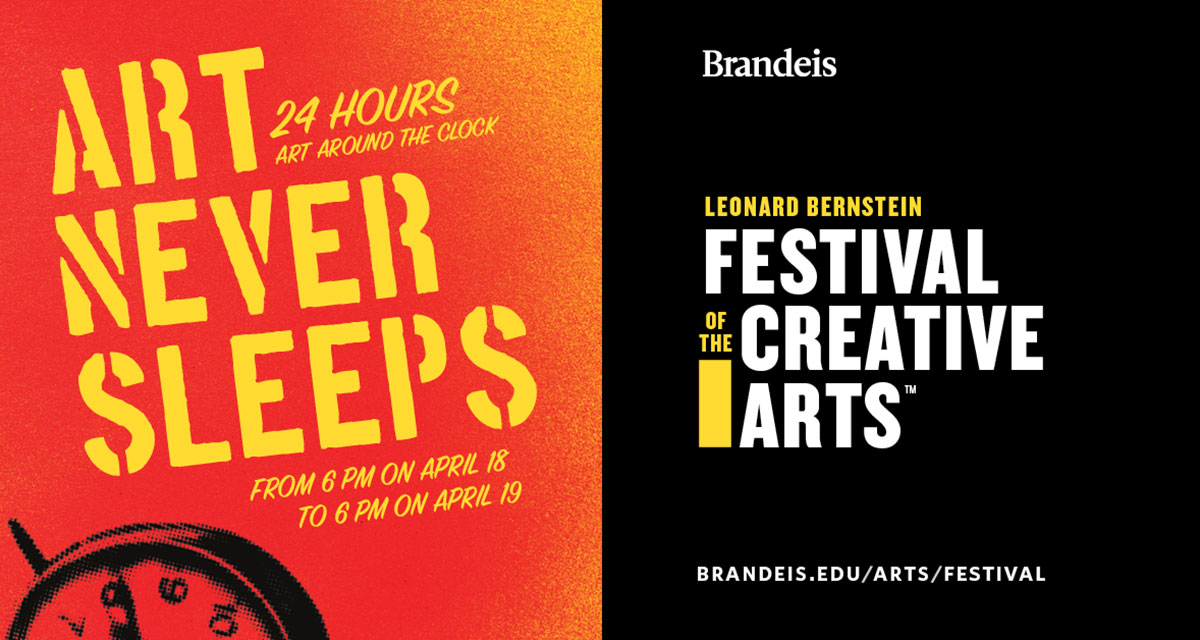
This year's Henri Lazarof New Music Brandeis Concert is a vital part of our 2026 Leonard Bernstein Festival of the Arts: "ART NEVER SLEEPS"
In 1952, Leonard Bernstein founded the first Festival of the Creative Arts at Brandeis University with a revolutionary idea: that art should be a living, breathing entity, accessible to everyone. He believed in Artful Learning: the idea that education is most powerful when the arts are integrated into every discipline.
Today, we carry that torch forward with our 2026 theme, Art Never Sleeps. By breaking down the barriers between artistic forms, we celebrate the relentless creativity of our students and acknowledge that even in the darkest and quietest moments, art is always with us.
In a world defined by constant change, the festival remains a testament to Bernstein’s enduring belief that art is both a necessity and a constant. We invite you to stay awake with us, explore new disciplines, and celebrate the creative expression that defines Brandeis.
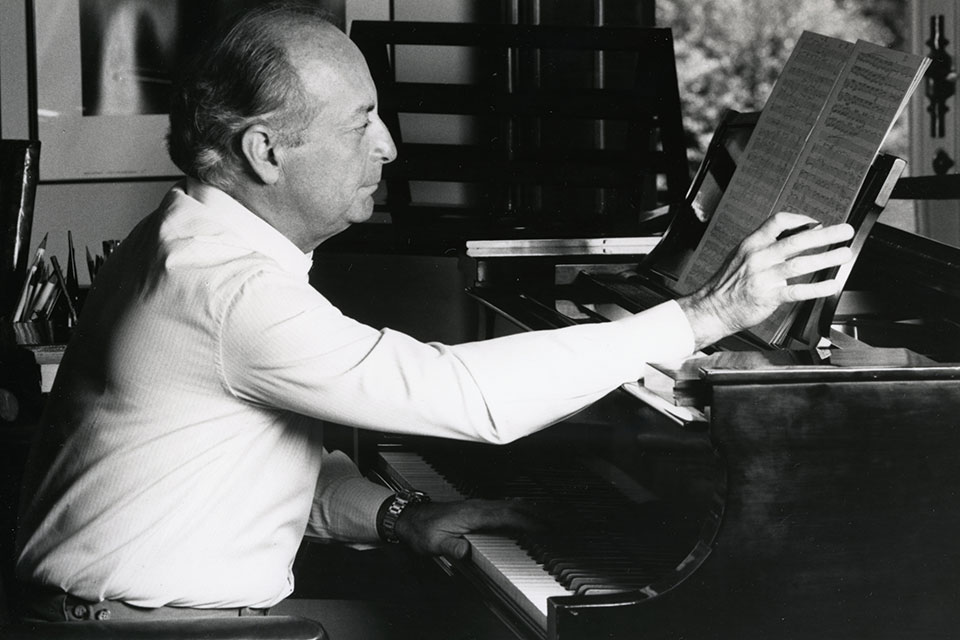
Henri Lazarof: A Life in Music
This new digital exhibit celebrates Lazarof's illustrious career as represented in the Henri Lazarof Archives at Brandeis University.
Visit the digital exhibit