Brandeis Wind Ensemble: Spring 2026
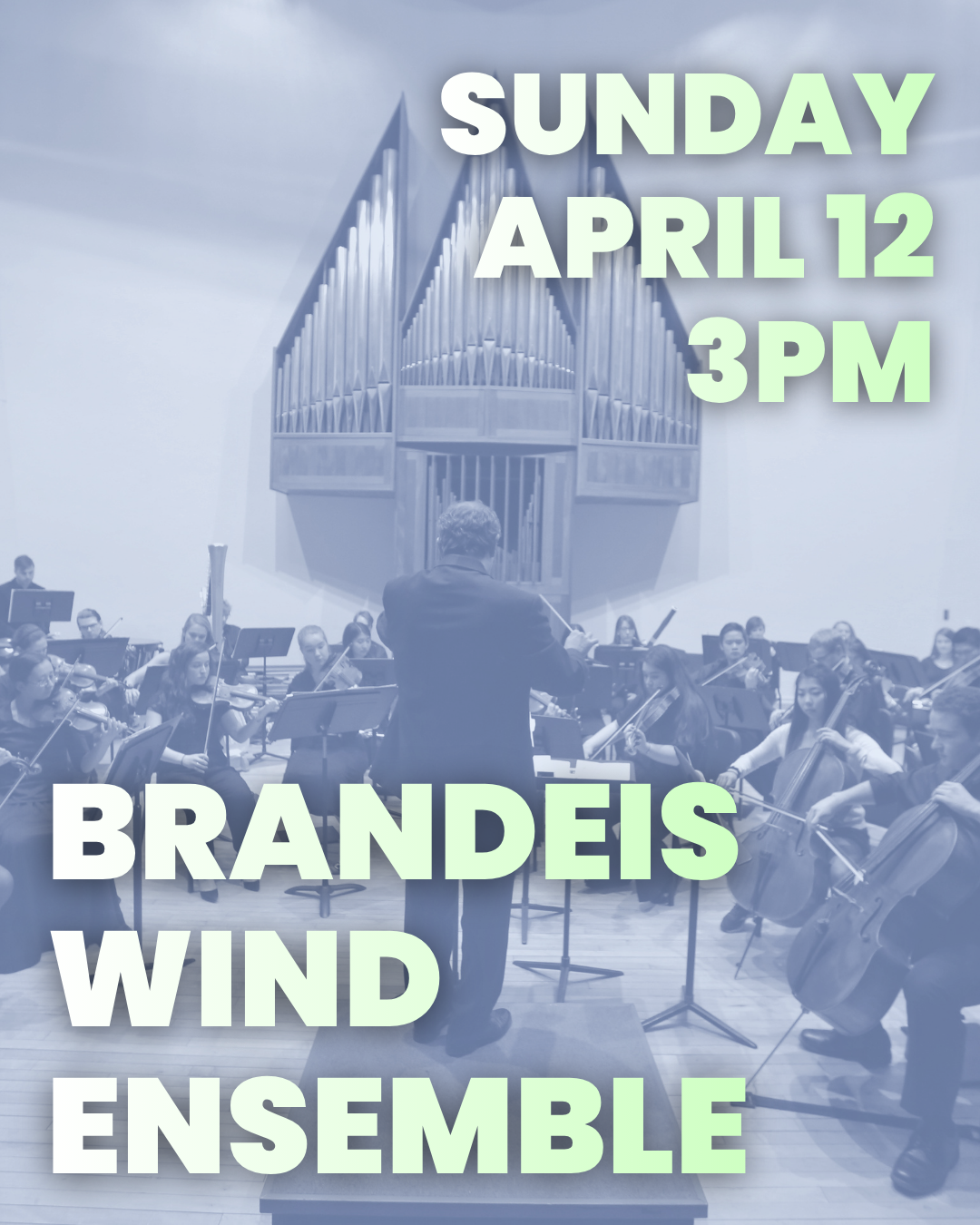
April 12, 2026 | Slosberg Music Center
Program & Notes
Brandeis Wind Ensemble Personnel
Flutes
Jennifer Hunt (piccolo)
Amelia Lysakowski
Jahnvi Mundra
Nicole O’Toole (piccolo)
Oboes
Mollie Penn
Larry Tunick (English Horn)
Bassoon
Zakk Piper
Clarinets
Kimberly LaPointe
Brian Lucy
Daphne Pissios
Bass Clarinet
Oren Weinstein
Alto Saxophones
Lily Fasciano
Yana Stoilova
Tenor Saxophone
Andy Wilds
Trumpets
Ken Arsenault
Alex Arnott
Vytas Navickas
French Horns
Nadeem Bakr
Tabitha Greenlees
Ryan Ramey
Trombones
Samuel Liu
Esther Horwich
Bob Piankian
Euphonium
Cole MacEwen
Tuba
Michael Aloisi
Percussion
Kevin Burke
Cesar Garde
Johnathan Jena
Emerson Rever
Harp
Autumn Ramey
Sundance ... Frank Ticheli
Sun Dance by Frank Ticheli, composed in 1997, presents a bright and powerful musical
work which uses energetic rhythms to create vivid musical pictures. The piece was
commissioned by Austin Independent School District and the All-City Honor Band Festival to
celebrate its 25th anniversary.
In his own program note, Ticheli explains that he began with the abstract goal of
conveying “bright joy,” a mood that blossomed into the more specific image of a sun-drenched small-town festival where townspeople gather, stroll, and dance to music under a warm sky.
The composition centers on the dual nature of musical elements which combine singing
with dancing. The oboe presents a soft melodic theme which serves as the main musical idea but the composition achieves its lively movement through its syncopated rhythmic elements which also generate both musical lines and background support.
Pease, A. (2016, March 24). Sun dance by frank ticheli. Wind Band Literature.
https://windliterature.org/2016/03/24/sun-dance-by-frank-ticheli/
Sun Dance. (2022). Wind Repertory Project. https://www.windrep.org/Sun_Dance
Ticheli, F. (1997). Sun Dance [Wind ensemble score]. Manhattan Beach Music.
Frank Ticheli holds the position of Professor of Composition at the University of
Southern California’s Thornton School of Music since 1991. He has also served as Composer in Residence of the Pacific Symphony from 1991 to 1998 and continues to work with the orchestra and music director Carl St. Clair. Many of his compositions have been performed by ensembles around the country and abroad at such prestigious venues as Carnegie Hall. Recently, his music was performed at the Mid-Europe Music Festival in Schladming, Austria, in London and Manchester, England by the Meadows Wind Ensemble from the Moores School of Music at the University of Houston, and at multiple locations in Singapore by the Singapore Armed Forces Central Band. Every year he also travels to multiple cities in Japan with the Bands of America
National Honor Band.
Frank Ticheli. (n.d.). Wind Repertory Project. https://www.windrep.org/Frank_Ticheli
Norman Rockwell Suite ... Hayato Hirose
The "Norman Rockwell Suite" was composed based on three representative paintings by the famous American painter Norman Rockwell (1894–1978).
Rockwell, widely known as the cover illustrator for the popular magazine "The Saturday Evening Post," left behind many humorous and heartwarming works depicting the daily lives of ordinary Americans in the early 20th century, and his works have been enjoyed by many people around the world. Commissioned by the Boston-based Metropolitan Wind Symphony Orchestra, this piece was composed in 2005, using Rockwell, who had ties to the city, as its subject. It was premiered by the orchestra in the same year.
[Movement 1] The Marriage Certificate (1955)
This movement depicts a newlywed couple signing their marriage certificate at the town hall. Set to a 6/8 waltz, the fresh scene of them signing with anticipation is portrayed with music full of hope and joy.
[Movement 2] Shuffleton's Barbershop (1950)
This movement depicts middle-aged music lovers playing instruments in a small barbershop in town after closing time. The heartwarming music portrays the scene of musical friends gathering at the end of a workday to enjoy a little fun.
[Movement 3] Christmas Homecoming (1948)
This movement depicts Rockwell's eldest son returning home for Christmas and being warmly welcomed by his family and relatives. On the train, the son's heart is filled with excitement as he approaches his hometown, while his family is busy preparing to welcome him, looking forward to the moment of reunion. The two finally reunite at the end, bringing the song to a joyous conclusion.
-
Notes by Hayato Hirose
Hayato Hirose (b. 1974) is a Japanese composer and conductor. He completed his master's degree in composition and wind band conducting at Lemmens Institute (Belgium), bachelor's degree in composition at Boston Conservatory, and his professional study at the Tokyo Music & Mediaarts Shobi. He studied composition with Jan Van der Roost, Piet Swerts, Andy Vores, and Yoriaki Matsudaira.
Many of his works have been published by major publishers in Europe, the U.S., and Japan, and he has received numerous honors and awards. He is also an active conductor with much professional experience in band, choir, and orchestra conducting. Currently he is on the faculty at Shobi Music College in Tokyo.
Hayato Hirose. (2022). Wind Repertory Project.
https://www.windrep.org/Hayato_Hirose
Havendance … David Holsinger
David Holsinger's first child, his daughter Haven, was the inspiration for this 1983 composition. Its driving rhythms represent the energy of an eight-year-old, who was constantly dancing and twirling around the house, dreaming of being a ballerina. The composition undergoes several variations in style, but it is always filled with energy. Some passages evoke the image of a single dancer, with solo pirouettes and leaps; these light efforts grow to draw in the full dance company with an unrelenting, underlying rhythm. Havendance is the first of three dancesongs honoring the composer's children; Nilesdance and Graysondance reflect the diverse personalities of his two sons.
-
Program notes by David Bruce Adams
David R. Holsinger, composer, conductor, arranger, and educator, was born December 26, 1945, in Hardin, Missouri. He received the B.M. and M.M. degrees in composition from Central Methodist College and Central Missouri State University. His composition studies were with noted wind band composers Donald Bohlen and Charles Hoag. Prior to coming to the CDT in 1999, Holsinger was a full-time music minister for 15 years and composer-in-residence in Texas.
His more than 120 works for wind band have won numerous performances, including two ABA Ostwald Composition Prizes. Other honors include the Orpheus Award given by the Eastman School of Music and the award of the degree of Doctor of Humane Letters, Hon. Causa, from Gustavus Adolphus College. He has held composer-in-residence positions at several schools and universities, and his works have received special recognition in national competitions. More than 400 guests recently attended a gala to celebrate the life and work of the celebrated musician and renowned educator. The event, which served as a showcase of the school’s premier musical ensembles, was hosted by Lee University on Saturday, April 22.
David Holsinger. (n.d.). Wind Repertory Project.
https://www.windrep.org/David_Holsinger
America The Beautiful … Samuel Augustus Ward (arr. Carmen Dragon)
In a brief essay written about 1925, Katharine Lee Bates reminisced about her summer of 1893 and her trip to the top of Pikes Peak, where she wrote “America the Beautiful,” one of the most popular of all American patriotic songs. On vacation in Colorado Springs, where she was working as a teacher at Colorado Springs High School for the summer, her colleagues from another school in town invited her to drive up to the summit in a wagon. From the stunning vistas at the top, she wrote the poem on the way down. Published in The Congregationalist in September 1895, it was later set to music and combined with the already well-known tune “Materna,” written by Samuel A. Ward in 1910. “These qualities of idealism and sense of human brotherhood which characterize the American people accounted for the immense popularity of her song,” she wrote:
AMERICA THE BEAUTIFUL
O beautiful for spacious skies,
For amber waves of grain,
For purple mountain majesties
Above the fruited plain!
America! America!
God shed His grace on thee
And crown thy good with brotherhood
From sea to shining sea!
O beautiful for pilgrim feet,
Whose stern, impassioned stress
A thoroughfare for freedom beat
Across the wilderness!
America! America!
God mend thine every flaw,
Confirm thy soul in self-control,
Thy liberty in law!
O beautiful for heroes proved
In liberating strife,
Who more than self their country loved,
And mercy more than life!
America! America!
May God thy gold refine
Till all success be nobleness,
And every gain divine!
O beautiful for patriot dream
That sees beyond the years
Thine alabaster cities gleam
Undimmed by human tears!
America! America!
God shed His grace on thee,
And crown thy good with brotherhood
From sea to shining sea!
“America the Beautiful,” 1893 | Gilder Lehrman Institute of American History. (n.d.).
https://www.gilderlehrman.org/history-resources/spotlight-primary-source/america-beautiful-1893
Samuel Augustus Ward (28 December 1847, Newark, N.J. – 28 September 1903, Newark) was an American organist and composer. Ward studied music in New York and became an organist at Grace Episcopal Church in Newark in 1880. He is remembered for his hymn Materna (1882), which was used for the anthem America the Beautiful, with words by Katharine Lee Bates. However, Ward never met Bates. He died in 1903 in Newark and was buried in Mount Pleasant Cemetery. Ward was inducted into the Songwriters Hall of Fame in 1970.
Samuel Augustus Ward. (2022). Wind Repertory Project.
https://www.windrep.org/Samuel_Augustus_Ward
The Stars and Stripes Forever March … John Philip Sousa
Except for "The Star-Spangled Banner," The Stars and Stripes Forever is perhaps the most powerful symbol of American patriotism. This great march by John Philip Sousa was written in 1897 and immediately became the hit of the season. The march was performed by Sousa's band at almost every engagement, frequently as an encore. The composer received "divine inspiration" for The Stars and Stripes Forever while returning to this country from a tour abroad in 1896. According to Sousa, the trio section of the march symbolized the three sections of the country at that time: the North, the South, and the West. The Stars and Stripes Forever is performed, recorded, and recognized all over the world today and is regarded by many as the greatest march ever written.
When John Philip Sousa accepted the challenge of becoming the 17th leader of the "Old Corps" United States Marine Band in 1880, he brought to the esteemed Corps the energy, dedication, and creativity that he poured into the music of the band. The native Washingtonian entered the Corps as a young boy under the baton of John Jackson and joined the famous group as a flutist in 1872. Known affectionately as "The March King" for his contributions to the American band repertoire, many of Sousa's compositions, including Semper Fidelis, The Washington Post, and Pershing's March, remain fixtures of band performances around the world. Through his strict and innovative rehearsals and his energetic promotion of the music of others, as well as his own original works, Sousa created a new national image of "The President's Own" band. Resigning from the Corps in 1892 to create a band of his own, Sousa became one of the world's greatest bandmasters and embarked upon a successful musical career that spanned nearly 40 years, culminating in his passing in 1932. The National Memorial bearing his name stands west of the Lincoln Memorial on the National Mall, housing the same Corps Sousa so lovingly directed. Both the Marine Corps Band and the institutions bearing his name are committed to supporting and honoring young people through the creation, performance, and study of band music.
Bierley, P. (1984). The Stars and Stripes Forever March. Www.marineband.marines.mil.
https://www.marineband.marines.mil/Audio-Resources/The-Complete-Marches-of-John-Philip-Sousa/The-Stars-and-Stripes-Forever-March/
About the Conductor
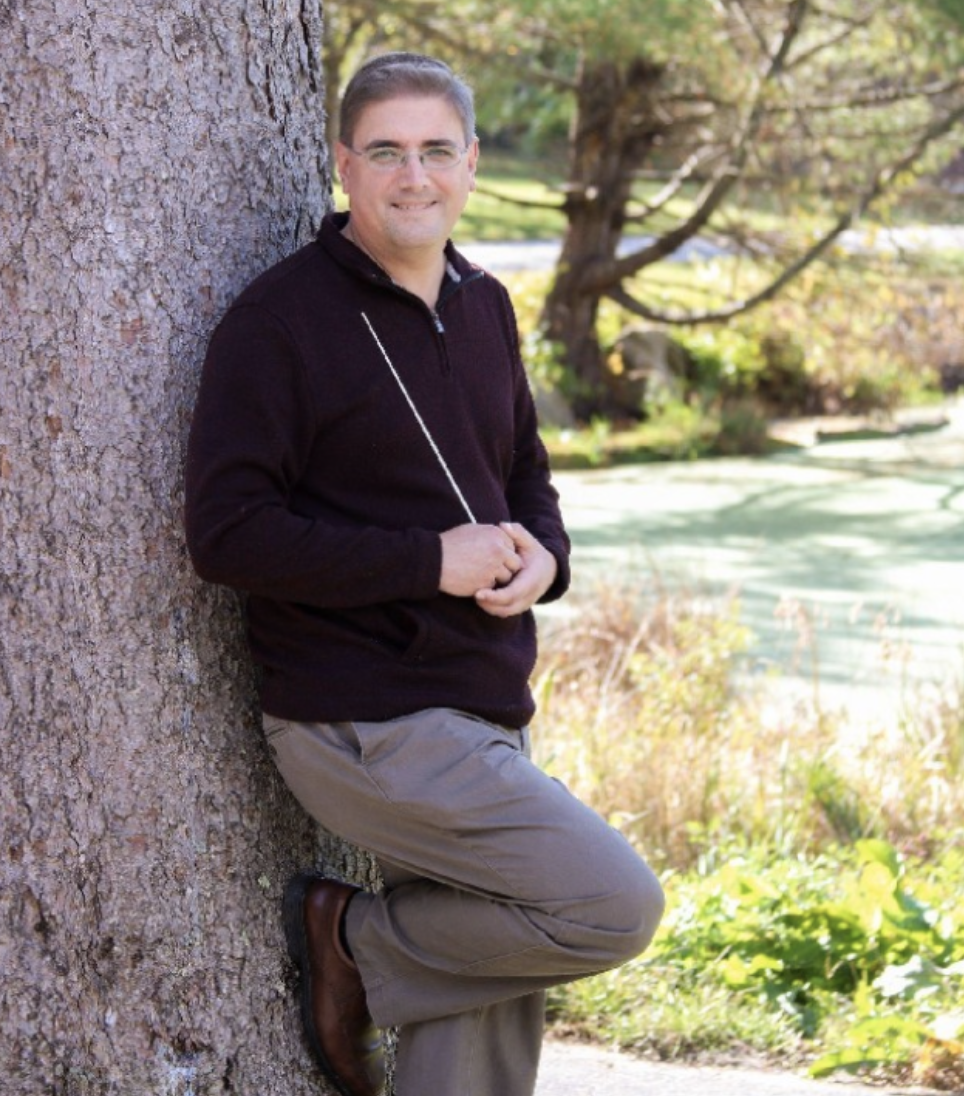 Thomas A. Souza, a native of Taunton, Massachusetts, grew up immersed in music, often attending concerts by the Taunton City Band where his father played clarinet, singing in the choir with his mother, or listening to his grandfather play the organ upstairs. He currently serves as the Band Director at North Middlesex Regional High School in Townsend, Massachusetts. Previously, Mr. Souza spent eighteen years as the band director at Fairgrounds Middle School in Nashua, New Hampshire, where he also held the role of K-12 Music Coordinator. Since 2005, he has been the conductor and director of the Brandeis University Wind Ensemble. During the summer, Mr. Souza conducts the Townsend Military Band and teaches at the Mary Jo Leahey Symphonic Band Camp at the University of Massachusetts Lowell.
Mr. Souza earned both his bachelor’s degree in Music
Education and Music Performance, and his master’s degree in Conducting from the University of Massachusetts Lowell. He is currently pursuing a doctorate in Music Education at William Carey University. His dedication to music education
has been recognized with several honors, including the Ron Kraus Outside the Profession Award from the Nashua Education Foundation, Teacher of the Year by Symphony New Hampshire, and recognition by SBO Magazine as one of the 50 top educators in the United States, representing New Hampshire. Mr. Souza is also active as a guest conductor and adjudicator throughout New England.
Brandeis Concert Series
Slosberg Music Center
415 South Street
Waltham, MA 02453
781-736-3331
slosberg@brandeis.edu