Sportswashing or Statecraft? The Politics of Football in the Arab World
Ibrahim Elhoudaiby
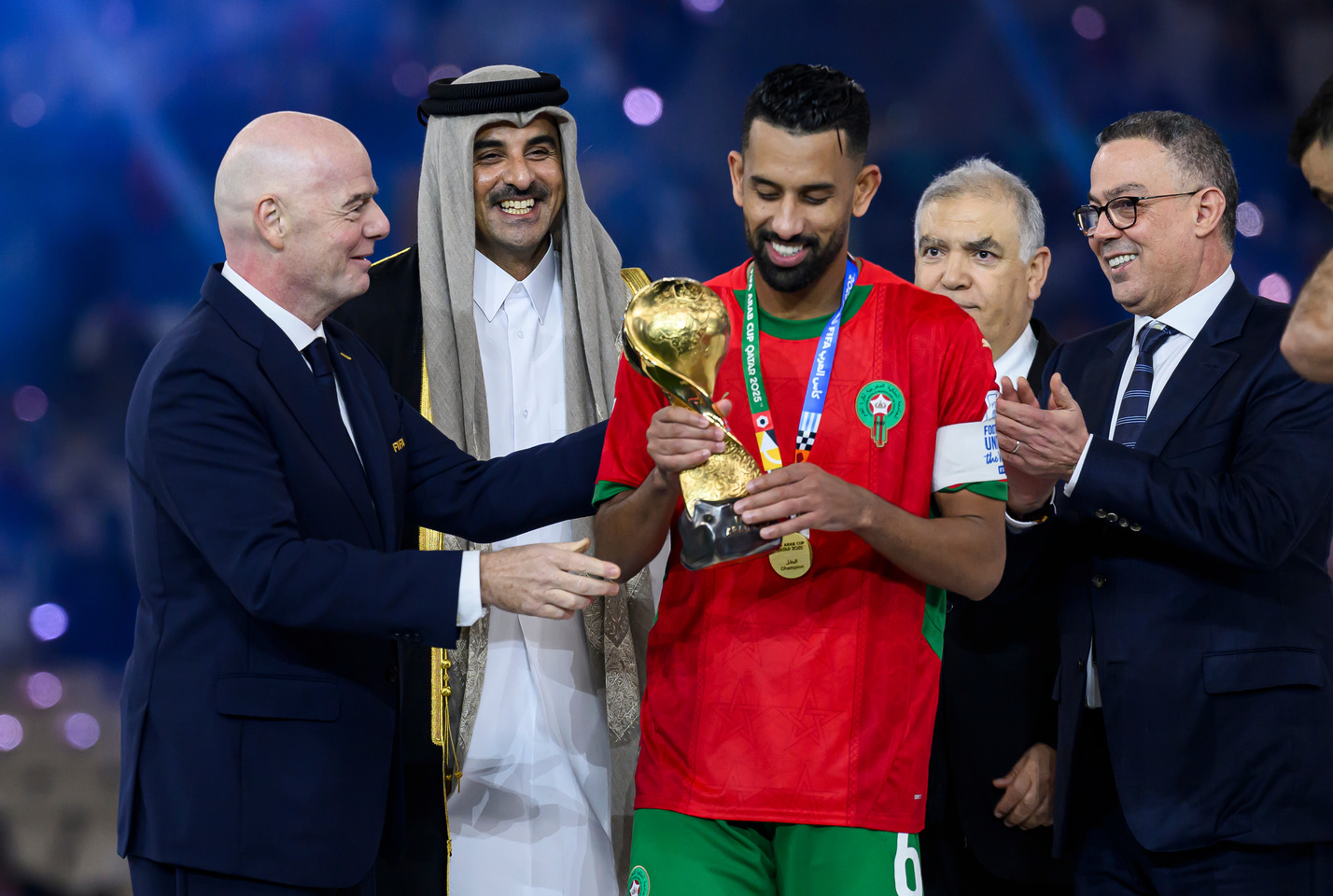
FIFA president Gianni Infantino and Emir of Qatar Sheikh Tamim bin Hamad Al-Thani hand the FIFA Arab Cup 2025 trophy to Mohamed Hrimat of Morocco. (Photo by Noushad Thekkayil/NurPhoto via AP)
Middle East Brief No. 169 | June 2026
When five-time Ballon d’Or winner Cristiano Ronaldo joined Saudi Pro League club Al-Nassr in January 2023, the transfer was widely dismissed as a publicity stunt: a financially lucrative late-career move to a league long peripheral to the global game. But he was soon followed by dozens of global stars departing Europe’s elite leagues for Saudi Arabia, making his arrival appear less exceptional and more indicative of a larger shift. The Arab world was moving decisively toward the center of global football.
Ronaldo’s move was part of a broader trend of growing Arab investment in the game: Europe’s top five leagues have seen a significant influx of Arab capital. Today, roughly half of the world’s ten most valuable clubs benefit from Gulf investment, whether through ownership stakes or major sponsorship deals.[1] At the same time, the geographical center of football’s premier event—the FIFA World Cup—is increasingly shifting toward the region. Although the United States will co-host the 2026 tournament with Mexico and Canada, this appears to be an exception. Every other edition between 2022 and 2034 has been or will be hosted or co-hosted by an Arab state: Qatar hosted in 2022 as the first Arab nation to do so; Morocco will co-host in 2030 with Spain and Portugal; and Saudi Arabia is set to host in 2034.
Sports and political analysts often interpret this surge in Arab investment in football as a form of “sportswashing”: an attempt by oil-rich monarchies to launder their international reputations by hosting mega sports events. The logic behind this interpretation is straightforward: The scale of expenditure on football-related projects far exceeds any plausible financial return. Qatar, for example, spent an estimated $220 billion on infrastructure, stadiums, and accommodations in the decade preceding the 2022 World Cup—nearly fifteen times what Russia spent on the 2018 tournament.[2] This figure dwarfs the tournament’s revenues. If no economic rationale can justify such outlays, the argument goes, the motivations must be political—and foremost among them is the effort to launder these regimes’ international reputations.
But explaining the rise of Arab football on the global stage primarily through the lens of sportswashing obscures the more consequential political functions that football performs across the region. Football is not simply an instrument of public diplomacy, but a mass social phenomenon with substantial political utility. It is also an industry—one that brings together players, clubs, stadiums, commercial actors, financial flows, competitions, fan cultures, media ecosystems, and broadcasting rights within a dense political economy.
This Brief examines the political significance of football in the Arab world by showing how it has become an instrument of statecraft rather than merely a vehicle for reputation management. Football industries across the region are deeply interconnected, though they serve distinct political functions that cannot be reduced to the catch-all notion of sportswashing. In Saudi Arabia, the industry contributes to the consolidation of power around a rising Crown Prince, reconfiguring authority away from older, more diffuse arrangements. In Qatar, it is closely integrated into national security strategy. In Morocco, football sits at the heart of the country’s development agenda, while in Egypt it catalyzes the production of a new political vision central to the post-revolutionary order. Taken together, these cases reveal football as a central arena through which Arab states reorganize power—with domestic populations, rather than international audiences, serving as the primary targets of football-related policies.
From Reputation to Rule: Football and Power Consolidation in MBS’s Saudi Arabia
The term “sportswashing” was coined in reference to Azerbaijan’s hosting of the European Games in 2015.[3] But its popularization coincided with, and was arguably catalyzed by, the scale of Saudi investment in football over the past decade—investments that have placed the Kingdom firmly at the center of the global game. Since 2015, the market value of the Saudis’ top domestic football league has increased nearly tenfold according to Transfermarkt, a widely used football industry database.[4] Over the same period, Saudi clubs have become increasingly competitive in continental and international competitions; the national team has qualified for three consecutive World Cups after failing to reach the previous two tournaments; and the Kingdom has hosted a growing number of major international football events. Taken together, these developments have transformed Saudi Arabia from “a footnote on the global soccer stage”[5] into one of its key hubs.
Critics often link these investments to the political rise of Crown Prince Mohammed bin Salman (MBS). His ascent to power was marked by a series of abrupt and coercive actions that subjected him to intense international scrutiny and criticism. He played a central role in launching the Saudi-led intervention in Yemen in 2015; orchestrated the removal of his cousin—then crown prince Mohammed bin Nayef—and secured his own elevation to the position in 2017; and allegedly ordered the assassination of journalist Jamal Khashoggi in the Saudi consulate in Istanbul in 2018. Against this backdrop, MBS incorporated football into Vision 2030, the flagship initiative he launched in 2016 to pivot the Kingdom away from oil dependency and foster a more dynamic society.[6] To critics, however, the project has also served as a public relations instrument aimed at rehabilitating the young prince’s international image. In this context, Saudi football investments readily lend themselves to interpretations of sportswashing.
But football, and Vision 2030 more broadly, is central to MBS’s project of consolidating power and restructuring Saudi Arabia’s political order. That order had long rested on three pillars: collective rule among the sons of King Abdul Aziz; an accommodation with the conservative religious establishment; and a rent-based social contract trading material benefits for political quiescence—all of which were already eroding as MBS rose to prominence. King Salman’s accession in 2015, following the deaths of key rival princes, concentrated unprecedented authority, even more so as the religious establishment had been partially weakened under the late King Abdullah, and the post-2014 collapse in oil prices had strained the fiscal foundations of distributive patronage. Vision 2030 both emerged from and accelerated this conjuncture of circumstances by articulating a legitimating countervision of the Kingdom—one that cast the present as deficient and in need of transformation. Its emphasis on a “vibrant society,” a “thriving economy,” and an “ambitious nation” justified curtailing clerical authority, sidelining merchant and royal elites under the banner of anti-corruption, and reducing redistribution in breach of the longstanding social contract, all in the name of a new nationalist project.
Dismantling the foundations of Saudi Arabia’s political order required more than institutional reforms or justifying narratives, however: It demanded the active mobilization of a social constituency capable of counterbalancing the Kingdom’s weakened yet still influential power centers. That constituency was the expanding youth population and Western-educated middle classes. Constituting nearly two-thirds of the population and shaped by the educational advances of the late King Abdullah—including mass overseas study—this constituency was widely understood to harbor aspirations for change that Vision 2030 both articulated and intensified through promises of opportunity, social freedom, and a “new social contract.”[7]
Football proved uniquely suited to channel these aspirations and harness them politically. Its popular support was already demonstrated when the national team’s failure to qualify for the 2014 World Cup provoked street protests—an exceedingly rare occurrence in the Kingdom—eventually forcing the resignation of the head of the Saudi Arabian Football Federation, Prince Nawwaf bin Faisal.[8] MBS capitalized on this potential by positioning himself—unlike his older rivals within the royal family or the religious establishment—as a credible patron of the game, using football to align himself with youthful popular culture.
Beyond moments of protest, football has contributed to the production of a new, more secular form of Saudi nationalism that challenges the long-standing dominance of the religious establishment over social life. As the Saudi scholar Madawi Al-Rasheed argues, Saudi nationalism has shifted from a religious and pan-Islamic orientation toward a narrower national identity under MBS—a rupture some see as unprecedented since the Kingdom’s founding.[9] Since its establishment, the Kingdom has drawn on a deep reservoir of pride from its status as the birthplace of Islam, a heritage that has remained central to its cultural self-definition. The religious establishment, as guardian of this tradition, has therefore played a significant role in public life. At the same time, football’s enduring popularity has made it especially useful for the production of a more secularized national pride, one not directly anchored in Islam or the authority of the religious establishment.
King Salman’s declaration of a public holiday following the national team’s victory over Argentina at the 2022 FIFA World Cup—an event that generated widespread and fervent celebration—is a case in point. Until recently, public holidays in the Kingdom were largely confined to Islamic observances. This changed in 2019, when a royal decree established “Foundation Day” as a national holiday, in an effort to cultivate a new form of nationalism and recast the narrative of the Kingdom’s origins in ways that decentered the religious establishment.[10] The subsequent declaration of a public holiday to celebrate a football victory built directly on this shift, expanding the space for secular, nationally oriented forms of collective celebration. In this way, football did not merely reflect these transformations but helped institutionalize them by giving public form to efforts both to limit the influence of the religious establishment over social life and to weaken its capacity to oppose reform.
This dynamic is especially visible in the Crown Prince’s vision of a “vibrant society,” which hinges on constructing an economy less exclusionary of women. For decades, the religious establishment imposed significant restrictions on Saudi women, including bans on driving and attending public sporting events, as well as severe constraints in the workplace linked to the male guardianship system and norms of gender segregation. The state’s decisions—to lift the driving ban in June 2018 and, a year later, to amend labor laws to allow adult women to work without a guardian’s approval—directly overrode this framework.
Crucially, however, these reforms were previewed not in the legal or economic sphere but in the domain of sports—an arena more readily aligned with international, secular norms. In 2017, women were permitted to enter football stadiums, marking a controlled but highly visible rupture with established social boundaries. This shift did more than open stadium gates: It normalized women’s presence in public leisure spaces, redefined acceptable forms of social interaction, and publicly staged a new social order before it was fully codified in law. In this sense, football became a socially intelligible and politically manageable domain through which broader transformations in gender norms could be introduced. The subsequent expansion of women’s participation in the workforce—from roughly 10 percent in 2011 to over 30 percent by 2023—underscores how these symbolic and spatial reconfigurations translated into material change.[11]
As noted above, MBS successfully positioned himself as the patron of Saudi football, thereby facilitating his consolidation of power. In Vision 2030, the sport was treated as a strategic sector central to economic diversification and social reform. Only days after Vision 2030’s launch, MBS created the General Entertainment Authority, which soon became a key entity in driving the Kingdom’s aggressive football investments, from hosting major events to recruiting global stars to the Pro League. Building on this momentum—and following Qatar’s successful hosting of the 2022 World Cup—Saudi Arabia secured the right to host the 2034 tournament through a FIFA process structured to yield the Kingdom as the sole viable candidate. The World Cup now furnishes MBS with a powerful instrument for further centralizing authority: Its institutional, legal, and infrastructural demands legitimize the acceleration of top-down reforms overseen by Western-educated technocrats who, like FIFA officials themselves, treat the absence of public oversight and constitutional constraint not as obstacles but as assets.[12] The result has been a marked personalization and consolidation of power in Saudi Arabia.
Small States, Global Games: Football and National Security in Qatar
If Saudi investment in football has functioned as a tool of internal power consolidation, Qatar’s engagement with the sport has pursued a different political aim: constraining vulnerabilities in a region dominated by larger powers. Since at least the Iraqi invasion of Kuwait in 1990–91, smaller Gulf monarchies—most notably Qatar, the UAE, Bahrain, and Oman—have viewed the region’s “superpowers,” particularly Saudi Arabia and Iran, as existential threats. The Saudi challenge was especially acute: Beyond its demographic and territorial dominance, the Kingdom commands unrivaled religious and symbolic authority. These anxieties shaped a broader strategy among smaller Gulf states to consolidate soft power and strategic autonomy through alternative religious institutions, transnational media platforms, and close security partnerships with the United States—efforts exemplified by the UAE’s promotion of “moderate” Sufi Islamic currents, Qatar’s hosting of Yusuf al-Qaradawi and the International Union of Muslim Scholars, the creation of Al Jazeera, and the hosting of major U.S. military bases.
Within this broader strategy, Qatar sought to defend its national security by tying it directly to the political economy of football:[13] Over the past decade, it significantly expanded its involvement in the global football industry. Qatar Sports Investments acquired a controlling stake in Paris Saint-Germain, France’s most prominent football club, while Qatar Airways provided major sponsorships to leading clubs, including Barcelona, Inter Milan, AS Roma, Bayern Munich, and Boca Juniors. As well, Qatar has regularly hosted high-profile tournaments, including the World Cup, the Arab Cup, and the Asian Cup, as well as major club competitions.
Qatar also made large-scale investments in broadcasting rights. Since 2009, Qatari-owned beIN Sports has acquired the entire portfolio of the Arab Radio and Television Network (ART), previously the dominant sports broadcaster in the region, and it has since secured exclusive broadcasting rights for key football competitions, including the World Cup, major European leagues, and continental tournaments. Through this form of vertical integration, Qatar effectively came to control key parts of the football “value chain,” significantly reducing its exposure to the volatility of the global football economy.[14]
More consequentially, these measures embedded Qatar as an indispensable node within football’s global political economy, enabling it to convert vested economic interests into political leverage. Football proved particularly effective in producing what might be called “shared futures,” by means of which the material interests of influential international actors became structurally aligned with those of the Qatari regime. As European football’s multi-billion-dollar industry grew increasingly reliant on Qatari sponsorship, its exposure to risks stemming from any threat to Qatar’s national security also increased—thereby raising the likelihood that the interests invested in this industry would be mobilized in defense of Qatar’s national interests. The repeated hosting of major tournaments likewise deepened these actors’ material stakes in Qatar’s sovereignty, political stability, and regime continuity, upon which their investments and revenue streams ultimately depend.
Hosting the 2022 FIFA World Cup should therefore not be understood as a singular or exceptional event, nor as the culmination of Qatar’s engagement with football. Rather, it functioned as an accelerator within a broader strategy of leveraging sport to advance national security. By justifying the concentration of infrastructure investment, intensifying ties with global institutions, and dramatically elevating Qatar’s visibility, the tournament deepened the shared futures crucial to Qatar’s stability and regime continuity. This dynamic did not end in 2022; it extended through the continued hosting of other major tournaments, including the AFC Asian Cup and the FIFA Arab Cup. The significance of hosting the World Cup thus lies in its role in expediting and magnifying an ongoing project of integration, leverage, and security.
The political utility of this strategy became evident in 2017. In June of that year, Saudi Arabia, the UAE, Bahrain, and Egypt imposed a blockade on Qatar over disagreements concerning regional politics. During the blockade, Saudi Arabia barred access to beIN Sports within the kingdom. To avoid alienating domestic audiences who relied on the network to follow international football, Saudi authorities facilitated access to sports content through the pirate broadcaster BeoutQ, which directly targeted Qatar’s flagship network and reportedly inflicted losses exceeding USD 1 billion.[15]
In response, Qatar mobilized international football institutions—notably FIFA, UEFA, and Europe’s leading leagues—which issued statements supporting Qatar and condemning the piracy campaign as a breach that threatened the financial foundations of global football. These actors also backed Qatar’s legal action, which culminated in a 2020 World Trade Organization ruling against Saudi Arabia for failing to protect intellectual property rights. Throughout the conflict, Qatar was thus able to constrain Saudi Arabia’s own ambitions vis-à-vis global football: Efforts to expand its role in the sport and to host the FIFA Club World Cup stalled until October 2021, nearly ten months after the formal end of the Gulf blockade, when Saudi Arabia lifted its ban on beIN Sports and moved to settle Qatar’s complaint at the WTO.[16] Only thereafter did the Saudi sovereign wealth fund acquire an 80 percent stake in Newcastle United. Two years later, Saudi Arabia hosted the Club World Cup for the first time, and it subsequently secured the right to host the 2034 FIFA World Cup.
Morocco’s Football-Led Development and Its Discontents
While Qatar sought to project Arab prestige through the spectacular hosting of the 2022 FIFA World Cup, it was Morocco that ultimately came to embody that prestige on the pitch. The national team’s unprecedented run to the semi-finals—defeating several European sides—was widely read as a surprise, yet Moroccan officials presented it as the outcome of a “long-term, carefully calibrated public policy” pursued since Mohammed VI’s accession in 1999.[17] At that time, Morocco was suffering from profound developmental and sporting crises: underinvestment in public services, stark rural–urban inequalities, high unemployment, deficient infrastructure, and a prolonged period of football underperformance, accompanied by failed World Cup bids and escalating stadium violence. In this context, state-led investment in football did not merely aim to improve competitive results; it repositioned the sport at the center of a broader development strategy: reshaping public spending priorities, redefining modes of government intervention, and recalibrating the relationship between the state and the private sector.
From the outset of Mohammed VI’s reign, the government cast investment in football as a vehicle for job creation through infrastructure construction and employment within sports institutions, even as it would also stimulate transport, tourism, and urban development. Over time, this vision expanded: Football was presented as a strategic tool of national development, expected not only to generate employment and infrastructure but also to channel youth energies away from extremism and violence. As the king repeatedly argued—before FIFA and later the United Nations—major football projects and mega-events could serve as catalysts for building a “modern state,” equipped with the material and social foundations of long-term development.[18]
This vision was translated into policy in 2008 at the Skhirat Conference, convened amid an acute football crisis and framed by the king as an effort to harness sport as a “powerful vehicle for human development.”[19] The conference brought together state officials, palace advisers, and technocrats and resulted in the National Sports Strategy (2008–2020), which formally placed sport—especially football—at the center of public policy. The strategy set ambitious targets: expanding sports infrastructure and institutions, increasing the number of professional athletes, broadening mass participation, and mobilizing sport as a tool to address youth unemployment and shield young people from extremism. Achieving these goals required a reorientation of public spending along with regulatory and fiscal incentives designed to attract private investment.
At the same time, the strategy redefined the state’s role in football development by responding to sustained critiques of the “Makhzenization” of sport: the capture of sporting institutions by court-linked elites for rent extraction.[20] The strategy reframed governance as a technical and economic challenge, depoliticizing decisions over resource allocation while limiting the state’s direct intervention to two domains: investing in infrastructure and financing talent development.[21]This division of labor was institutionalized through public–private partnerships, including the creation of a state-owned company to build and renovate stadiums, the establishment of the Mohammed VI Football Academy to identify and train elite youth talent, and the 2010 law enabling clubs to become commercial entities.
But though it elevated football to the center of development politics, the strategy failed to deliver meaningful gains on either the developmental or sporting fronts. By the mid-2010s, core social indicators remained largely unchanged; sporting outcomes were equally disappointing, with Morocco failing to qualify for the 2010 and 2014 World Cups and exiting early from successive Africa Cup of Nations (AFCON) tournaments. Even flagship mega-events faltered, as illustrated by the costly withdrawal from hosting the 2015 AFCON.[22]
Nor did football succeed in depoliticizing or pacifying youth. Ultras groups participated in the February 20th movement, which emerged in 2011, and mobilized chants demanding social justice and criticizing the regime. As street mobilization receded, stadiums emerged as alternative sites of dissent, where chants, songs, and tifos—choreographed visual displays, like giant banners—echoed the movement’s claims. This political activity was accompanied by a marked escalation in violence, both between fans and the police and among rival supporter groups. In April 2013, more than 200 people were arrested after clashes during a match between Raja Casablanca and AS FAR resulted in widespread destruction of public transport and commercial property; three years later, in March 2016, violent infighting among Raja supporters left three people dead and fifty-four injured.[23] For a moment, the project of interweaving football with economic development appeared to have reached an impasse.
Subsequent successes on the football front, however, revived the project. The fine imposed by the Confederation of African Football (CAF) after Morocco’s last-minute withdrawal from organizing the 2015 AFCON incentivized Moroccan football administrators to deepen their involvement in the organization’s leadership, most notably through Fouzi Lekjaa, a technocrat who has presided over the Royal Moroccan Football Federation since 2014. At the same time, the Mohammed VI Football Academy began producing a new generation of players both for the national team and for professional leagues abroad.
These institutional shifts soon yielded tangible results: The national team qualified for every subsequent Africa Cup of Nations and World Cup tournament, and advanced beyond the group stage in each. At the club level, Wydad Casablanca became, in 2017, the first Moroccan side to win the CAF Champions League since 1999. By the early 2020s, roughly 15 percent of players in the Moroccan professional league were Academy graduates;[24] four were members of the 2022 World Cup squad, and four others were part of the team that won the U-20 Africa Cup of Nations in 2025.
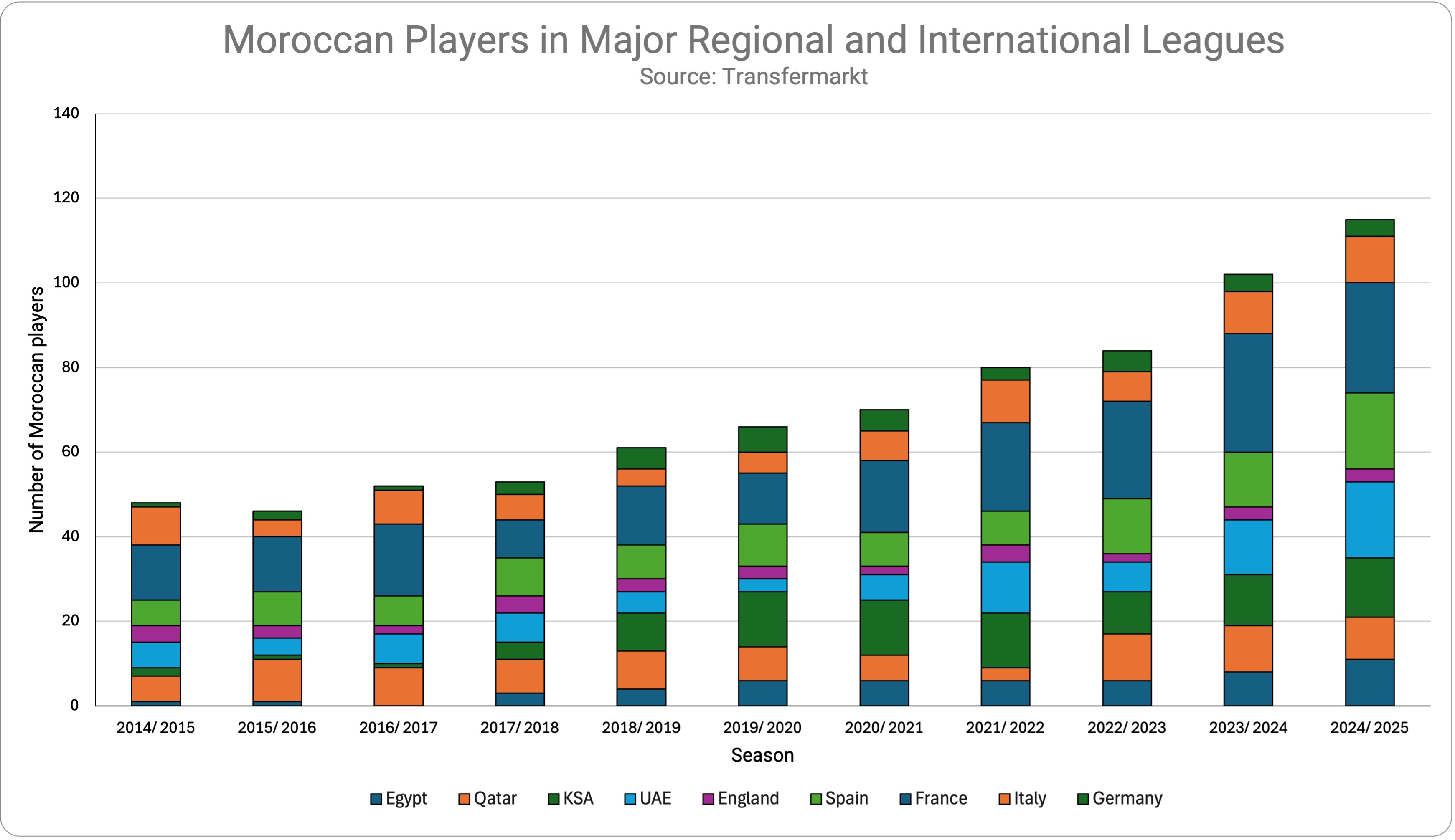
These successes underscore the importance of football as a technique of governance through which developmental priorities, political control, and institutional power in Morocco were restructured. They reshaped the country’s developmental landscape in three interrelated ways.
First, high-profile sporting achievements obscured the state’s failure to deliver on mass participation in sport. Despite ambitious targets with respect to expanding grassroots practice,[25] public resources were overwhelmingly directed toward professional football, while participation rates and athlete numbers fell far short of stated goals.[26] Football success thus legitimized the reallocation of public expenditures away from broader social and economic needs, thereby reviving the project of “development through football” and justifying renewed bids for mega-events. Public funds were increasingly channeled toward stadiums and infrastructure—most notably in preparation for the 2030 World Cup—at the expense of social services, a shift that later became a focal point of youth-led protests.
Second, football success facilitated political containment. Improved sporting performance helped to pacify football fandom and suppress dissent, as ultras—once central to post-2011 mobilization—were no longer security threats capable of undermining the football economy itself. Their dissolution by the Ministry of the Interior, alongside heightened surveillance and stadium restrictions, was justified as necessary to restore order and safeguard sporting success.
Third, football’s centrality reorganized authority within the state. Sports officials and administrators were no longer mere policy instruments, but emerged as key architects—and beneficiaries—of development. Figures such as Fouzi Lekjaa accumulated political and budgetary power, while club leaders converted sporting popularity into economic capital and parliamentary influence.[27]
Football as Political Vision in Post-2013 Egypt
Morocco’s recent football trajectory has a close parallel in Egypt, where the sport has likewise been deeply entangled with protest, violence, decline, and resurgence. In both countries, football fans played visible roles in popular mobilization—the February 20th movement in Morocco and the 2011 revolution in Egypt—and in both cases, periods of politicization were followed by episodes of severe stadium violence that authorities reframed as security threats rather than social or political phenomena, thereby justifying the disbanding of organized supporter groups. Yet the purposes to which football was subsequently mobilized diverged. Whereas government investment in Morocco primarily sought to catalyze a particular developmental trajectory, football in post-2013 Egypt was leveraged to produce a new political vision—a set of shared representations, symbols, and narratives through which political order is made thinkable and legitimate—aimed at pacifying the society after a period of revolutionary upheaval.
Egypt’s experience was marked by especially traumatic moments, most notably the killing of seventy-two al-Ahly supporters at Port Said Stadium in 2012 and twenty-two Zamalek fans in a stampede in 2015.[28] These episodes unfolded against the backdrop of the 2011 revolution, which ousted President Mubarak in February and opened a brief democratic window marked by mass protest and recurrent violence, before the ouster of a democratically elected president through popular mobilization and military intervention in the summer of 2013.
This political upheaval coincided with a prolonged sports downturn. After dominating African football between 2006 and 2010, Egypt’s national team failed to qualify for the Africa Cup of Nations until 2017, and suffered a humiliating 6–1 defeat in the 2014 World Cup qualifiers. Yet, as in Morocco, this decline was followed by a rapid revival. The team qualified for the 2018 and 2026 World Cups; reached every Africa Cup of Nations from 2017 onward, twice coming close to continental victory; qualified for consecutive Olympic Games; and witnessed a marked revival of the domestic league, whose market value rose substantially with renewed continental success and the hosting of the 2019 Africa Cup of Nations.

This resurgence was driven by sustained political support and active state engineering. Between 2017 and 2022, total expenditures on the Egyptian league reached almost double its revenues—figures that defy straightforward economic explanation, and underscore how football development was underwritten by political priorities rather than market logic.[29] This imbalance reflects the regime’s growing political interest in the sport. Under Mubarak, it was commonly held that football functioned as an “opiate of the masses” and an anti-mobilizing force, even when organized fan groups were viewed as a potential threat. The state largely approached football as a domain to be managed rather than strategically cultivated.[30]
In contrast, the military-backed regime that emerged after 2013 treated football as a key arena of governance, believing that owing to its overwhelming popularity, it could help produce a new political conception—one in which notions of citizenship, and the associated expectations of responsibility and accountability, were curtailed and replaced by new norms of governance.
Since 2011, regime intervention in the football domain has taken two principal, mutually reinforcing forms. The first involved the expansion of the sector alongside its progressive incorporation into the state’s orbit. What had previously been a relatively competitive sponsorship environment dominated by private firms was, from around 2014 onward, consolidated into a near-monopoly controlled by regime-aligned intermediaries. The rise of Presentation Sports—transformed from an advertising company into a central rights holder, absorbed into the Egyptian Media Group, and ultimately sold to Eagle Capital, a fund owned by the General Intelligence Service—exemplifies this shift.[31]
At the same time, the regime restructured the satellite television sector and repurposed it as a sports-centered broadcast ecosystem. Prior to the 2011 revolution, businessmen-owned satellite channels attracted audiences primarily through sports programming and political talk shows.[32] In the immediate aftermath of the uprising, political talk shows surged while sports media entered a deep crisis, driven by the national team’s declining performance and the suspension of the domestic league. Following the military intervention of July 2013, dissenting voices were silenced across private satellite channels, and ostensibly independent outlets were progressively consolidated under state-aligned ownership. The trajectory of Ahmed Abou Hashima illustrates this process: After founding the Egyptian Media Group in 2016, he oversaw a rapid wave of acquisitions that transformed it into the country’s largest media conglomerate, before its sale to Eagle Capital in 2017.[33]
But censorship alone proved insufficient in an increasingly fragmented media environment. State media were expected both to attract viewers and to propagate the regime’s narrative, but heavy-handed censorship undermined this project: Repetitive punditry struggled to compete with the immediacy and pluralism of social media, as well as opposition satellite channels broadcasting from abroad. In response, the regime leveraged its effective monopoly over satellite television to redirect public attention away from politics and toward sport. It retained the commercially successful talk-show format but stripped it of national political content, repurposing it almost entirely around football. Football talk shows thus replaced political talk shows as the core programming across most satellite channels, not only on sports networks but across the broader television landscape—which allowed the regime to reconcile political control with the imperatives of audience capture.
While largely refraining from direct commentary on national politics, football talk shows functioned as pedagogical spaces that contributed to the production of a new political understanding: Football emerged as a microcosm through which proper forms of conduct could be modeled and debated. Leading clubs operated their own television channels and maintained regular representation across major networks, on which pundits addressed supporters not as consumers or rights-bearing citizens, but as stakeholders with duties, expected to accept sacrifice and defer to unaccountable administrators in the name of collective success. Club officials were portrayed as technocratic decision-makers whose authority should remain insulated from popular demands, on the grounds that accountability would hinder their capacity to pursue the clubs’ long-term interests.[34]
Parallels with national politics were often made explicit: Just as the president was said to require freedom from public accountability in order to make difficult decisions in the national interest, club administrators, it was argued, could not serve their teams’ “real” interests if they answered to fans.[35] Success on the pitch was presented as the ultimate justification for this arrangement, as it produced pride and symbolic distinction that outweighed concerns over participation or representation and demanded sacrifice in the form of financial, administrative, and even security-related burdens. This mode of intervention on the part of the regime thereby transformed football into a mass medium through which obedience, hierarchy, and the suspension of accountability were rendered natural, and even desirable.
A second form of regime intervention in Egyptian football operated through the reengineering and pacification of stadiums, combining coercive repression with technocratic control. Ultras groups—central to politicizing football fandom before and during the 2011 revolution—posed a direct challenge to a football project premised on depoliticization and the curtailment of accountability. Their horizontal organization, anti-authoritarian ethos, and resistance to the commodification of sport made them especially appealing to disaffected youth and subversive of the prevailing social order.[36] The post-2013 regime therefore moved decisively to dismantle this constituency. Following the 2015 stadium massacre, courts banned ultras groups and designated them terrorist organizations; leaders and members were imprisoned, and supporters groups formally disbanded by 2018; and stadiums were effectively emptied, with access limited to security-approved invitees.
This crackdown enabled the controlled reconstitution of stadiums as sites for producing a new political order. Spectator access to stadiums was tightly managed through strict caps, security vetting, fan-ID systems, extensive surveillance, and rapid policing of chants or behavior deemed disorderly or political. Hosting the 2019 Africa Cup of Nations helped normalize this model of “disciplined” fandom, in which spectators were expected to perform loyalty without deliberation or critique. Stadiums thus became political prototypes: Just as fans were urged to accept sacrifice and defer to unaccountable administrators in exchange for victory, citizens were encouraged to endure hardship in return for symbolic achievement.
Like other cases examined in this Brief, Egypt shows how football can be reengineered into a technology of governance—used to discipline publics, manufacture consent, and substitute symbolic victory for political participation. Yet the persistence of arrests, bans, and boycotts reveals the limits of this strategy. Developments in Morocco point in a similar direction: During the Gen Z–led protests of September 2025, demonstrators—many of them football fans—explicitly turned the language of sport against the state, chanting against World Cup–related spending and demanding that public resources be redirected toward health care and education.[37] Taken together, these cases suggest that though football can be mobilized to stabilize regimes and reorder political expectations, its conversion into a durable mode of governance remains contingent, reversible, and politically contested.
Football and Statecraft in the Arab World
The Arab world has come to occupy an increasingly central place in global football. More consequential, however, is the extent to which football has come to occupy a central place in the politics of the Arab world itself. The dominant sportswashing framework obscures this shift by interpreting football investment primarily as an externally oriented bid for Western legitimacy. In doing so, it misrecognizes football’s political significance by overlooking the internal social, economic, and political pressures that have turned the sport into a key realm of governance—and by flattening the diverse political purposes the “beautiful game” has come to serve across the region.
A focus on domestic dynamics reveals a different picture. Across the region, football has become a tool for managing internal crises and reconfiguring state–society relations. Mega-events commonly cited as instances of sportswashing acquire different meanings in this light. Saudi Arabia’s hosting ambitions reinforced MBS’s consolidation of power; Qatar’s World Cup bolstered its national security strategy; Morocco’s bids legitimized developmental priorities; and Egypt’s hosting helped reshape the post-2013 political landscape. In most cases, football projects were aimed primarily at domestic audiences and built upon—while neutralizing or redirecting—popular football cultures that had previously fueled protest and dissent.
Finally, looking at each country’s effort in isolation misses the broader regional political economy that links these efforts. Arab football projects are simultaneously competitive and interdependent: States rival one another over hosting rights, broadcasting markets, and institutional influence, even as capital, players, and organizations circulate across borders. Gulf capital has flowed into the Egyptian league, supporting its success; Egyptian clubs have participated in Saudi-led football initiatives; Arab states have collectively contributed to the success of Qatar’s tournaments by choosing to participate in them; and Moroccan players increasingly populate leagues across the region. Football in the Arab world thus constitutes not a series of isolated spectacles performed for Western consumption, but a dense regional political economy—one in which competition, cooperation, and imitation intersect to reshape governance, legitimacy, and collective life.
Ibrahim Elhoudaiby is a junior research fellow at the Crown Center.
For more Crown publications on topics covered in this Middle East Brief, see “The New Rentierism in the Middle East: How Gulf Oil Wealth Has Kept Democracy at Bay since 2011,”“Golden Passports and Golden Visas in the Gulf,” “The Opposition Effect: Islamism and Women’s Rights in the Midst of Morocco’s Family Code Reform,” “Implementing Saudi Arabia's Vision 2030: An Interim Balance Sheet,” and “The Egyptian Revolution Is Not a Failed Revolution.”
[1]Steve Menary, “Brand Finance Football 50 Dominated by Clubs Powered by Gulf Investment,” The National, June 07, 2015, https://www.thenationalnews.com/business/brand-finance-football-50-dominated-by-clubs-powered-by-gulf-investment-1.105345.
[2]Adam Lyjak, “The Finances Behind the 2022 World Cup,” Michigan Journal of Economics, January 10, 2023, https://sites.lsa.umich.edu/mje/2023/01/10/the-finances-behind-the-2022-world-cup/.
[3]Sam Cunningham, “From the Qatar World Cup 2022 to F1, PSG, Newcastle Utd and Man City: ‘Sportswashing’ Allegations Explained,” The i Paper, November 23, 2021, https://tinyurl.com/58fu8ksr.
[4]Transfermarkt’s valuations are routinely cited by major sports media and have been widely employed in academic research on football economics and labor markets. See Oliver Müller, Alexander Simons, and Markus Weinmann, “Beyond Crowd Judgments: Data-Driven Estimation of Market Value in Association Football,” European Journal of Operational Research 263, no. 2 (2017): 611–624.
[5]Tariq Panja and Ahmed Al Omran, “Saudi Soccer League Creates Huge Fund to Sign Global Stars,” New York Times, June 2/June 6, 2023, https://www.nytimes.com/2023/06/02/sports/soccer/saudi-soccer-messi-benzema-ronaldo.html.
[6]For more on Vision 2030, see Nader Habibi, “Implementing Saudi Arabia’s Vision 2030: An Interim Balance Sheet,” Middle East Brief, no. 127, Brandeis University, Crown Center for Middle East Studies, Brandeis University, April 2019.
[7]Michael Herb, “The Decay of Family Rule in Saudi Arabia,” in Struggles for Political Change in the Arab World: Regimes, Oppositions, and External Actors after the Spring, ed. Lisa Blaydes, Amr Hamzawy, and Hesham Sallam (Ann Arbor: University of Michigan Press, 2022), p. 107.
[8]Dag Tuastad, “The Qatar World Cup and the New Islamic Approach to Football in the Middle East,” The Project on Middle East Political Science (POMEPS), accessed May 4, 2026, https://pomeps.org/the-qatar-world-cup-and-the-new-islamic-approach-to-football-in-the-middle-east.
[9]Madawi Al-Rasheed, “The New Populist Nationalism in Saudi Arabia: Imagined Utopia by Royal Decree,” LSE Blogs, May 05, 2020, https://blogs.lse.ac.uk/mec/2020/05/05/the-new-populist-nationalism-in-saudi-arabia-imagined-utopia-by-royal-decree/.
[10]Sultan Alamer, “A New Holiday Heralds a More Complex Understanding of Saudi Arabia’s Origins,” New Lines Magazine, February 23, 2024.
[11]Jennifer Peck, “Working Women Are Changing Saudi Arabia,” Foreign Affairs, June 19, 2024, https://www.foreignaffairs.com/saudi-arabia/working-women-are-changing-saudi-arabia.
[12]FIFA officials have repeatedly expressed a preference for working with authoritarian regimes, which offer centralized decision-making and fewer political constraints. (See “Jerome Valcke: FIFA Chief Says Too Much Democracy Can Be Hindrance,” BBC News, April 24, 2013, https://www.bbc.com/sport/football/22288688.) As Sultan Alamer similarly notes with respect to Saudi Arabia, officials there do not view the absence of public oversight, the lack of constitutional constraints, or the authoritarian character of governance as liabilities to be addressed or avoided [but] “as assets that facilitate their task.” (See Sultan Alamer, “Behind the Scenes: Superstars in Saudi Arabia” [Carnegie Endowment for International Peace, Sada, June 8, 2023], https://carnegieendowment.org/sada/2023/06/behind-the-scenes-superstars-in-saudi-arabia.)
[13]Danyel Reiche, “Investing in Sporting Success as a Domestic and Foreign Policy Tool: The Case of Qatar,” International Journal of Sport Policy and Politics, 7:4 (2014), pp. 489–504, https://www.aub.edu.lb/fas/pspa/politics-sports/Documents/Reiche-2014-Qatar-Sport%20Policy.pdf.
[14]Sarath K. Ganji, “How Qatar Became a World Leader in Sportswashing,” Journal of Democracy, November 2022, https://www.journalofdemocracy.org/how-qatar-became-a-world-leader-in-sportswashing/.
[15]Craig L. LaMay, “Qatar’s beIN Sports and Football Broadcasting in the Middle East: International Influence and Regional Rancor,” in Football in the Middle East: State, Society, and the Beautiful Game, ed. Abdullah Al-Arian (London: Hurst, 2022), p. 305.
[16]LaMay, “Qatar’s beIN Sports,” pp. 313–14.
[17]Ministry of Youth, Culture and Communication (Morocco), Al-Riyadha fi 25 Sana min Khutab wa-Rasaʾil Sahib al-Jalala al-Malik Muhammad al-Sadis, Yuliyuz 1999–Yuniyu 2024 (Rabat, 2024), p. 9.
[18]See the king’s letter to FIFA’s Executive Committee (May 2004) and his letter to the UN Economic and Social Council, presented at its July 2006 meeting; both are reproduced in Al-Riyadha fi 25 Sana, pp. 17–18 and 27–30, respectively.
[19]Al-Riyadha fi 25 Sana, p. 35.
[20]Ibrahim Hayani, “Al-Maghrib wa-Ka’s al-‘Alam 2030: Zeina Kharijiyya Tukhfi Hashashat al-Dakhil,” Alpheratz, October 16, 2025, https://tinyurl.com/5ffthjyk.
[21]Al-Riyadha fi 25 Sana, p. 30. The Makhzen is the constellation of institutions, elites, and patronage networks organized around the Moroccan monarchy and through which royal authority is exercised. The term denotes not only the state apparatus but also the broader political order that connects the palace to administrative, economic, security, and local actors.
[22]Simon Hughes, “How Morocco Became a Burgeoning Football Superpower,” New York Times, December 22, 2024, https://www.nytimes.com/athletic/5989079/2024/12/22/morocco-world-cup-superpower/.
[23]Yassir Yousfi, “Moroccan Ultra Groups of Football: From Tifos to Street Politics,” chap. 6 in Public Policy in the Arab World: Responding to Uprisings, Pandemic, and War, ed. Anis Ben Brik (Cheltenham: Edward Elgar, 2024), https://www.elgaronline.com/edcollchap-oa/book/9781035312696/book-part-9781035312696-16.xml.
[24]"Académie Mohammed VI: De l’excellence de la formation . . . au triomphe professionnel,” Le360 Sport, May 23, 2025, https://sport.le360.ma/football/academie-mohammed-vi-de-lexcellence-de-la-formation-au-triomphe-professionnel_63CD7JEGJBC25IAYKP5YYVJHXE/.
[25]“Al-Siyasa Al-Riyadhiyya b-il Maghrib: Taqrir al-Majlis al-Iqtisadi w-al Ijtima‘i w-al-bi’i,” Royaume du Maroc: Conseil Economique, Social et Environmental, 2019, p. 22, https://www.cese.ma/media/2021/02/Av-S26a.pdf.
[26]Ibrahim Hayani, Al-Maghrib wa-Ka’s al-‘Alam 2030.
[27]Ibrahim Hayani, Al-Maghrib wa-Ka’s al-‘Alam 2030.
[28]See for example David Conn, “Port Said Football Disaster Exposes Political Vacuum Left by Revolution,” The Guardian, February 2, 2012, https://www.theguardian.com/world/2012/feb/02/port-said-football-disaster-revolution; and Aryn Baker, “Egyptian Fans Blame Police for the Deaths of 22 in Stadium Violence,” Time, February 9, 2015, https://time.com/3701152/egypt-zamalek-football.
[29]Hani Abdel-Nabi, “Taqrir ‘Alami Yarsud Khusarat al-Andiya al-Misriyya 447 Milyoun Junaih Khilal 5 Sanawat” [A global report monitors the loss of Egyptian clubs 447 million pounds in 5 years], Al-Youm Al-Sabi‘, March 16, 2022, https://tinyurl.com/5yej99r3.
[30]Karim Medhat Ennarah, “The Ultras Ahlawy: Football, Violence, and the Quest for Justice,” The Century Foundation, April 11, 2017, https://tcf.org/content/report/the-ultras-ahlawy/.
[31]“Taʿarraf ʿala Sharikat Presentation wa-man hum al-qaʾimin ʿalayha,” YouTube video, Sada Elbalad Channel, May 23, 2015, https://www.youtube.com/watch?v=7aVtFog0ehg.
[32]Fatima el-Issawi, Egyptian Media under Transition: In the Name of the Regime...In the Name of the People? (London School of Economics, POLIS, 2014), 74, https://researchonline.lse.ac.uk/id/eprint/59868/1/El-Issawi_Egyptian-Media-Under-Transition_2014_pub.pdf.
[33]Hossam Bahgat, “Looking into the Latest Acquisition of Egyptian Media Companies by General Intelligence,” Mada Masr, December 21, 2017, https://tinyurl.com/3x855et5.
[34]This logic is frequently legitimized through invocations of Saleh Selim, the former president of Al Ahly, who repeatedly insisted that although fans are an essential part of the club, decision-making must remain the exclusive prerogative of the board. (See Salih Salim: al-Ahly la yudar min al-mudarrijat [“Al Ahly Is Not Run from the Stands”], YouTube video (Al Ahly TV), May 23, 2015, https://www.youtube.com/watch?v=DN_NzdRHU-E.).
[35]Halaqat “Malik wa Kitabah” | 'Adli al-Qa'i wa Ibrahim al-Mannisi, YouTube video (Al Ahly TV), December 11, 2025, https://www.youtube.com/watch?v=5a6JgACRTgs.
[36]Ronnie Close, “Reclaim the Spectacle: Ultras Fandom and the Politics of the Sporting Event in Egypt,” The Project on Middle East Political Science (POMEPS), https://pomeps.org/reclaim-the-spectacle-ultras-fandom-and-the-politics-of-the-sporting-event-in-egypt.
[37]Hajar Chaffag, “We Need Hospitals More Than Football Stadiums, Say Morocco’s Young Protesters,” BBC News, October 3, 2025, https://www.bbc.com/news/articles/c8rv2l3me40o.
Recommended Citation: Elhoudaiby, Ibrahim. “Sportswashing or Statecraft? The Politics of Football in the Arab World” Middle East Brief, no. 169. Crown Center for Middle East Studies, Brandeis University, June 2026.
The opinions and findings expressed in this Brief belong to the authors exclusively and do not reflect those of the Crown Center or Brandeis University.