Fall 2010 Letter

Daniel Terris, Vice President for Global Affairs
Dear Brandeis community,
This fall marks the fourth year of Brandeis University's commitment to comprehensive global engagement. As we begin the semester, welcoming a new class and preparing for a new presidential transition, I thought it was a good time to let you know where we stand as an increasingly international community of scholars, students, alumni, families and organizational partners.
First, it is worth remembering that Brandeis is part of an educational transformation happening across the world. Higher education expansion is not only increasing access for students, but also making the connection between knowledge and development more important. We are seeing repeated calls from national and international leaders, including from President Obama, advocating for major, knowledge-based cooperation around issues of environmental change, public health, economic stability, and human equality. Despite the economic crisis, universities in many countries are setting up outposts, campuses, and embassy-style offices to meet this need.
Such cooperation takes many forms. At Brandeis, we are beginning to develop a new approach to partnership that involves a small set of sustained, core commitments across the world. During his recent trip to India, Jehuda Reinharz addressed these kinds of sustained collaborations in speeches to the Delhi Sustainable Development Summit and to the Asia Society.
These commitments will be built with a social justice mission, and they will relate directly to the undergraduate learning experience. Ideally, they will also provide a few central hubs for collaboration involving alumni, overseas partners, faculty research and many other areas of our university. We have begun planning for these commitments by launching some initial, flagship projects that seek to form the foundations for sustained engagement (see top right).
In a few years, the goal will be for Brandeis to have a highly-visible set of global relationships around the world. Such relationships might also foster collaborative development projects that take advantage of the expertise in the humanities, social sciences, sciences, professional schools, and centers/institutes. If we have learned anything from the last decade, it is that the major issues of our time cannot be presented as absolutes of one particular area; nor can we ignore the particularities of culture and society. At Brandeis, we continue to seek meaningful approaches to interdisciplinary thinking and cosmopolitan identity rooted in the liberal arts -- that is, in the art of thinking itself.
Below are a few highlights of our recent achievements together as a global university. I also encourage you to visit the Office of Global Affairs web site, where you can learn more detailed information on our efforts towards a "Global Brandeis" strategy.
Sincerely,
Daniel Terris
Vice President for Global Affairs
HIGHLIGHTS OF BRANDEIS UNIVERSITY GLOBAL ENGAGEMENT
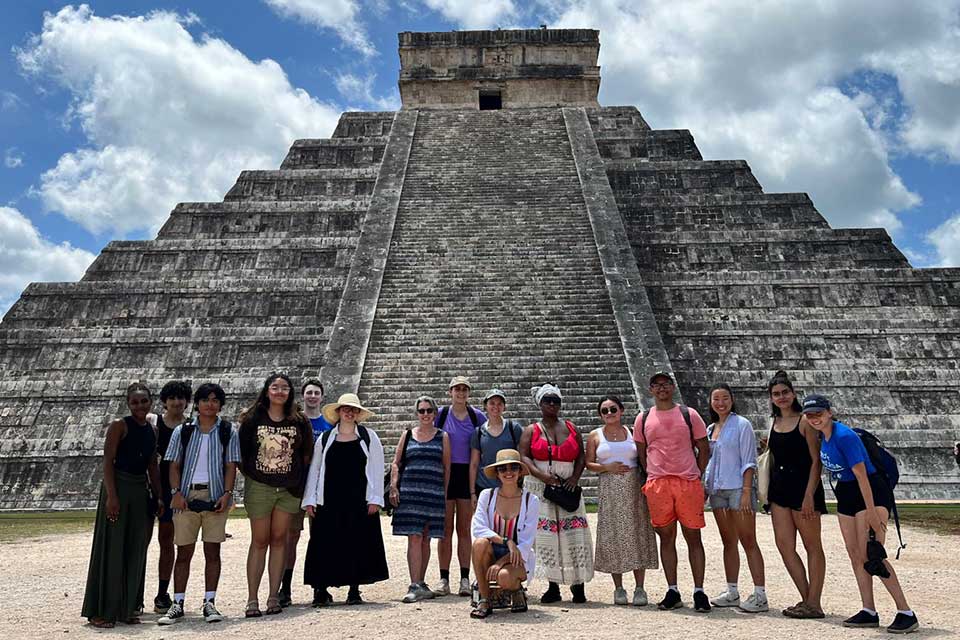
Our undergraduates continue to study and work abroad at record numbers, with 40% of students studying abroad each year. They can choose from among 250 programs in 70 countries. While many students study abroad for a year or a semester, summer study abroad has been increasingly popular.
Many more students go abroad through a variety of internships, fellowships, research projects, and individual travel. Last year, Brandeis University awarded more than 100 fellowships for summer work, through the Hiatt WOW program, the Sorensen Fellowships of the Ethics Center, and many more departmental awards. The graduate schools also send students away for practica and internships. You can read about some of their experiences on our blog site.
More importantly than our strong numbers, these students are typically Brandeisian in their pursuits -- which is to say, not typical at all. They are venturing out to remote and non-traditional locations, and creating projects with both breadth and depth. A recent New York Times article highlighted several Brandeis students studying abroad in the Middle East.
This past year, the university also created several new programs that are led by Brandeis faculty members. These new summer programs include Brandeis in The Hague, and a Sicily, Italy program on Italian language and culture. The graduate and professional schools are also creating summer experiences; a recent International Business School "World Financial Center" program took IBS students to Chile. Such programs allow closer integration of global experiences with the Brandeis curriculum.
Integrating global experiences is, in fact, a crucial part of our work together as a university community. As part of the Brandeis Assessment efforts, the Office of Global Affairs is chairing a new university-wide sub-committee on global learning goals. After preliminary discussions last spring, we will be working with faculty from different departments to test out some of these initial ideas in courses. Our goal is to create a flexible framework for faculty and departments to integrate global learning into existing learning outcomes and assessment mechanisms.
Many parts of the university curriculum offer a chance to learn about and analyze the world in both its global and its local contexts. You can find many of these interrconected fields by going to "The Global University" under the University's Areas of Study. International & Global Studies (IGS) and Health: Science, Society, and Policy (HSSP) remain highly-popular majors, as do our area and regional studies programs.
Our unique connections to the global Jewish community and to Israel continue to remain priorities. There are several avenues to explore Jewish Studies at Brandeis, and several centers and institutes are devoted to questions of Jewish studies and scholarship on modern Israel. The Schusterman Center for Israel Studies recently completed its annual Summer Institute for Israel Studies, an innovative faculty development program, and it will host the 27th Association for Israel Studies Conference in June 2011.
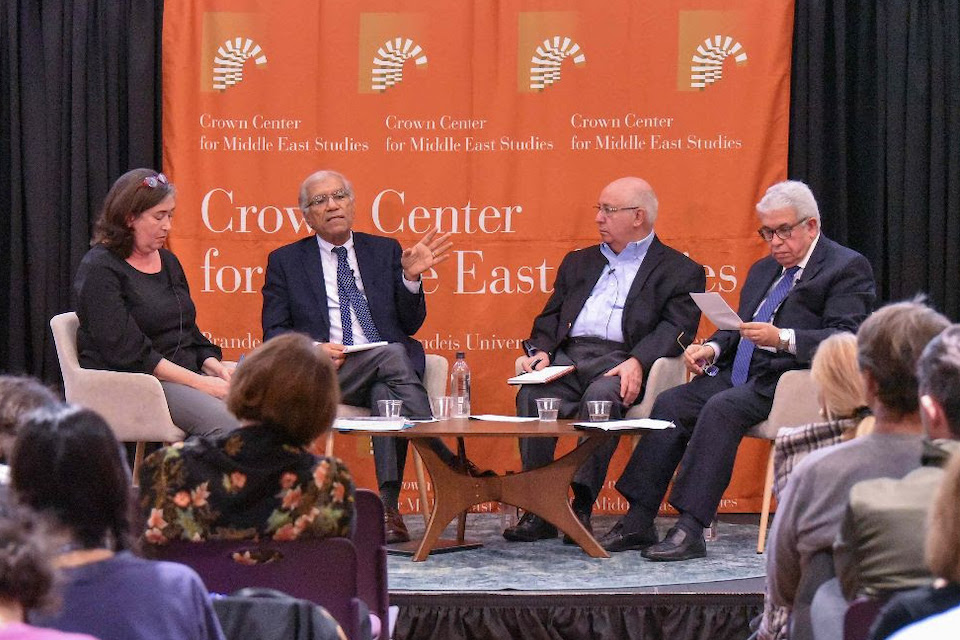
Last year, the Office of Global Affairs also hosted two "Global Brandeis" symposia. These occasional gatherings are a chance for the community to think broadly about international issues and their impact on higher education. The 2009-10 symposia featured Kris Olds (University of Wisconsin-Madison), a geographer interested in the globalization of the service industries; and Darla Deardorff (Duke University), an expert in the burgeoning field of intercultural communication and competence.
Brandeis University continues to be a major player in global research, both in terms of content and collaboration. This fall marks the opening of the Mandel Center for the Humanities, which will become a hub for interdisciplinary inquiry. In the spring, the Heller School for Social Policy and Management launched a new Institute for Global Health and Development, under the leadership of Prof. A. K. Nandakumar. In May, the Graduate School celebrated the graduation of its first class of Global Studies masters students.
This past spring also saw the record-breaking first results of the "world's largest physics experiment" at CERN, which involved the Brandeis high-energy physics group. Prof. James Bensinger has been appointed "US ATLAS Muon Manager" for the ATLAS experiment at the Large Hadron Collider at CERN.
Throughout the fall semester, we will be continuing to feature the work of Brandeis professors and the work of our International Centers & Institutes, including those faculty who were recently awarded Fulbright Awards.
The class of 2014 holds the distinction of being the most international incoming class, at 16% of the undergraduate student body, up from 15% in 2009 and 7% in 2008. The incoming students hail from 84 different countries. In addition, our new Gateway Scholars program, an intense English-language preparation experience designed for first-year academic preparation, involves 46 students from six countries.
Seven new Wien International Scholars from the incoming class will join 34 others, for a total of 41 Wien Scholars on campus, representing over 20 different countries. Wien Scholar alum Devika Mahadevan '00, a social change leader in Mumbai, India, was presented with the Alumni Achievement Award this summer.
The success of international recruitment at the undergraduate level is matched by outreach at the graduate and professional level. The Graduate School is crafting a new plan for international outreach including partnership with EducationUSA centers around the globe. At the International Business School, 70% of the incoming class is from outside the United States representing 67 countries, including some of our largest incoming IBS groups from China and India. At the Heller School, all six degree programs continue to attract a high number of international students, and a new dual degree in Sustainable International Development and Coexistence & Conflict is increasingly popular, with 17 incoming dual degree students. Second year dual-degree student Irene Cocovi Mensah, of Benin, was recently chosen to attend the President's Forum with Young African Leaders with President Obama in Washington, D. C.
The Brandeis campus is home to an ever-increasing number of global events, including the new Soli Sorabjee Lectures in South Asian Studies. We have prepared a few event highlights on our global event calendar; you can also follow regular updates about recent events on our blog site.
Of course, the "global campus" extends beyond Waltham to our active alumni community. We are continuing to build and strengthen alumni networks across the globe. In recent years, Brandeis held alumni events in Berlin, Germany (May 2010), Tokyo, Japan (May 2010), Delhi and Mumbai, India (February 2010), and China (an Alumni Travel program in June 2009). The 2010 Alumni Travel trips, featuring President Jehuda Reinharz and Prof. Shula Reinharz, will be to Kenya/Tanzania (June 2010) and to Vietnam (October 2010). Our official Alumni Clubs continue annual meetings in England, Canada, Israel, and South Korea. We also have a dedicated Wien Scholar Alumni Network.
Our students are some of the most active and globally-minded in higher education. After the Haiti earthquake, students around campus joined together with faculty to create the Brandeis Haiti Relief Effort, raising over $30,000 for a number of charity and relief organizations. Other on-going international projects include Revive Mumbai, Positive Foundations, STAND, Students Crossing Boundaries, Girl Effect, and many more. These organized efforts do not even begin to shed light on individual projects. We will be continuing to profile such efforts during the fall semester.
These highlights are only sketches of what makes up a truly global Brandeis. If you'd like to have your project featured this semester/year, email oga@brandeis.edu.