

Brandeis Online
Should I get a master’s in applied data science?

June 3, 2026
Will pursuing a master’s in applied data science help you achieve your goals? Gain insight from Dr. Keishalee Shaw, Chair of Applied Data Science and Decision Analytics at Brandeis Online.
Is applied data science a valuable field to pursue?
In short, yes. The numbers tell part of the story. Between September 2024 and September 2025, U.S. employers posted over 88,000 openings for master's-level professionals in data science, statistics, and operations research, at a median salary of $140,200 with 7.7% annual growth. Fast-growing skills include Python, machine learning, data analysis, and R. The Boston metro alone posted over 5,600 data-focused positions in the past year, drawing from healthcare, finance, higher education, and technology.
But the numbers don't capture the deeper urgency. We are at a moment when AI is being embedded in consequential decisions, such as who gets a loan, who receives a diagnosis, who gets flagged by an algorithm in a hiring process, and how we allocate energy resources. And we don't yet have enough professionals who know how to build these systems responsibly. Gartner has estimated that 60% of AI projects will be abandoned by 2026 due to inadequate data foundations, and that 63% of organizations report a lack of clarity about what "AI-ready data" even means. That is a crisis of talent and governance at scale.
Brandeis Online’s Applied Data and Decision Analytics program directly addresses that crisis. We are training the professionals who will close the gap between AI ambition and AI accountability, not because it's a nice thing to have, but because it's essential for organizations that want to deploy AI sustainably, ethically, and at scale.
Will a master’s in applied data science make me more competitive in the workforce?
Graduates of programs like Brandeis Online’s MS in Applied Data Science and Decision Analytics leave with a genuinely distinctive combination of capabilities that are difficult to find in a single individual, and that combination is precisely what employers are searching for.
On the technical side, graduates will have hands-on proficiency with Python and R; machine learning engineering and MLOps practices; data pipeline architecture in cloud environments using tools like Apache Spark and MongoDB Atlas; statistical modeling and causal inference; time series forecasting; and business intelligence through platforms like Tableau and Power BI. They will also have deep experience with generative AI, large language model evaluation, prompt engineering, and responsible GenAI deployment.
On the strategic and ethical side, applied data science graduates will be equipped to conduct AI bias and fairness audits, apply global governance frameworks, design data ethics policies, integrate ESG and sustainability metrics into data system design, and communicate complex analytical findings clearly to executive and non-technical audiences.
Crucially, graduates of Brandeis Online’s MS in Applied Data Science and Decision Analytics will know how to work across disciplines. The program’s capstone experience, its peer collaboration model, and its case-based learning approach all build the cross-functional, team-oriented mindset that real organizations need. The skills that make our graduates competitive aren't just the technical ones — it's the ability to connect data science to decision-making, to understand the ethical stakes of a model before it's deployed, and to lead with both rigor and responsibility.
What career paths does a master’s in applied data science qualify you for?
The career pathways for applied data science master’s students are genuinely broad, which reflects how pervasive the need for data fluency has become across industries.
Graduates are well-positioned for roles like Data Scientist, Machine Learning Engineer, Analytics Manager, Business Intelligence Developer, Data Engineer, AI Product Manager, AI Governance Analyst, Chief Data Officer, Director of Data Strategy, and Decision Intelligence Consultant. Those who complete programs with a focus on governance and ethics are particularly well-positioned for the growing category of roles as: Data Ethics Officer, Chief Trust Officer, and Director of Responsible AI, that organizations are standing up in response to regulatory pressure from frameworks like the EU AI Act and NIST AI RMF.
In terms of industries, graduates are competitive in healthcare, financial services, technology, consulting, public sector, life sciences, and higher education.
What background do I need to get a master's in applied data science?
I think about this in terms of drive more than background. You don't need to come in as a programmer or a statistician; though, if you are, you'll find plenty of challenge and growth. What you do need is genuine curiosity about data, comfort with ambiguity, and a real desire to connect analytical work to meaningful decisions.
That said, Brandeis Online’s applied data science program is designed for six core learner profiles. There's the Analytics Accelerator: a mid-career professional in business, HR, or operations who has domain knowledge and wants to develop fluency in Python, modeling, and visualization to move into senior analytics roles. There's the Cloud Engineer who wants to deepen from technical execution into AI governance and ethical systems design. There's the AI Product Strategist, a consultant or program manager who wants to bridge the gap between data science teams and executive leadership. There's the Domain Data Scientist, a healthcare analyst, policy researcher, or life scientist who wants to extend their impact with applied modeling skills. There's the Data Center Sustainability Architect who wants to lead carbon-reduction and ESG analytics initiatives. And there's the AI Governance Analyst, a compliance manager or risk analyst who wants to lead responsible AI programs.
What unites all of these personas is that they are analytically oriented, professionally ambitious, and motivated by real-world impact. If you see data as a tool for making better decisions, not just generating reports, Brandeis Online’s MS in Applied Data Science and Decision Analytics was built for you.
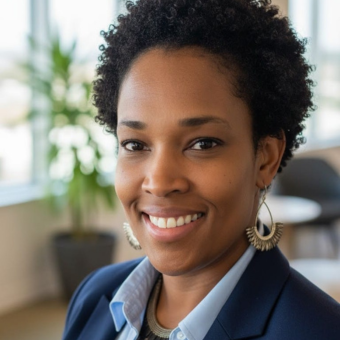 About the Program Chair
Dr. Keishalee Shaw is the Founder and Principal of STRATA Responsible AI and an Adjunct Professor at Brandeis University, where she serves as Program Chair for the Master of Science in Applied Data Science and Decision Analytics. She holds a Ph.D. in Strategic Leadership, graduate degrees in healthcare management and analytics, and certifications in AI product design and responsible innovation.
For more information on the MS in Applied Data Science and Decision Analytics at Brandeis Online, view the program page or contact Dr. Shaw at kshaw@brandeis.edu.
More Stories

May 26, 2026
Thinking of taking the next step in your career? Hear from Dr. Trenya Garner about whether an MS in Health Informatics may be the right path for you.