Geeking Out With...Ophelia Delali Akoto
May 4, 2026
Abigail Arnold | Office of Graduate Affairs
Geeking Out With…is a feature in which we talk to graduate students about their passions. You can check out past installments here.
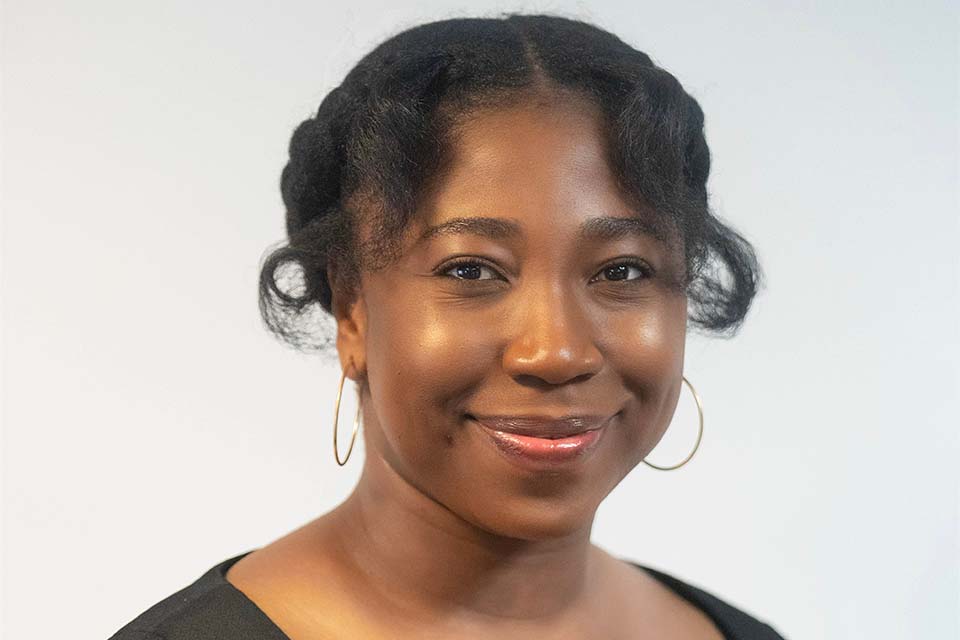
Ophelia Delali Akoto is a fourth-year PhD student in the Social Policy program. She will be graduating this month. She joined “Geeking Out With…” to talk about her research on STEM education for girls in Ghana.
This interview has been edited for clarity.
What is your dissertation research about?
My research is on STEM education and its implications for labor force dynamics for girls and women in Ghana. My dissertation consists of three papers on the STEM pipeline from education to the workforce. The first paper looks at the probability of girls getting STEM education and how such education translates into jobs and their wages. The second and third papers analyze education for junior and senior high school students (equivalent to middle school and high school students in the US), the barriers girls experience when pursuing STEM education at those ages, and how their teachers guide them. Do teachers encourage or discourage girls in pursuing STEM education? What are the classroom cultures that encourage or inhibit girls in this field?
How did you become interested in this topic?
I was born in Ghana and moved to the US when I was about seventeen. I realized when I came here that the education system was quite different. In Ghana, when students are at the end of junior high school, they need to decide which specific courses to pursue in senior high school. After that, they can’t change their courses: they are stuck with them for senior high school, college, and beyond. Growing up, I was not really interested in science; I could have pursued it if I had been encouraged, but teachers encouraged me to study general arts (an area that leads to subjects like sociology) because I was good at reading. In fact, when I came to the US for college, I studied business, which I could not have done if I stayed in Ghana because of the track I selected at the end of junior high.
Recently, one of my younger cousins was graduating from junior high, and she told me she wanted to pursue STEM but her teachers said she shouldn’t. So I was curious about whether girls are guided away from STEM at young ages. I wanted to explore the guidance process, which is often unclear. In Ghana, many STEM teachers also don’t have the right resources to teach the subject themselves, so they can’t really know if girls will succeed in the field. We want an equal society, and it’s important for women to be represented in STEM; if discouraged at a young age, how can they go on to pursue these subjects in college?
What did you discover in your research that you did not expect?
What was very interesting to me was how gender inequality is such an innate part of the Ghanaian social fabric and how people don’t even view it as a bias. This starts at a very young age – if you’re the only sister, your mother will tell you to wash your brothers’ dishes after meals, and you are being trained to be a mother and wife. This translates into views of girls’ and women’s education and occupations. When interviewing a junior high school teacher, I asked him how he would guide a female student through selecting her senior courses, especially if she wanted to pursue STEM. He said he would do a “background check” by going to her home and seeing how she is at home and if she is good to her parents. He once went to a girl’s home where her mother said she did not wash her clothes, and he felt she could not pursue STEM and be a nurse if she had dirty clothes. He did not hold boys to the same standards, but he did not see this as gender bias because the standards for girls are so baked into society. In my quantitative studies, I found that STEM education leads to STEM occupations, but women are less likely to get jobs with the same education as men, and they also earn less when they do, across all the models I used. I knew gender inequality existed, but the way it’s ingrained and people did not see it as a bias was the most shocking.
Typically, when students pick their senior high school courses, they are between ten and fourteen. Who knows what they will want to do in the future then? Teachers play a very clear role in the process; the parents may make a final decision, but the teachers are the ones who advise the parents about what individual students are good at. So the gender bias of teachers is a big deal. In my view, the whole structure of selecting courses needs to be changed, but it has existed for a long time.
What places did you do your research in?
I did research in three Ghanaian cities. Accra is the capital and has access to the most resources, so I thought it would be a good place to compare to other cities. Cape Coast has historically been known as an educational hub and has good schools; it is similar to Accra in that way, so I wanted to compare and contrast them. Tamale, a city in the north, is known for levels of poverty and educational deficits and was the third place I visited. I did research at all kinds of schools – boys’, girls’, and co-ed (Ghana is about evenly divided between single-sex and co-ed schools), public and private.
Even in Accra, where I thought there would be a lot of resources, there were not good resources for science education; that was also where I spoke to the teacher who visited girls’ homes. In Cape Coast, the girls’ schools had a culture of fear related to discipline. The girls thought discipline was being told what to do: sitting when told to sit, standing when told to stand. They were afraid to speak to authority. Even in co-ed schools, girls were treated differently. Most senior high schools are boarding schools, and they do prep sessions from seven to ten at night; after that, the girls have to go to bed right away, but the boys can stay up and study longer. I had to probe and probe the teachers and students to get them to realize it was unequal because in their minds, they were protecting the girls. Still, the co-ed schools seemed better for girls. I went to one of the best girls’ schools, and a teacher told me that they have a one-month orientation during which the girls are “inculcated” in morals and values. Girls’ schools have values like humility, purity, and respect, while mixed schools have values like excellence and hard work. Tamale had even greater disparities: some girls were not even going to school because they didn’t have the water to bathe due to shortages.
You participated in this year’s Three Minute Thesis (3MT) competition and presented your research there. What made you want to participate, and how did you find the experience?
When I saw the emails about 3MT, I was preparing to defend my dissertation. The competition was a way for me to push myself and tell my research as a story. I wanted to present it to a wide audience and prepare in case I was asked about it in a job interview. It was a really good experience that pushed me to learn about storytelling when it comes to research. The feedback helped me learn to communicate my research to someone who has never heard about it.
What do you want to do with your research after graduating?
I want to publish all my papers. I also started a US/Ghana periods product nonprofit. We distribute period products to girls in Ghana and to homeless shelters in the US. This is an issue that really does affect girls’ education, especially in the north of Ghana. I want to continue doing research but would also like to work for nonprofits or the government. I am open to different things! My long-term goal is to be Minister of Education someday in Ghana.
Are there people at Brandeis who have helped you in your research journey?
My dissertation committee members – chair Joseph Assan, Lisa Lynch, and Olajumoke Yacob-Haliso – have been really phenomenal with their time and talent. Tatjana Meschede was my doctoral seminar chair and very helpful throughout the process. My friend Tozoe Marton really pushed me because she really wanted to finish the PhD in four years; she’d call me up and tell me to push to the next step. I came to a good school, and I’ve really enjoyed my time here!
When you’re not doing research, what do you like to do?
I enjoy going to the movies, especially on the weekends. I also really like Arsenal Yards in Watertown, so sometimes I just go sit there, people watch, and think about life!
What advice do you have for other students exploring their passions?
I think one thing I have learned about myself throughout this process is that sometimes support is not always there, so you have to be able to push yourself. You have to be kind of obsessed with the things you are passionate about in order to continue to your goals even when no one is watching or applauding. Mentorship is also very important, so ask people at the top of your field how they got there.