Geeking Out With...Ambria Jones
June 1, 2026
Abigail Arnold | Office of Graduate Affairs
Geeking Out With…is a feature in which we talk to graduate students about their passions. You can check out past installments here.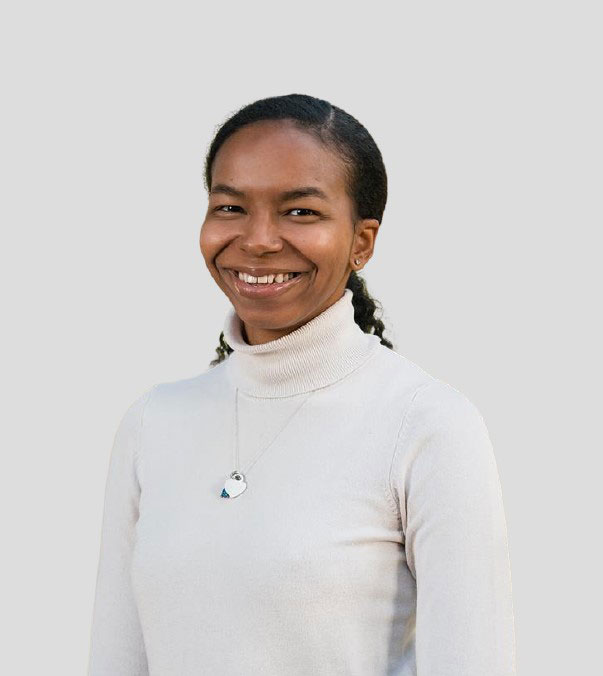
Ambria Jones is a rising second-year PhD student in the Sociology program. Her research focuses on how communities work to resolve food insecurity and how different mutual aid systems can support them. She joined Geeking Out With… to talk about the origins of her project, what she’s done so far, and where she hopes to take it in the future. “There’s always been a communal aspect to food,” she said, “so when people are without, it’s nice to see how they create resilience in face of scarcity.”
This interview has been edited for clarity.
How did you become interested in this topic?
When I was twelve, I learned about a grant to start a community garden. I said I could do that, and I set up meetings with leaders in the Chicago-area village of Oak Park, where my family lives, and read lots of books from the library about how to get started. When I found a plot of land, the village leaders said that they didn’t think I was serious and they were already developing the land. I was mad because I thought they’d been taking me seriously! But when I was telling people about my idea, I learned about other places in the area that had community gardens. A local community college hosted a free urban agricultural camp, and I signed up for it. We did a tour of different farming systems in the city, including community gardens, a co-op, a hydroponic farm, and a farm to table restaurant. I wondered what happened if the needed systems were not working – what would the community leaders do next? That got my wheels turning. I eventually got to start a community garden at my high school: the faculty advisor of our environmental club supported me in starting it, and things happened quickly. But I recognized the community adjacent to us did not have similar resources and was classified as a food desert. I started to wonder more about how one community could have abundance and an adjoining community could not.
You and these questions obviously go way back! How have you built on them as a PhD student?
In the field methods course I took in my first semester here, we had to develop, design, and conduct a research study. A requirement was to be at our study site four to six hours a week, which felt doable until all the reading started! So I was trying to find something easy to commute to and thought of my past experience volunteering at a food pantry. I went to the campus VolunteerFest, met Cathy Carlson, who oversees the food pantry here, and decided to volunteer there. I saw it as an opportunity to contribute to the campus and also do research. There is the perception among the community that Brandeis is a rich institution, which is in tension with the needs of students experiencing food insecurity.
One model I want to follow as an academic is community-based research. I never want to be top-down and tell people what their problem is and how to solve it, because that’s out of touch. It’s a privilege to be embraced by a community and hear what they need in order to thrive.
Where do you plan to take your project as you move forward in your program?
At the end of the fall semester, I said, “I don’t just want to be the food pantry girl.” But then I thought about it – the current reception of my work is positive, and it’s being seen as meaningful. I want to make this its own project that is one pillar of the food insecurity house. When I discussed the food pantry work with Professor Siri Suh, she said there were some sociological questions I hadn’t yet answered; we are going to modify them to be hopefully more focused on student perspective and to increase engagement. So I will put that project to the side for a bit.
My focus in my second year will be more on the placement of food resources and how they’re distributed in an area – for example, my home community has three grocery stores, and the adjacent community doesn’t have any. I am going to work on mapping resources in the Boston area and how communities that lack resources get them or if they’re left without what they need. When someone does not know a resource is available, you have to wonder: is it well advertised, is it open for people, is it accessible? For example, if someone goes to a food pantry and they don’t have the transportation to get the food back home, are they given something to carry it in? Or for a university like Brandeis, what about putting a box of food on the Waltham shuttle? Is that accessible? How can we bring area resources to campus to make them accessible? I’m looking at Boston because I find the concentration of colleges and universities so fascinating here. I was at a conference at another school where they were talking about starting a campus food pantry as well, and I realized I had a similar knee-jerk reaction to those who see Brandeis as a rich institution: I wondered why they needed a pantry when they had such a beautiful campus. This also raises questions about why schools are creating their own resources and the potential scarcity when students and other locals are trying to access the same resources. It’s great that I have so many options to explore, but I know that soon I have to funnel it into one dissertation topic.
What people or resources at Brandeis have helped you in your work?
Cathy Carlson opened up the food pantry, which is a very private space, to me, and she contributes so much to the university. Siri Suh was the principal investigator on my food pantry project, and her support enabled me to go to conferences and present my work. The rest of the Sociology Department has also been great. Rachel McKane, my advisor, is the best and helps me put ideas to paper and have real conversations about what’s feasible on what timeline. Laura Miller gave me a syllabus on the sociology of food, and it’s been my guiding light since. Lauren Jordahl is always promoting conferences and funding opportunities to us, and her emails have helped me find new opportunities. Our chair, Sarah Mayorga, has encouraged me to join various sociological associations and helped me with time management and how to approach being in a doctoral program when it’s my first time and I have no idea what I’m doing! And my cohort and other grad student colleagues are just amazing. You need colleagues to listen to your work, so having them in my corner means a whole lot to me.
When you’re not working on your research, what else do you like to do?
I like to cook, and I love listening to podcasts. I love running, and it’s been a huge part of my physical and mental well-being. I like hanging out with my friends and going to watch parties or karaoke. Building community is super important to me. Academia is not as daunting when you recognize everyone as your colleague, and it’s even better and more fun when you recognize them as your friend.
What advice would you give to other graduate students exploring their passions?
Do the thing that keeps you up at night. Do the thing that you can’t stop talking about, that you want to be the answer to. There may be an answer already, but you want to contribute an even better one. Opportunities are just that, so go for them – if you don’t get it, it was still an opportunity. Failures will suck, but embrace that you took the chance and thought you were worth it. Recognize you have colleagues going through the same struggles and faculty who have your back – tell them if you need support. Research is only as powerful as the people behind you and who you’re working with. If you asked eleven-year-old me what she’d be when she grew up, she would have said a politician or lawyer, but when I look back, it always came back to this topic. So now that I have the opportunity for research, I’m trying to take full advantage of it.
Take care of your mental health. Mental, emotional, and physical health are more important than everything. Life will still happen and it will get hard, because grad school doesn’t stop. Communicate your needs and take advantage of the health center and BCC. If you are not well, you will not do your best work – you can’t achieve your goals if you are not well. Imposter syndrome can make you feel defeated when you admit your struggles, but they mean you are close to the goal. Seek community in and outside of Brandeis. My cohort-mate Alexander Zapata-Torres and I always say we will drag each other across the finish line! And if you haven’t found someone, come talk to me – I am always free to chit-chat.