Undergraduate Teaching Fellows Program
Learn more about the UTF program from past Fellows
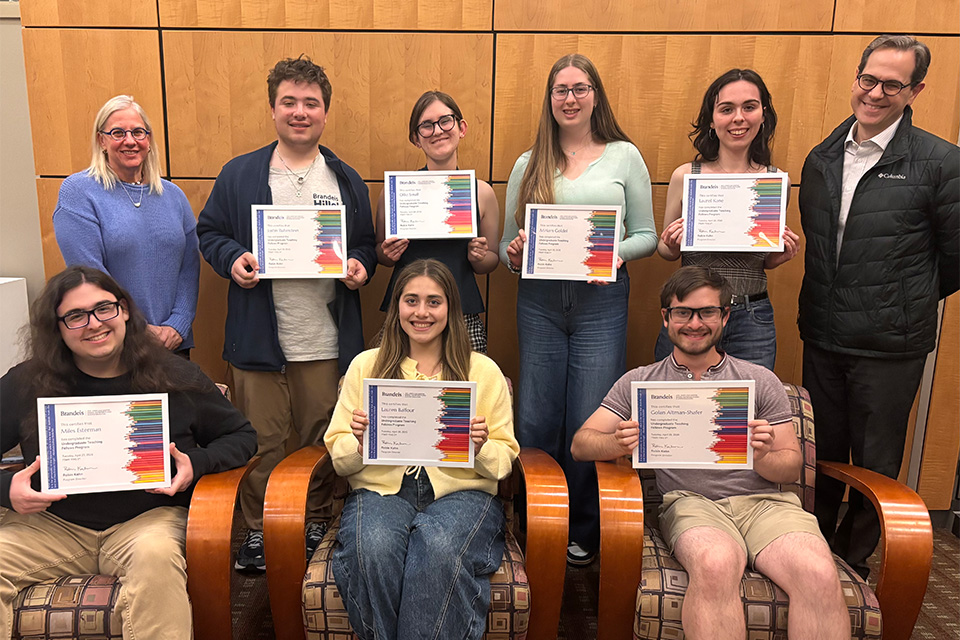
Program Director Robin Kahn, Justin Rubenstein '28, Ollie Small '28, Miriam Goldel '28, Laurel Kane '26, Professor Jon Levisohn, Miles Esterman '29, Lauren Balfour '28, Golan Altman-Shafer '29, and Julia Slavin '28 (not pictured).
Testimonials
“Because the UTF program frames Jewish supplementary education as holy work and then treats it as such, I feel as though I really have a new appreciation for how important supplementary education is, and my role as a teacher is a much more important part of my week...”
“In particular, I have come to understand that supplementary school is about creating a positive connection and association with Jewish learning and identity for our students.”
“My expectations were more than met… this was an incredible group of Fellows… and the facilitator’s guidance turned our conversations into strategy sessions and knowledge building sessions. I truly didn’t think that this experience would be so impactful, but it was.”
“I had a really enjoyable time over the course of the year growing with my fellow teachers and thinking more critically about how to be a better Hebrew School teacher.”
“These seminars helped me gain a great amount of perspective because they gave me tips on how to be proactive about situations that might arise in my classroom. I especially enjoyed conversations when they were centered around another teacher’s issues, so that I could take time to reflect on my class.”
Personal Statements
Each year the Fellows finish the year with a Siyum where they celebrate with their classroom supervisors and mentors, Mandel Center faculty, and each other, and share what was learned. Here are excerpts from the personal statements the 2024-25 and 2025-26 UTF-Brandeis Fellows shared at the April 3, 2025 and April 28, 2026 Siyums respectively. Watch highlights of personal statements here.
Expand All
Liana: The Undergraduate Teaching Fellowship was an important resource for me…Throughout the year, UTF was a place where I could get advice about any issues I was having, and was a space that helped me grow as a Jewish educator.
Rachel: I got the opportunity to do my own Jewish learning every week, in bi-monthly seminars with a group of other religious school teachers…I learned how to think more creatively…Together we learned the value of asking questions and how asking questions is a Jewish value.
Miriam: I’m grateful to have learned so many new ways to teach and how to help motivate my students…Before the UTF fellowship, I did not realize how important it was for me to help the students feel a personal connection to learning Hebrew and biblical texts. I soon realized the difference it makes to dive deeper into words and their meanings through the way that we approached learning texts in the seminars.
Ultimately, I’ve gained a deeper appreciation for the diversity of learners that I encounter at religious school and I am looking forward to continuing my work helping each of them connect to their Judaism.
Hannah: Reflecting on my journey throughout this fellowship has been an eye-opening experience, full of growth, collaboration, and new insights…I’m so grateful to have had the opportunity to work and learn with other amazing Jewish college students who share the same passion for Jewish education I do…Through this fellowship, I’ve been able to think more deeply about the impact I want to have on my students.
Simone: UTF has given me the confidence to answer difficult questions about God, how to discuss Israel with my students, and how to connect with my classroom and meet them where they are emotionally.
Elinoa: Now I care about teaching in a way that helps my students’ social emotional development as well as teaching them the content…In the future, I hope to continue having an impact on Jewish kids through youth programs and volunteering at Jewish organizations.
Liana: Through creative and intentional lessons, I learned how to foster an inclusive, welcoming and joyful classroom community that will hopefully inspire each one of (my students) to want to continue learning and finding and contributing to Jewish communities.
When I walked into UTF for the first time, I expected a series of seminars dedicated to improving my Sunday school teaching skills. As a first-time teacher, I was excited to get the chance to grow quickly and build my identity as a competent teacher. Yet what I got from Robin Kahn and the UTF program was much more valuable. UTF taught me to implement the idea of treating others how I want to be treated, by raising the level and standards of the way that I teach. This means cutting out fluff, connecting with them emotionally, and actually preparing them for dynamic Jewish futures.
Instead of just starting with a discussion on lesson planning, we took a moment to stop, center ourselves, and ask ourselves how we are really doing. I felt safe being in an environment where I could answer “How are you?” with anything but “Good.”
The seminars were fascinating. I still remember seminar 5, when we were given a moodmeter with two different axes: intensity and contentment. This not only helped me understand the depth of emotions, it also gave an insight into the depth that our words have, and the importance of choosing them carefully. Another session that stood out to me was seminar 4, where we were introduced to the line-by-line study method. It was an important reminder to slow down and not skip to the “focal point” of the text.
While prioritizing depth over speed is a good reminder to share with the students, they are quite relevant to me, too. Sometimes I go into a text thinking I know everything, but slowing down a bit helps reveal more nuance. This is the biggest lesson I have taken away from UTF: Nuance. The room I enter biweekly holds definite proof against making Jewish blanket statements involving a lack of knowledge, respect, and integrity, and always invites me to check my bias.
Within David Kolb’s model of experiential learning, abstract conceptualization was a major part of our focus. We spend a lot of time crafting different teaching methods to be as effective as possible. The ability to have multiple game plans for any situation is a crucial safety net as I continue my teaching in the future is one of the most important lessons from UTF
Without UTF, I wouldn’t be nearly as intentional with lesson planning and teaching as I am now, and I have Robin to thank for that. I would totally recommend all Brandeis TST teachers to apply for this fellowship.
Best,
Golan Altman-Shafer
Since the beginning of the year I have become much more confident in my ability as an educator. Learning more about my students and seeing their trust has helped my confidence along with our relationship. As an instructor I’ve begun to think more about how I accommodate everyone in the classroom.
As someone who struggled a lot through a majority of my schooling, I try my best to accommodate everyone. One way I do this is by giving my students some freedom during class. For example, while having a discussion I allow and sometimes encourage my students to doodle. Additionally, while doing independent work, I try to help out students depending on how much help they need rather than giving them all the same help. My goal is to keep them engaged while helping their development and making sure they will be successful students now and in the future.
At the beginning of the year I was focused on what I was teaching rather than how I was teaching but I have begun to think much more about how and what other hidden lessons are in the content I teach. For example, at the beginning of the year, I would have just cared about making sure the students knew the story we were talking about, but now I care about teaching it in a way that it helps their social emotional development along with teaching them content. In the future, I hope to continue having an impact on Jewish kids through help youth programs and volunteering at Jewish organizations. I also hope I can help increase kids' pride by living and expressing my pride in being Jewish.
Culturally, Sunday School and religious involvement is a rite of passage in many communities. My mom and dad did it. My brother and I did it. My future children will probably do it.
Growing up in Jewish in Mississippi and spending time in a Christian environment led me to develop a complicated relationship with my Judaism. During a class I took with Prof. Ziva Hassenfeld, I began to understand my personal foundation of religious education. In an article, “Why Does Joshua "Hate" School ... but Love Sunday School?” by Gwendolyn Thompson McMillon, Sunday school is highlighted as a vessel to learn essential social skills, reading practices, and developmental milestones, but can sometimes clash with the outside classroom. While Joshua grew up in a Christian environment, his experience helped me understand and a culture clash between classrooms and my Jewish upbringing which was a personal struggle for me when getting involved in a more active Jewish community.
My reform synagogue, Beth Israel, in Jackson Mississippi is quite different than Temple Shir Tikva. In full transparency, at first I had a hard time connecting with the Sunday School at Shir Tikva. In the deep south, my Jewish identity was something that made me different. However, after the arson attack at my home shul this past January, and with guidance of Robin, Alison and Jenna, my students, UTF seminars and my peers’ perspectives, I now know that honoring Jewish heritage, community, and Jewish joy is a vital component in developing a Jewish identity in the next generation.
One of the seminars that stood out to me was when we talked about Jewish values and which of them I most resonated with. Inspired by the idea of taking ownership and actively reflecting on character and incorporating the Hebrew word for the Jewish.
I have grown a lot as a Jewish educator in both my lessons and the way I view my students. The UTF fellowship has helped me expand my materials and acquire skills and quick resources for when lessons don't go as planned, or I have extra time. I am thinking more about how to contribute mindfulness and deeper thinking into my lessons. Now that I am lesson planning for two different age groups, I appreciate having resources to adapt materials for different ages.
Our conversations in the seminars have allowed me to hear what others are doing and how other age groups respond to topics I will be teaching or exploring with my students in class. This fellowship has highlighted how important it is to view students holistically. I appreciated the emphasis on social emotional learning as a reminder that we are not just teaching our students how to be Jewish, but helping them grow into good and kind people.
This semester was challenging for me, as I switched schools and had to adapt to two new classes. Not only was I entering a new space, but I had to fit into a place where the students had already built routines and were not expecting to start over mid-year. Along with being welcomed warmly by Temple Beth Elohim, UTF was an important resource for me, specifically offering me a panel of educators who had wisdom and had been in my position. Throughout the year, UTF was a place where I could get advice about any issues I was having and was a space that helped me grow as a Jewish educator.
Reflecting on my journey throughout this fellowship, it has been an eye-opening experience, full of growth, collaboration, and new insights. I am so grateful to have had the opportunity to work and learn with other amazing college student educators who share the same passion for Jewish education that I do. I have been able to see how I have grown and adapted my teaching and created a better learning environment for my students.
Throughout the year, I became more confident as a teacher and have improved my ability to cater my lessons to my individual students, their needs, and their likes and dislikes. I am now thinking about how I structure the time we spend together and how I can make each moment count. Though I had a lot of previous work and volunteer experience as an assistant teacher in the classroom, this is my first time teaching by myself and I have become more comfortable managing time, coming up with creative and engaging lesson plans, and communicating with parents.
Through this fellowship, I’ve been able to think more deeply about the impact I want to have on my students. I want to foster not just academic growth but also emotional and social development. Each week, I work to instill a deep sense of community and a connection with Judaism and Jewish values. As I continue teaching and working with children in Jewish settings, I look forward to deepening my connections with the children I work with and helping them to see the love and joy that I find within Jewish education and the Jewish community.
Through the UTF program, I developed a stronger sense of intentionality in my teaching. I used to measure success by whether students seemed engaged and if a lesson went according to plan. If it didn’t, I saw it as a failure. Now, I evaluate my teaching more thoughtfully by asking why a lesson unfolded the way it did and what different students took from it.
This shift has changed how I design lessons. At first, I understood multiple intelligences as the idea that different students learn in different ways. Now, I see that using multiple modes of learning benefits all students by exposing them to new ways of thinking and helping them build a wider range of skills. I make it a goal to incorporate a variety of ways to learn so students can engage in different ways and expand how they learn.
In our Sukkot lesson, rather than only reading, we also had students move around outside to build their own sukkot using natural materials, while learning the rules of what makes a sukkah a sukkah. They also shared personal traditions, and reflected in conversation on their meaning. This lesson got our students to experience a new way of learning about this holiday.
Another aspect of my teaching that has evolved is my storytelling. I used to prioritize my own voice in storytelling, but the UTF has taught me that storytelling accomplishes so much more. I've learned to slow down stories by pausing to ask questions and incorporate student voices. By asking the right questions, I can create space for curiosity, personal experiences, and deeper thinking to emerge.
In our lesson “Tzadik’s of the Ancient World,” we read 2 short stories in which Noah and Abraham must confront the dilemma between obeying G-d and doing whatever they can to protect the innocent. By slowing down my reading to ask students for their inferences, opinions, and thoughts, I not only increased engagement, but allowed students to see themselves in the story and question their values. Sharing and listening to the class helped solidify the theme of the lesson: that there is no one way to be a “Tzadik.”
I now see teaching not as delivering a successful lesson, but as designing meaningful learning experiences. My goal is to create a classroom where students think deeply, connect with each other, and find personal meaning in their Jewish learning.
Dear UTF,
I want to start by just saying thank you. You have taught me so much about myself, how to be a better educator, and how to be a better person. Before you and teaching at Temple Emanuel Religious School, I only had experience being a camp counselor and a preschool teacher, which are different from teaching religious school. The main difference is that the religious school children express that they don’t want to be there.
My favorite seminar was when we talked about Jewish values and how to use them in our classroom. The part I liked the most was when we had to pick a few values to use to manage a situation in the classroom. I had never thought about explicitly integrating Jewish values in that way before, but now I’m thinking about it all the time in the classroom. Here’s a made up example: if Avi makes fun of Bella’s shirt. I would take Avi aside and tell them that what they said was not very nice and in this classroom, we practice Hesed/kindness. I would have Avi write something to Bella that exhibits Hesed so they can go back to her, apologize, and show Hesed, which ensures that Avi understands the value that I am teaching - in addition to a set curriculum.
For much of this year I had the opportunity to bounce around various grades as a substitute teacher. This has given me a unique experience because I have been able to create connections with many different students.
UTF, you have taught me to realize that every student is different and our seminar on social emotional learning solidified that. This parsha activity made me realize that there are many different ways to make a lesson accessible and enjoyable for all students. During the SEL seminar, we used two similar worksheets to answer questions based on that week’s parsha that support students in developing their SEL skills. An example of a question is: who in the parsha is struggling? One of the worksheets had lines for students to write a written response, and the other worksheet had boxes for students to illustrate their response. These two different worksheets were designed for different ages, but as I thought about it more, I realized that these two worksheets could support students with different learning styles. Giving students autonomy empowers them to have some control over their learning.
What I know now is that there are various ways of learning and therefore I will use that to my advantage when making a lesson plan.
Thank you so much for opening up my mind to different ideas and opinions.
Sincerely,
Miriam
When I first started teaching this year, I had moved from being a Kindergarten madricha to being a sixth-grade Hebrew coach and substitute teacher, and I was suddenly thrown into a new Hebrew curriculum, a room of students with much less curiosity and a much less consistent schedule than the Kindergarteners.
I was worried that I would not be able to connect with the older students, especially as a substitute, and I struggled to see how I could bring my personality to my classes.
Through the Undergraduate Teaching Fellows program, I have learned to make an effort to get to know each student and to make sure that the classroom is a welcoming environment. When I sub for a class, I always start with an icebreaker, and I try to add at least one element to the lesson plan that helps them feel more comfortable with a new teacher. For example, a few weeks ago, we played “Passover March Madness.” The students immediately felt more comfortable talking to me, and they were eager to share how their family celebrates Passover.
Because of the UTF seminar, I focus more on how to engage each student, rather than just trying to get through the material, and I have found this focus is a much more enjoyable experience for me and the students.
Before I started UTF, I did not realize how important it was for me to help the students feel a personal connection to learning Hebrew and Biblical texts. I soon realized, through the way that we approached learning texts in the fellowship, the difference it makes to dive deeper into words and their meanings. I pushed my sixth-grade students to find personal connections to the Hebrew text they chose for their tallit. They saw how they could personally connect to Hebrew as the language of their community. More than that, they were able to find meaning in texts that made the Torah feel more relevant to them. I’m grateful to have learned so many new ways to teach and how to help motivate my students. Ultimately, I have gained a deeper appreciation for the diversity of learners that I encounter at religious school, and I am looking forward to continuing my work helping each of them connect to their Judaism.
At the beginning of the year, I was unsure about leading a classroom for the first time. Previously, I had only worked as a madricha and aided 1-1 during lessons; I was not responsible for lesson plans and classroom management wasn’t ultimately my responsibility, I wasn’t the one who held kids accountable for their behavior.
It’s been an adjustment to jump into the role of head teacher, especially because it has been two years since I was in a Hebrew School classroom in my hometown of St. Louis.
This year UTF has given me the confidence to answer difficult questions about G-d, how to discuss Israel, and how to connect with my classroom and meet them where they are emotionally.
I know that I have the skills to be a lead teacher. I strive to balance between being a fun teacher and being strict. Now I care more about what the kids are coming away with than them being well behaved all the time. They’re just kids at the end of the day, and a little bit of boundary-pushing is natural. I care more that they have a good time at Sunday school. I have taken student feedback and stuck a bit more loosely to the lesson plan if I think the activity won’t connect with my students. They like movement activities where they get to go outside or outside temples more than arts and crafts. For example, I had them play baseball outside during our lesson on Sandy Koufax. I hope that by having a positive experience in Sunday School that I have a desire to continue their Jewish education.
To My Students,
Our first day together was exciting and full of energy. You came enthusiastic and ready to learn. I didn’t yet know your names, but I knew that I was excited to build a joyful Jewish community with you all.
In the beginning of the year, I struggled to choose activities according to your needs and interests. I wasn’t thinking of creative ways to foster a sense of Jewish learning that would keep you inspired to continue learning and appreciating your Jewish identities. But, luckily I got the opportunity to do my own Jewish learning every week. In weekly fellowship sessions with a group of other religious school teachers, I learned how to zoom out and consider the big ideas I wanted you to leave with, and I learned to adapt my plans based on what engaged and excited you the most. I learned how to think more creatively and to put your needs and interests first.
One of my favorite Sundays we had this year was when we read the story of Joseph, and we stopped after every few lines to ask any and all questions you could come up with. I got this idea from one of my fellowship sessions, where we read a Jewish text by keeping most of the story covered, reading a few lines, and asking as many questions that we could come up with before uncovering the next part of the story. You guys thought that this was a crazy way to read a story, just as I did when the idea was first presented to me, but we can all admit now that we loved it. We had previously been struggling to stay focused while reading stories, but this new way made us all more invested in the story, and excited to continue reading it and finding out what happened. Together we learned about the value of asking questions, and how asking questions is a Jewish value. Of course I remember how upset you were when we ran out of time and had to wait an entire week to finish the story.
I also loved the day earlier in the year when I got to share one of my favorite games with you all: Jewish Spot It. I got this idea from my fellowship, where we used this game to discuss our memories and feelings about the items we had in common on our cards, and I loved getting to hear your stories and memories when I brought this game to you. I got to learn more about you and the parts of Judaism that were most important to you, whether this was a holiday or a ritual item, and I got to watch all of you become better friends with each other as you learned about each other’s Jewish stories.
With so little time together each week, I was nervous I wouldn’t have enough time to really get to know each of you and teach you everything I wanted to. But, through this fellowship I learned that one of the most important things I could teach you was to find the place and meaning of Judaism in your lives. And I got to know each of you, sometimes by hearing stories about your week, debating whether latkes or hamantaschen are better, or learning about why you love being Jewish. And, through creative and intentional lessons, I learned how to foster an inclusive, welcoming, and joyful classroom community that will hopefully inspire each of you to want to continue learning and finding and contributing to Jewish communities.
I hope each of you leave our class with a new Jewish value you want to infuse into your daily lives, a new story you love, or a new friend you made. Thank you for everything you’ve taught me this year, and thank you for building a community with me infused with kindness, joy, and a sincere love for learning.
Love,
Rachel
Through UTF, I have gained practical skills and knowledge about how to be an effective Jewish educator. These include how to develop activities for students to do in my religious school classroom, and how there are different ways to express and incorporate Judaism in a lesson plan. For example, when learning texts, there are questions with different levels of depth to ask students: some questions check for comprehension, and some ask students to develop their critical thinking skills. In addition, the way we use our space impacts learning. For example, rows of desks suggest a frontal lesson, U-shaped desks allow the teacher to help students and walk in the middle, and desks that are grouped to form a table encourage group work and collaboration. Similarly, how wall space is used can promote the learning experience for students. Miles and I started hanging up the students' work because of an idea from UTF. Displaying student work helped our students feel they and their work were valued, and that this contributed to making our classroom a community.
As someone who has been deeply involved in Jewish communities my whole life, this fellowship gave me practical ways to teach the next generation and help them build a strong foundation in Judaism including areas such as Israel, Hebrew, history, etc. With limited time with our students, as Professor Levisohn said, it is very important to give students the resources to build their own Jewish knowledge. As someone who wants to advise Jewish organizations on how to have a successful long-term strategy, this fellowship gave me the tools to both help my students understand and incorporate Judaism at the micro level and also gave me the tools to think about the field of Jewish education more broadly. The UTF fellowship leaves me with many new skills, and next year I hope to build a more strategic approach in my lesson planning and be more intentional about how I engage with my students.
The beauty of UTF is the opportunity to be in community with other Jewish educators just starting out on our journeys. As a new teacher, it was incredibly valuable to learn from educators with years of experience and from peers who were often facing the same growth and challenges in the Hebrew school classroom. However, the most impactful aspect of UTF is the hands-on approach. It’s one thing to sit in a classroom and learn about different pedagogies or techniques to regain control of a rowdy classroom. Still, it is quite another to be immersed in the practice the minute we step into the UTF seminar. I have often joked that we are “guinea pigs” to the educational techniques we learn each session, but this is so important! Learning activities like mapping out the social competencies in a piece of Jewish text or writing the agenda in an accessible place hold equal educational importance in the UTF education lab. This has taught me to notice the many items that contribute to a Jewish classroom, from ritual objects to an aleph-bet poster. Even something as broad as bringing one’s own values into the classroom deeply impacts my work as an educator and my relationship with my students. Thanks to UTF, I now interact with my students with a level of nuance and understanding that didn’t exist before, one that includes their lived experiences and the many ways they gain Jewish literacies. As I look to my future as a Jewish educator, I am carrying with me the Jewish values I want my students to know: understanding of history, peoplehood, and, of course, the joy of our community.
Dear Past Me,
I’m so proud of how you’ve grown over the past year as an educator. Every experience you have had this year, whether teaching at Hebrew School or working at the Dual Language School and developing at UTF has made you stronger. You’ve learned how to work with different kids. You have even started to notice signs of each individual intelligence in your students. Just today you realized that a student with behavioral problems just needed to sit down in music, hear the instruments, and sing with everyone else. You even saw that another kid – who was being perfect – could not even begin to focus in music because all he wanted to do was talk about math. You’re learning how to see potential in kids and connect them with different ideas in what they’re learning.
Even outside of religious school, you are seeing new ways to teach your students and impart values to them. You’re watching your students grow and repeat to you why they are helping others, even days later. They want to be kind and create a warm space. You never would have thought to point that out to them on your own. I can’t wait to see Future Me continue to grow into next year and all of the years to come. It has been the start of one of the greatest joys of my life to learn with and teach my students.
Best,
Current Ollie
Seminars in action