Undergraduate Teaching Fellows Program
Learn more about the UTF program from past Fellows
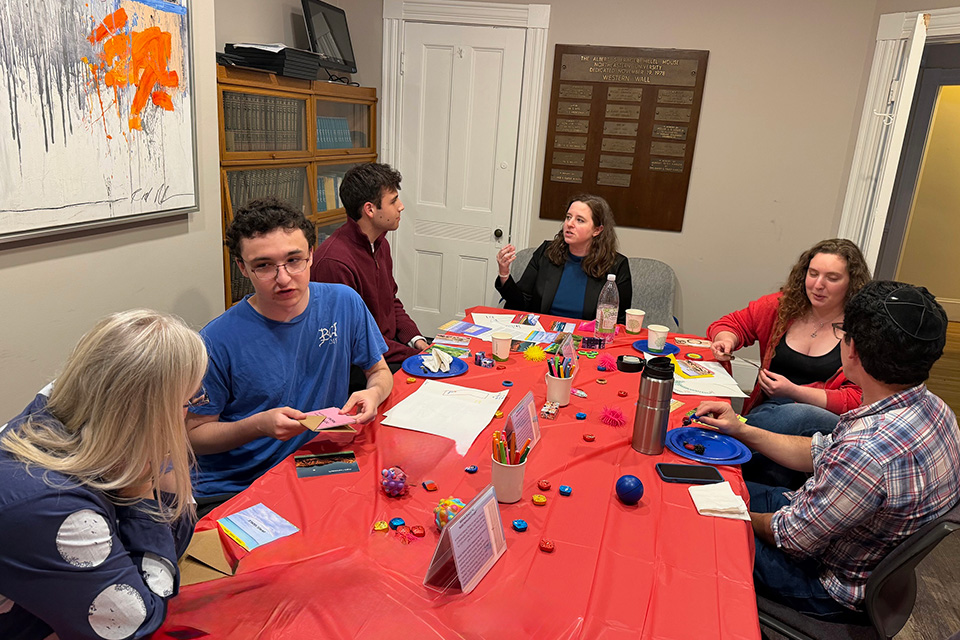
UTF Program Director Robin Kahn (Brandeis University), Yoni Becker '26 (Northeastern University), Andrew Zimmerman '27 (Northeastern University), Amy Deutsch (Temple Ohabei Shalom), Naomi Anbar '26 (Northeastern University), and Brian Fried (Northeastern University Hillel).
Testimonials
“Through this fellowship, I've learned that supplementary Jewish education demands creativity, flexibility, and genuine connection. ” Yoni Becker '26 (Northeastern University)
“Ultimately, this fellowship has allowed me to cultivate my skills as a Jewish educator, with the ability to expand beyond my experience this year and into future classrooms with students of so many different ages.” Naomi Anbar '26 (Northeastern University)
“I have come full circle and now teach with an open mind and an open heart, just as I want my kids to have." Andrew Zimmerman '27 (Northeastern University)
Personal Statements
Each year the Fellows finish the year with a Siyum where they celebrate with their classroom supervisors and mentors, Mandel Center faculty, and each other, and share what was learned. Here are excerpts from the personal statements the 2025-26 UTF-Boston Fellows shared.
Naomi Anbar '26
UTF has truly changed the way I view Jewish learning. As someone who never attended a formal Hebrew school, I came into both my teaching position and this fellowship as somewhat of a blank slate. I don’t think I really knew what to expect. I never considered the in-depth nature of not only being an educator, but being one in a Jewish space. As a teacher to first graders, one of the challenges is really helping the kids understand the stories we talk about. I remember we had a whole seminar dedicated to helping break down more complicated texts and helping the kids really understand what was going on. This really reshaped my thinking moving forward as we continued to read and discuss Bible stories with the kids in class. We also discussed the relationship between student, teacher, and content, and I was able to see in class that the more interested I appear in what we’re learning, the more the students will want to join in. This can be applied to anything from a Garden of Eden skit we write in class, to learning about the different holidays while seated at the table. Ultimately, this fellowship has allowed me to cultivate my skills as a Jewish educator, with the ability to expand beyond my experience this year and into future classrooms with students of so many different ages.
Yoni Becker '26
My dad is a teacher at a Jewish day school, so when my dad asked me how I wanted to make money in college, he not so subtly suggested getting a job in Jewish education. He was actually the one that found this fellowship through Northeastern Hillel and encouraged me to apply.
I didn’t really take a huge role in actively teaching when I began my role, but as someone who is moderately proficient in Hebrew, I was able to help teach Hebrew to less experienced kids. One issue I had with this is that the tools we use to teach Hebrew are helpful but one-dimensional – there weren’t two different ways to learn the same thing in a classroom full of different personalities. With the help of other teachers, we were able to gamify the Hebrew progression, adding prizes and making students want to learn Hebrew.
My aunt is also active in Jewish education, especially within Jewish special education. I was familiar with her work, having been to the summer camp she ran for neurodivergent youth before. This changed, when on my first day teaching, I met one of the sweetest kids in the program who occasionally has trouble managing his emotions. It is both rewarding and a challenge to work with him, and what I learned was that being able to constantly be in communication with him about how he is feeling, and him being able to not just articulate it with his words is even more important.
Through this fellowship, I've learned that supplementary Jewish education demands creativity, flexibility, and genuine connection. And as a Jewish educator, I've discovered that I cannot just pass down knowledge, I must meet every student exactly where they are.
Andrew Zimmerman '27
I would like to tell you why my teaching experience in this fellowship has been like a gooey lava cake with ice cream on top.
This Fellowship started as a full lava cake. Maybe I would have the occasional fudge spill out, but for the most part I was full, connected, and keeping everything together. There is nothing wrong with a full lava cake, but someone observing from the outside would have no idea how much potential is on the inside. Additionally, a full lava cake is fully closed off. None of the fudge can spill out making the whole thing look a little bland. This is how I started. New to teaching, I was a little closed off and had a bit of a bland teaching style. I found myself struggling to get students excited to learn even though I was friends with them.
Then we had our first session. Hearing about Rabbi Nehounya ben Hakama reciting a Bracha before entering a classroom was the first stab of the fork into the cake. A little bit of the fudge starts leaking out, showing fluidity, lack of blandness. The mouth starts watering, you start to crave the lava cake, wanting to dive in and experience it fully. Teaching became the same. Setting a purpose, understanding why I was teaching and knowing what I wanted to get out of it made me want to dive in, explore the deeper meanings, and become the best teacher I could be.
Further down the line, we had a seminar regarding connecting with students’ emotions. This is the point where the lava cake is half eaten. The fudge is flowing out of the middle and the ice cream on top has started dripping down into the cake. At this point I had been learning so much about connecting teaching to Judaism but felt like I was lacking practical skills to develop. Then we learned about how to connect with students’ emotions. We had charts and graphs that we could use to help our students communicate their feelings to us. This was the practical step I needed to connect it. I was now a free flowing, half-eaten lava cake, ready to keep chowing down and learning more.
Finally, the culmination of everything, the Siyyum. I now feel as though my teaching experience is a cleaned plate that was once a lava cake. I ate the whole cake and now embody both the rigidity of the outside and fluidity of the inside. I have come full circle and now teach with an open mind and an open heart, just as I want my kids to have. I am incredibly excited for all the new and exciting foods I’m going to eat just as I’m excited to see where the rest of my teaching and Jewish journey will take me.