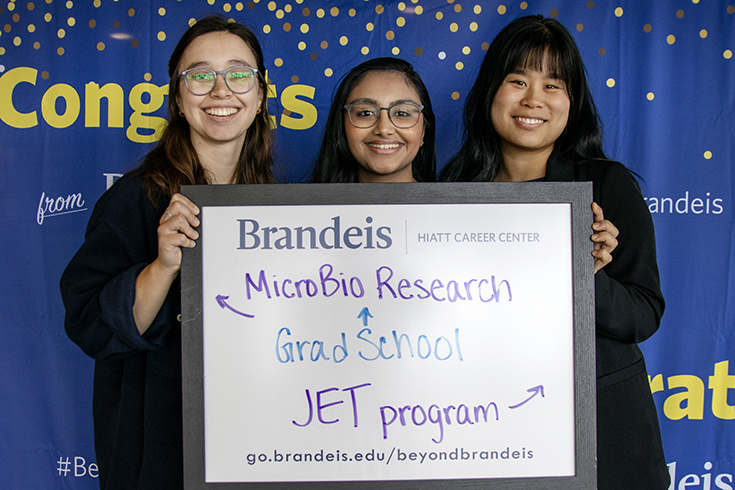
Class of 2025

Students launched careers with leading employers, continued their education in graduate and professional programs, or choose service-oriented roles through volunteer and nonprofit organizations.

98% percent of the Brandeis Class of 2025 is employed, attending graduate school, or engaged in other meaningful activities within six months of graduation.

First Destinations
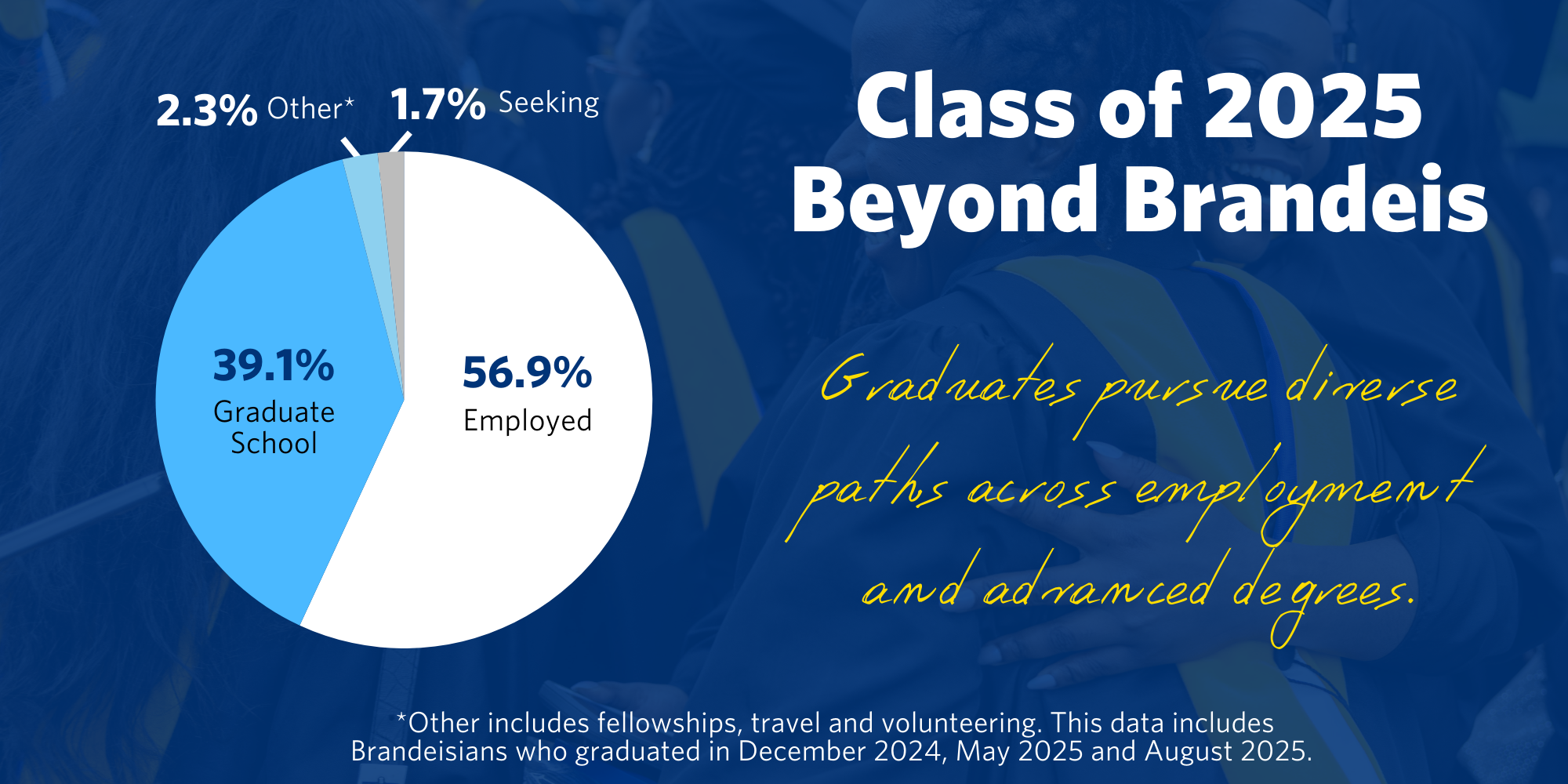
Pie chart titled "Class of 2025 Beyond Brandeis" showing post-graduation destinations: 56.9% employed, 39.1% graduate school, 2.3% other (including fellowships, travel, and volunteering), and 1.7% seeking. Accompanied by the text "Graduates pursue diverse paths across employment and advanced degrees." Data includes Brandeisians who graduated in December 2024, May 2025, and August 2025. 

The Brandeis Advantage

Brandeis outcomes show a stronger graduate school pipeline and a much lower seeking rate than their peers.
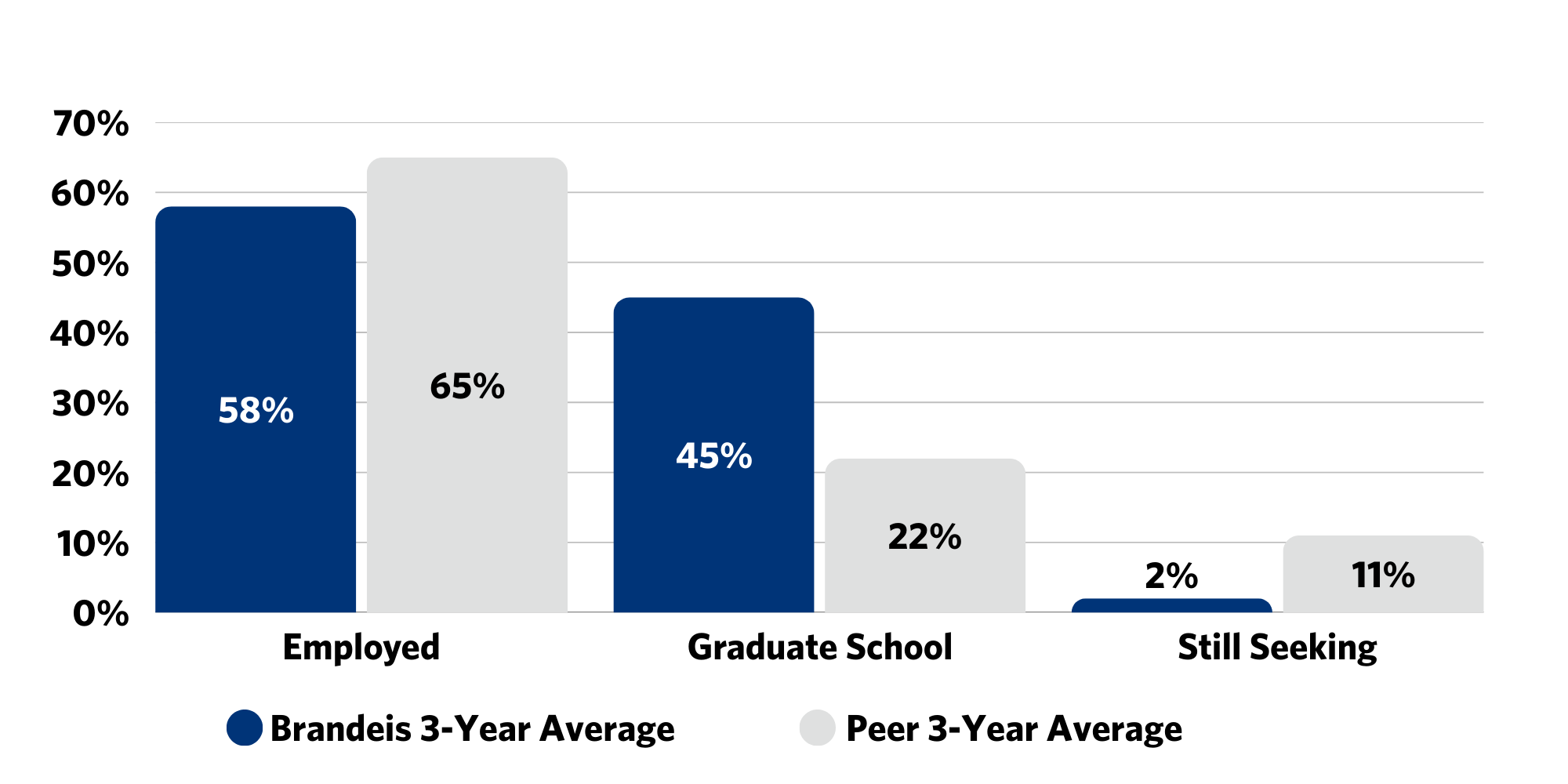
Grouped bar chart comparing Brandeis University's 3-year average graduate outcomes against a peer institution 3-year average across three categories. For employment, Brandeis is at 58% versus peers at 65%. For graduate school enrollment, Brandeis is notably higher at 45% compared to peers at 22%. For graduates still seeking, Brandeis is significantly lower at 2% versus peers at 11%. Brandeis data is shown in dark navy blue; peer data in light gray.

First Jobs

Graduates move into full- and part-time roles, join service organizations, work as freelancers, or start their own businesses. Post-graduate internships and fellowships are also common, providing additional professional experience for those who need it. 

Top first-job fields included healthcare, financial services, science and research, computer science and engineering, and counseling and social services.
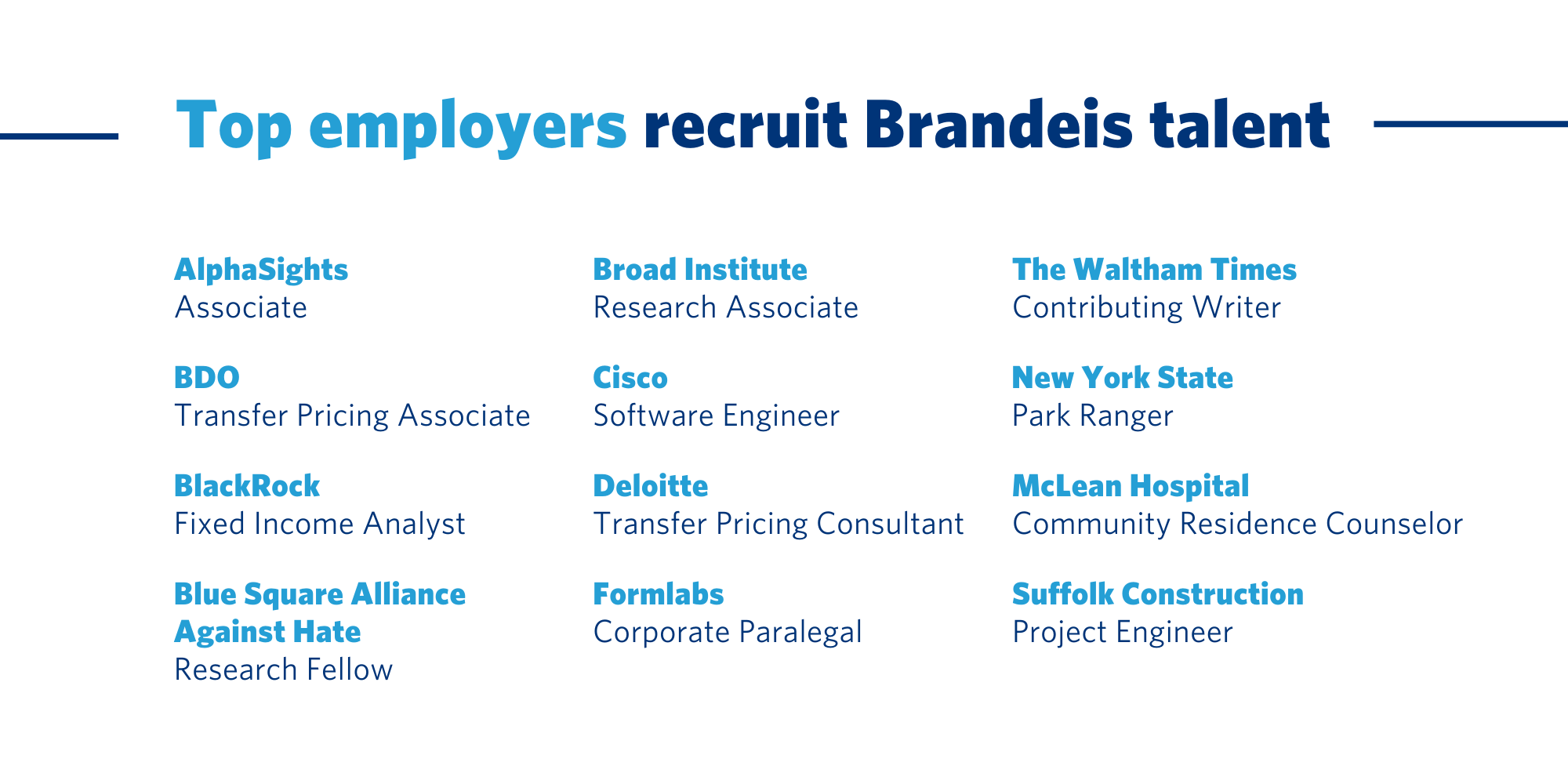
Graphic titled "Top employers recruit Brandeis talent" listing 12 employers and roles held by Brandeis graduates: AlphaSights (Associate), BDO (Transfer Pricing Associate), BlackRock (Fixed Income Analyst), Blue Square Alliance Against Hate (Research Fellow), Broad Institute (Research Associate), Cisco (Software Engineer), Deloitte (Transfer Pricing Consultant), Formlabs (Corporate Paralegal), The Waltham Times (Contributing Writer), New York State (Park Ranger), McLean Hospital (Community Residence Counselor), and Suffolk Construction (Project Engineer).

Explore More Employment By Industry 

Degrees Deliver Financial Return

College graduates have greater resilience to skill disruption and stronger long-term career mobility, supporting advancement into higher-level roles over time.
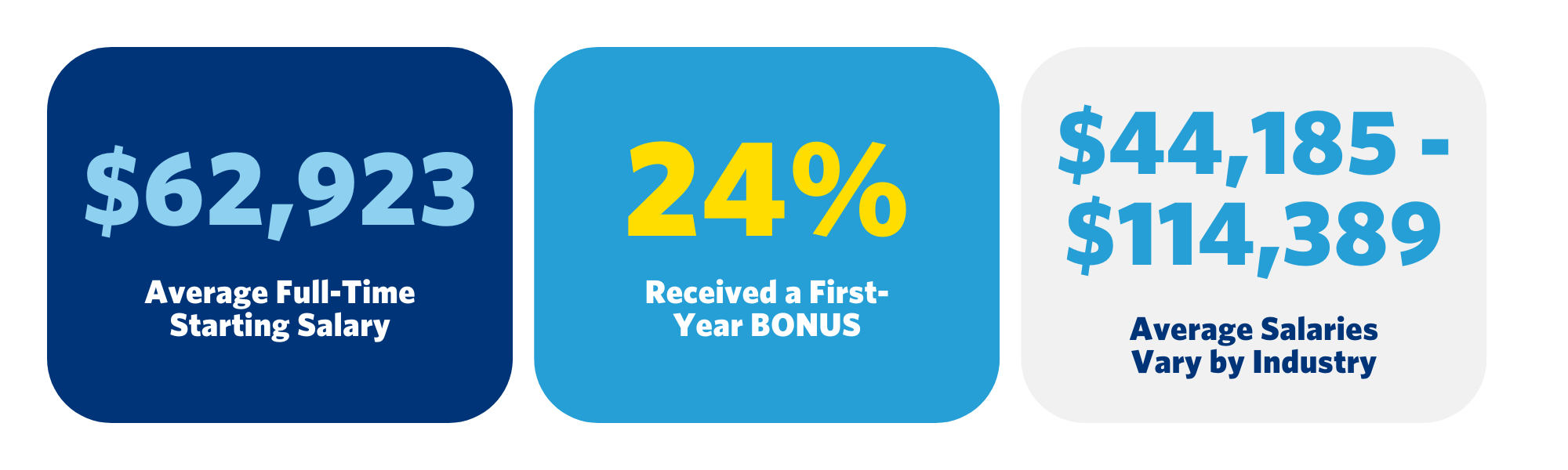
Graphic with three career outcome statistics displayed in bold blue and teal rounded boxes. Top banner reads “Average Full-Time Starting Salary” with large light-blue text showing $62,923. Bottom left box shows “24%” in yellow with the text “Received a First-Year Bonus.” Right side displays the salary range “$44,185 – $114,389” with the caption “Average Salaries Vary by Industry.”


Securing the Offer

How students find jobs varies strongly by industry. Structured fields like finance, consulting, and technology rely most on formal applications and internships, while education, public service, and nonprofit roles are more often secured through networking, referrals, and field-specific platforms.


Students use a multi-channel approach
Applying Online Networking & LinkedIn
Employer career pages and a mix of general and industry-specific job boards. Networking is the most common pathway. Outreach to past supervisors, alumni, and personal connections.
Internships Brandeis Events and Resources
Return offers from internships account for many full-time roles. Career fairs, Handshake, department newsletters, and student organizations.


Job offers come at different times of the year depending on industry and when students start looking. Some industries recruit early, but most students receive offers in April or August the year they graduate.


Directly from Students: How Brandeis Prepared Them

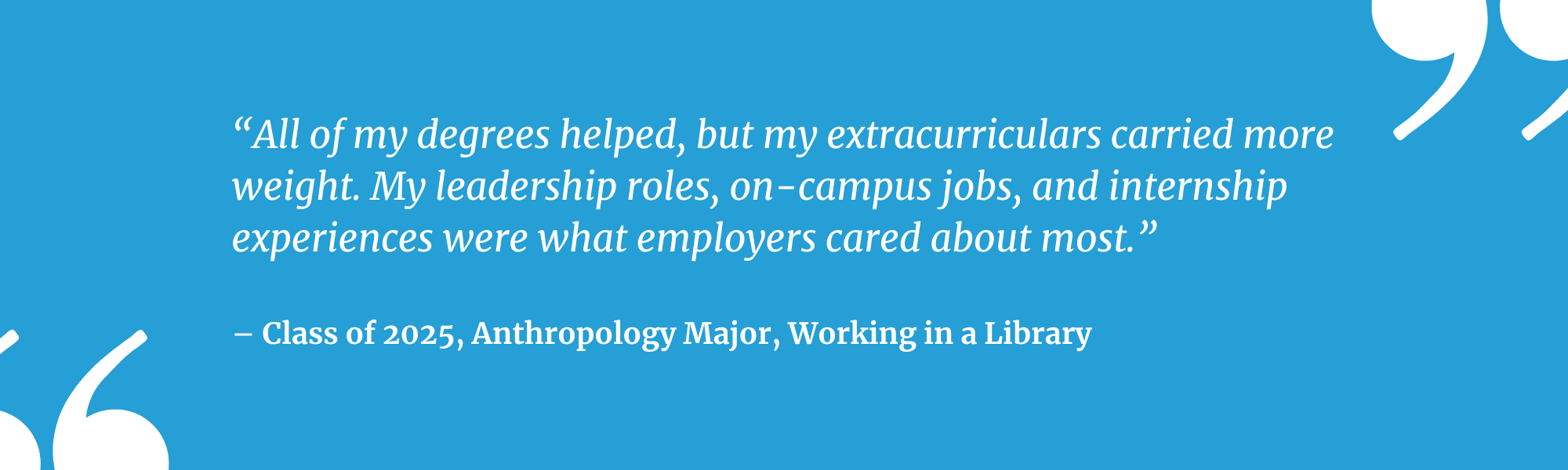
Scroll to see all the quotes: 
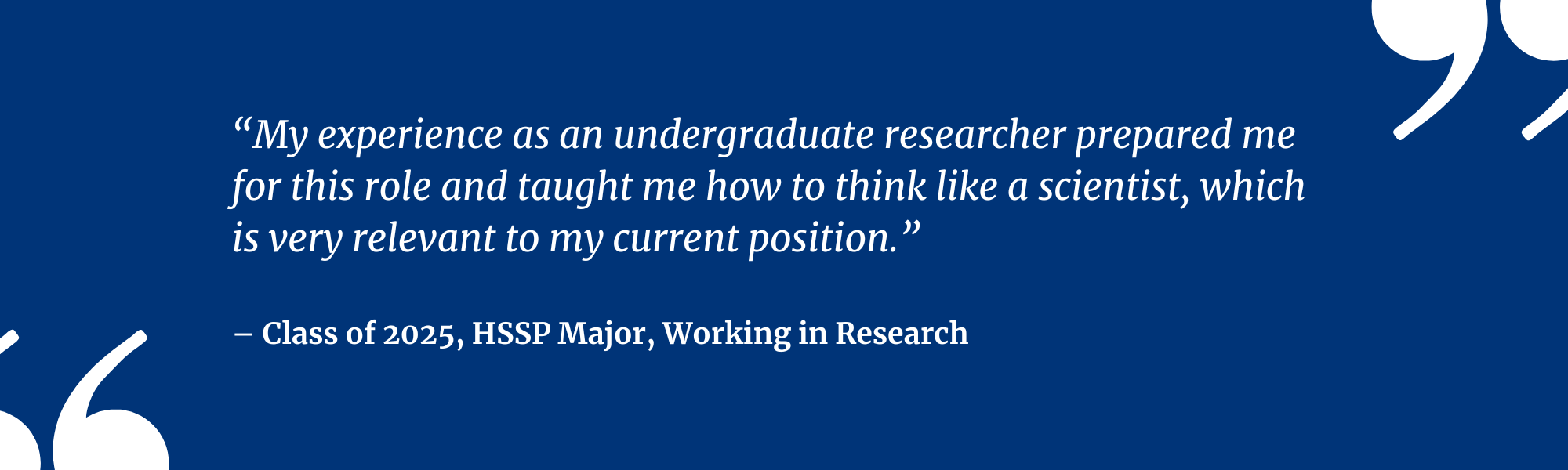
Graphic with a navy background featuring a quote: “My experience as an undergraduate researcher prepared me for this role and taught me how to think like a scientist, which is very relevant to my current position.” — Class of 2025, HSSP Major, Research Fellow.
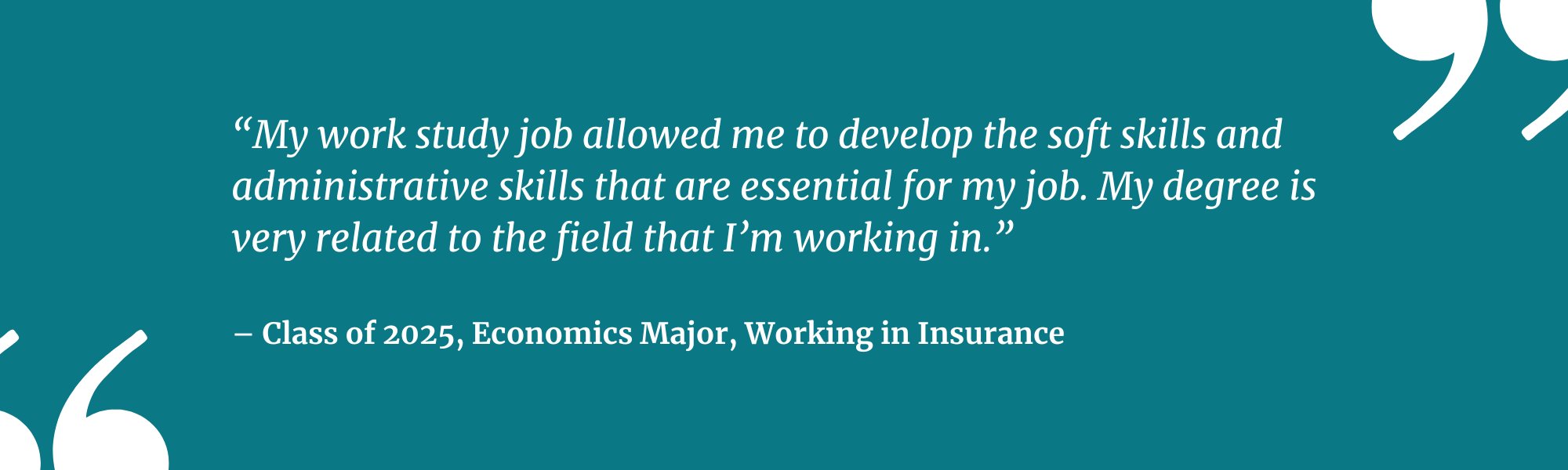
Graphic with a teal background featuring a quote: “My work study job allowed me to develop the soft skills and administrative skills that are essential for my job. My degree is very related to the field that I’m working in.” — Class of 2025, Economics Major, Working in Insurance.
Graphic with a navy background featuring a quote: “My experience as an undergraduate researcher prepared me for this role and taught me how to think like a scientist, which is very relevant to my current position.” — Class of 2025, HSSP Major, Research Fellow.
 

Continuing Education

Nearly 40% of the class of 2025 is pursuing an advanced degree within 6 months. 

Brandeis students are frequently admitted to top master’s and doctoral programs after completing their undergraduate degrees. Most enroll in full-time programs, while some choose part-time study alongside full-time employment.

A small number of students are still applying or completing additional coursework to strengthen their graduate school applications.

Top Areas of Study

Financial Services: including pathways such as the Brandeis BA/MA in International Economics and Finance (M.A.) and 1 to 2-year specialized masters programs. 

Healthcare: medicine, nursing, health professions, are top destinations. This includes those in medical school as well as students pursuing master’s programs in health policy and speech-language pathology.

Computer Science and Engineering: Master’s programs in computer science and industrial engineering are increasing in popularity. 
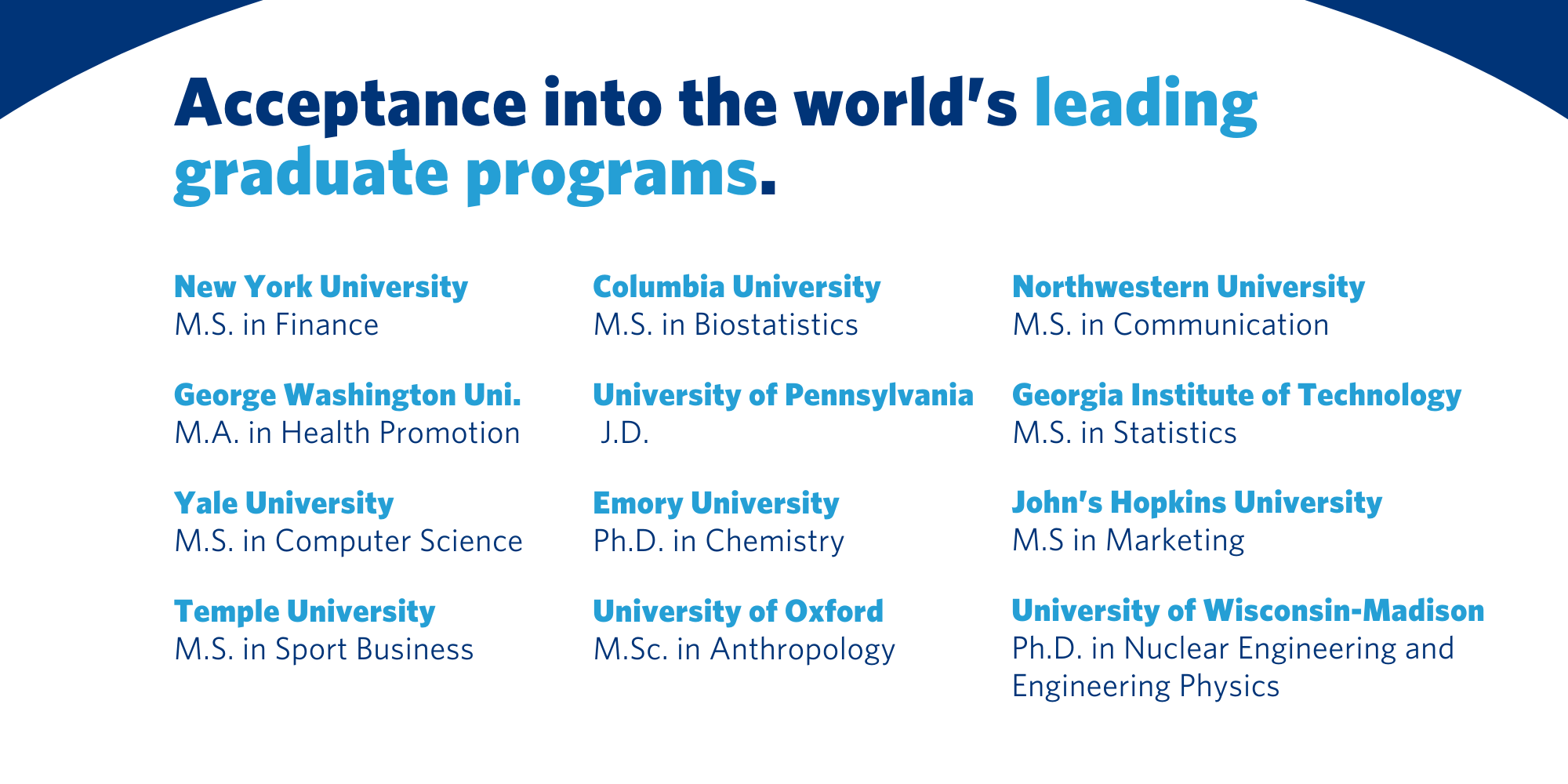
Graphic titled "Acceptance into the world's leading graduate programs" listing 12 graduate schools and programs attended by Brandeis alumni: New York University (M.S. in Finance), George Washington University (M.A. in Health Promotion), Yale University (M.S. in Computer Science), Temple University (M.S. in Sport Business), Columbia University (M.S. in Biostatistics), University of Pennsylvania (J.D.), Emory University (Ph.D. in Chemistry), University of Oxford (M.Sc. in Anthropology), Northwestern University (M.S. in Communication), Georgia Institute of Technology (M.S. in Statistics), Johns Hopkins University (M.S. in Marketing), and University of Wisconsin-Madison (Ph.D. in Nuclear Engineering and Engineering Physics).

Explore more Advancing Education


Class of 2025 results are based on a 70% knowledge rate within six months of graduation, following NACE reporting standards for first-destination data.