Academics
Summer 2026 Course Overview
You will take two courses simultaneously for a total of 8 credits. One course is taught by a local faculty member from Universidad Nacional and the other course will be taught by Brandeis faculty. All academic work will be taught in English.
Your learning will consist of a combination of classroom lecture and coursework, guest speakers, and field trips to sites of interest in and around the country. All aspects of this program will deepen your understanding of environmental conservation, current environmental issues in Costa Rica, and sustainable development. Multi-day excursions to various parts of the country will provide students with hands-on learning opportunities and the chance to complete basic ecological research and interact with local plants and wildlife.
Expand All
Costa Rica has a significant percentage of its territory under some category of protection, a result partially achieved through private reserves dedicated to ecotourism and research. Nonetheless, a major challenge for Costa Rica is the ability to raise awareness in the local society about such natural resources, to inventory and preserve them, and to promote their importance and future development. Based on the Costa Rican experience, this course will address aspects of ecology as an interdisciplinary science for the protection and recovery of the environment. A special focus will be on conceptual components of ecosystems and the ways they interact.
Taught by UNA Professor Ronald Sánchez Brenes
Prerequisites
None
Course Credit
The course grades will be listed on students' Brandeis transcript and will count on their overall GPA. The courses will count as Brandeis credit, and not as transfer credit
- Environmental Studies Majors and Minors: Fulfills a Science elective
- Biology Majors and Minors: Fulfills a Biology elective
- Brandeis Core: Fulfills the Science requirement
Explores land conservation in the context of the environmental and climate movements, focusing on both North America and international conservation work. It examines and critiques historical and contemporary approaches to conservation by a range of non-profit, private sector, and government actors.
Taught by Brandeis Professor Charlie Chester.
Prerequisite
None
Course Credit
The course grades will be listed on students' Brandeis transcript and will count on their overall GPA. The courses will count as Brandeis credit, and not as transfer credit.
- Environmental Studies Majors & Minors: Satisfies the Arts, Humanities, and Social Science elective requirement.
- Brandeis Core: Fulfills the Social Sciences requirement.
For those eligible, students may fulfill their Applied Learning Experience PLUS one natural science elective.
Spanish Language and Culture
In addition to the Environmental Studies courses you are taking in San Jose, all students will participate in introductory Spanish language and culture lessons during orientation that supplement the academic experience in Costa Rica.
Academic Excursions
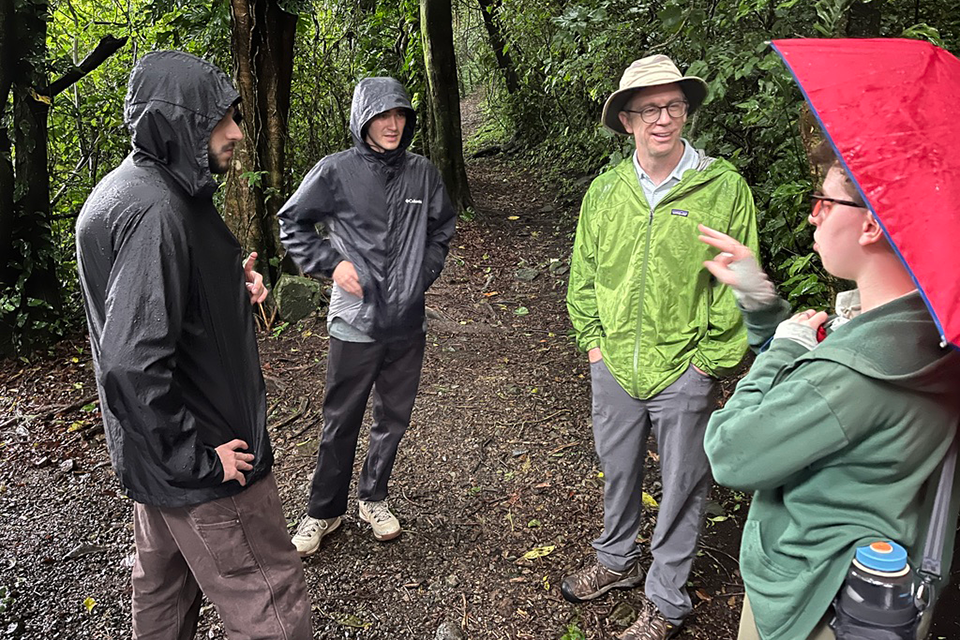
During the course of the program there will be various academic excursions throughout the country, which are organized to help bring you into direct contact with the subject matter you are studying. Students will participate on multi-day excursions to the rainforest at La Selva Biological Research Station, the cloud forest in Monteverde, and the dry forest in Liberia. Day trips to other parts of the country, including visits with the Bribri indigenous community and to San Jose, will add on-the-ground knowledge to the academic coursework.
Prerequisites for the Program
A Spanish course is highly recommended before attending the program but not required.